What Is Plastic With Silicone OverMolding Manufacturing?
- Share
- publisher
- siliconeplus
- Issue Time
- Jun 2,2026
Summary
Learn what plastic with silicone overmolding manufacturing is, how the process works, and why it is used for waterproof plastic insert parts, electronic housings, automotive connectors, medical device components, wearable devices, beauty devices, and OEM/ODM custom silicone manufacturing.
Introduction
Many engineers and sourcing teams ask whether plastic with silicone overmolding is the right solution for waterproof electronic housings, connector seals, medical device components, wearable devices, beauty devices, or industrial sealing parts. The answer matters because poor bonding between plastic and silicone can cause delamination, water leakage, unstable assembly, and product failure. This article explains how plastic silicone overmolding works and how to choose the right manufacturing partner.
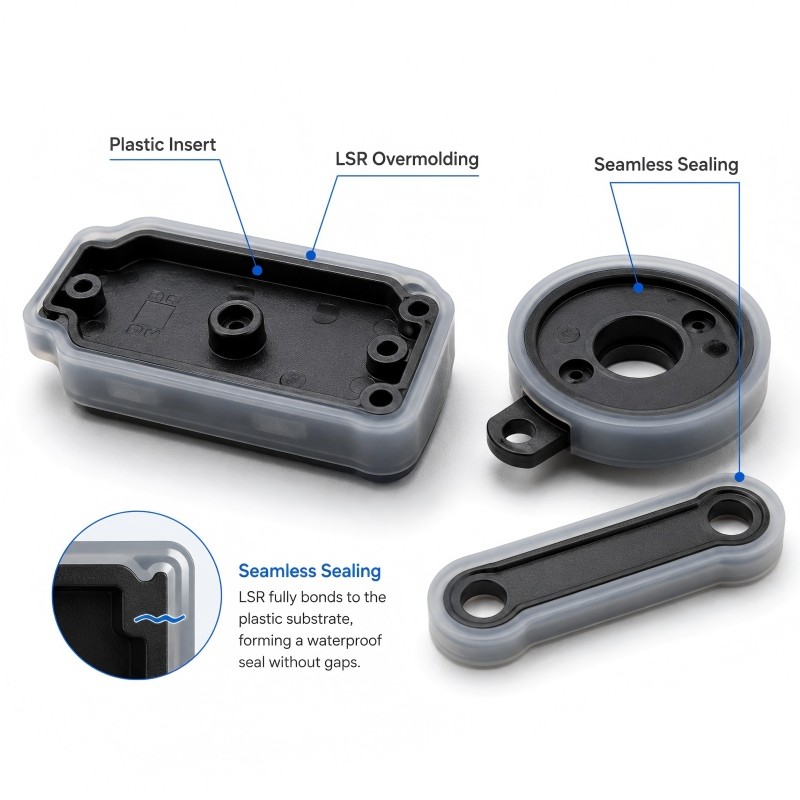
Plastic with silicone overmolding manufacturing is a custom process that molds liquid silicone rubber over plastic inserts, housings, frames, or structural parts to create waterproof, dustproof, soft-touch, shock-resistant, and durable components. It is widely used for electronic housings, automotive connectors, medical device parts, wearable devices, beauty devices, waterproof buttons, and OEM/ODM projects requiring strong bonding and stable sealing performance.
Transition Paragraph
For B2B buyers, the key question is not only whether silicone can cover plastic. It is whether the final part can stay bonded, sealed, and stable during real use.
People Also Ask: What Is Plastic With Silicone OverMolding Manufacturing?
Plastic with silicone overmolding manufacturing is a process that combines plastic inserts with silicone rubber through insert molding or liquid silicone overmolding. The plastic part is placed into a precision mold, and silicone is molded around selected areas to create sealing, soft-touch, anti-slip, shock absorption, waterproofing, or dustproof protection.
Unlike ordinary silicone molding, silicone over plastic requires both plastic insert control and silicone molding experience. The supplier must consider plastic material type, insert tolerance, surface condition, bonding area, silicone flow, mold temperature, curing condition, and final assembly environment.
This process is especially useful when a product needs the structural strength of plastic and the flexible sealing performance of silicone at the same time. Plastic provides shape, rigidity, assembly support, or product structure, while silicone provides waterproof sealing, soft touch, anti-slip grip, shock absorption, and environmental protection.
For Shenzhen Liyongan Silicone Rubber Products Co., Ltd., plastic silicone overmolding is part of a broader OEM/ODM custom silicone manufacturing capability, including liquid silicone injection molding, silicone over metal, FPC silicone overmolding, silicone and silicone overmolding, waterproof silicone seals, medical grade silicone parts, wearable device seals, automotive sealing parts, and industrial custom silicone components.
People Also Ask: How Does Plastic Silicone Overmolding Work?
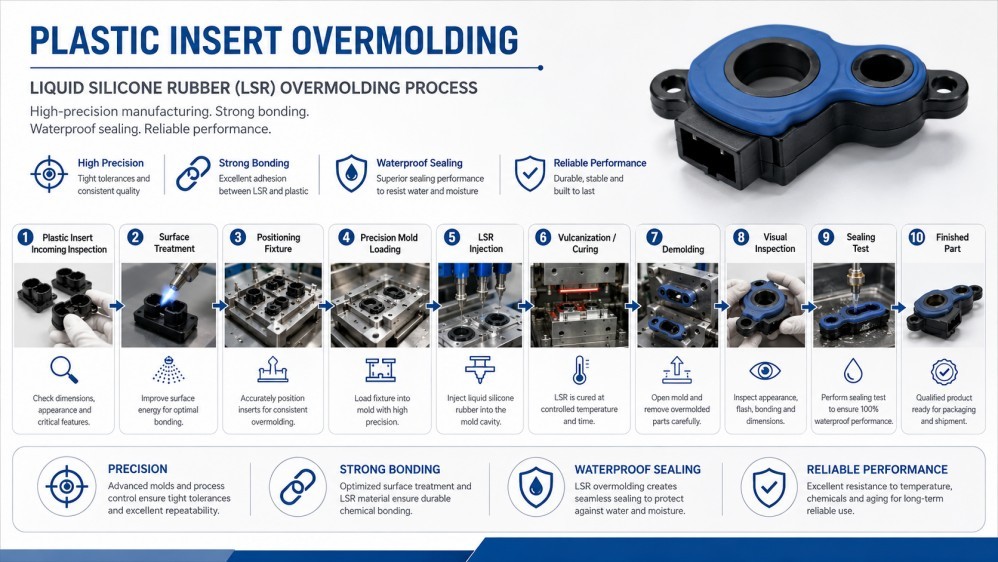
The plastic silicone overmolding process usually starts with engineering evaluation. Engineers review the plastic insert drawing, 3D structure, material type, tolerance, surface finish, bonding area, silicone coverage area, waterproof level, hardness requirement, assembly method, and application environment.
Next, the plastic insert is prepared. Depending on the project, plastic parts may require cleaning, drying, surface treatment, primer, plasma treatment, or special material matching. This step is important because dust, oil, moisture, release agents, or unsuitable plastic materials can reduce bonding between silicone and plastic.
After preparation, the plastic insert is placed into a precision mold. Insert positioning is critical. If the plastic part shifts during molding, the silicone layer may become uneven, the sealing lip may be misaligned, or the final part may not fit the assembly.
Liquid silicone rubber is then injected or molded around selected areas of the plastic insert. The silicone cures under controlled heat and pressure, forming a bonded sealing layer, soft-touch surface, waterproof edge, anti-slip grip, vibration-damping structure, or protective layer.
After demolding, the part is inspected. For plastic overmolded silicone parts, inspection may include appearance, flash, bonding condition, dimensions, insert position, sealing edge, compression structure, and waterproof performance if required.
People Also Ask: Why Is Silicone Used for Plastic Overmolding?
Silicone is widely used for plastic overmolding because it combines flexibility, softness, sealing performance, insulation, and environmental resistance. It helps improve the function of plastic parts without losing the structural advantages of plastic.
The first advantage is waterproof sealing. Plastic housings, connectors, buttons, interfaces, and electronic modules often need protection from water, dust, sweat, or cleaning fluids. Silicone can form a flexible barrier around plastic structures and improve sealing reliability.
The second advantage is soft-touch performance. Plastic is rigid, while silicone is soft and elastic. Overmolding silicone onto plastic can improve grip, comfort, user touch, and anti-slip performance.
The third advantage is shock absorption. Plastic structures may be affected by vibration, impact, or assembly stress. Silicone can help reduce vibration, protect edges, and improve long-term product durability.
The fourth advantage is compact structure integration. Instead of assembling separate rubber gaskets or applying adhesive manually, plastic silicone overmolding can combine sealing, bonding, protection, and soft-touch functions into one molded component.
The fifth advantage is design flexibility. Plastic with silicone overmolding can be used for thin-wall structures, precision holes, sealing lips, snap-fit areas, buttons, grooves, and compact waterproof modules.
People Also Ask: What Products Use Plastic With Silicone Overmolding?
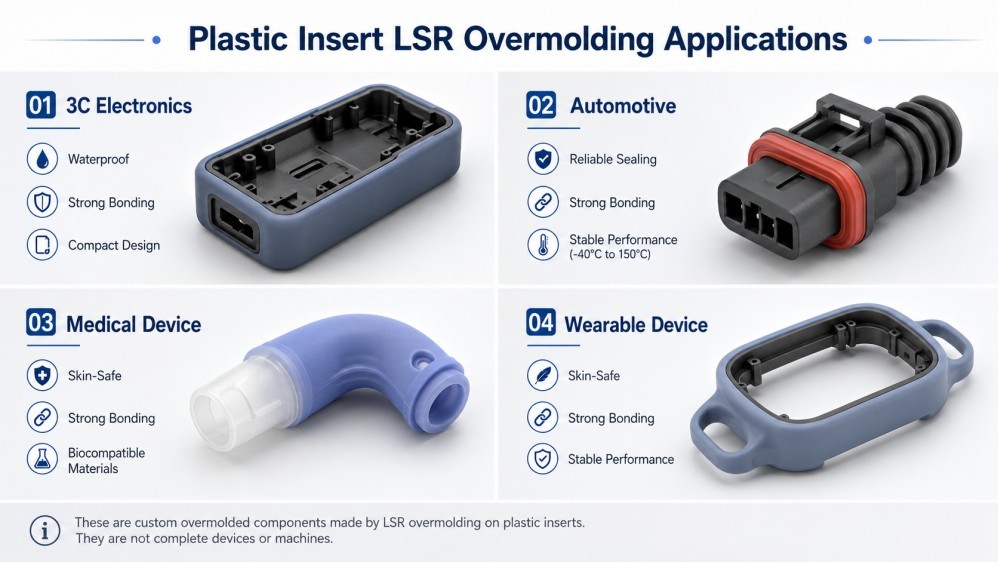
Plastic with silicone overmolding is used in products that require structural support, waterproof sealing, soft touch, dust protection, or long-term durability.
In electronic devices, plastic silicone overmolding can be used for waterproof housings, Type-C sealing parts, SIM tray seals, button seals, battery cover gaskets, speaker gaskets, microphone gaskets, handheld device seals, and portable electronic waterproof modules. These parts often require high precision, thin-wall structure, dustproof design, and stable sealing.
In automotive electronics and new energy vehicles, plastic silicone overmolding can be used for connector housings, sensor components, wire harness interfaces, charging port sealing parts, battery pack sealing structures, BMS-related components, and anti-vibration electronic assemblies. These parts often require waterproof sealing, high and low temperature resistance, aging resistance, and long-term reliability.
In medical and health care devices, plastic silicone overmolding can be used for medical handles, diagnostic device housings, sensor components, sealing rings, plastic insert parts, and soft-touch medical device structures. These applications may require medical grade silicone options, clean production awareness, precise structure, and reliable sealing.
For healthcare projects, medical grade silicone parts can be customized for device sealing, soft-touch protection, plastic insert bonding, sensor integration, and patient-contact structures.
In wearable electronics, plastic silicone overmolding can be used for smartwatch waterproof seals, wearable sensor housings, charging contact seals, smart ring structures, button sealing parts, and small waterproof electronic modules. These parts need compact design, sweat resistance, soft contact, and stable assembly.
In beauty and health care devices, plastic overmolded silicone parts can be used for waterproof housings, soft grip structures, device interface seals, handheld beauty device parts, and skin-contact silicone covers. Silicone helps improve comfort, waterproofing, anti-slip performance, and appearance quality.
People Also Ask: What Is the Difference Between Plastic Silicone Overmolding and Traditional Assembly?
Traditional assembly often uses separate rubber seals, manual adhesive bonding, foam tape, mechanical fastening, or post-assembly gaskets. These methods may work for simple products, but they can create risks in compact, waterproof, or high-reliability components.
Plastic silicone overmolding integrates silicone directly onto the plastic insert. This can improve positioning accuracy, reduce assembly steps, and form a more stable sealing structure. For small waterproof parts or complex plastic housings, overmolding also reduces the risk of gasket movement, uneven adhesive application, or assembly misalignment.
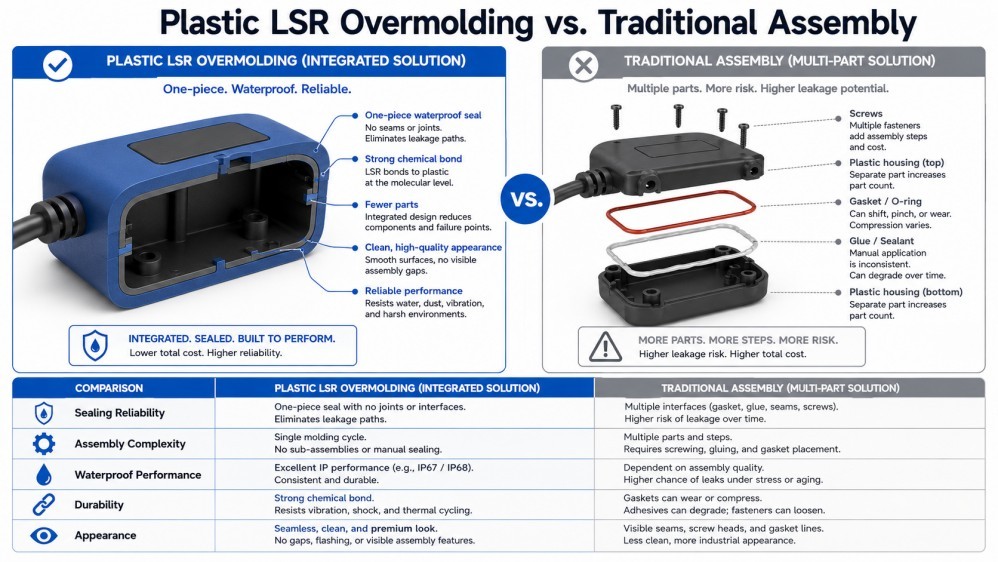
Plastic Silicone Overmolding vs Traditional Assembly
| Comparison Item | Plastic Silicone Overmolding | Traditional Assembly |
|---|---|---|
| Structure | Silicone is molded directly onto selected plastic areas | Uses separate gasket, glue, tape, screws, or manual assembly |
| Sealing Stability | More integrated waterproof sealing structure | Depends on assembly accuracy and adhesive control |
| Bonding Method | Requires correct plastic material, mold design, and silicone process | Relies on glue, compression, or mechanical fixing |
| Assembly Process | Can reduce manual assembly steps | Often needs extra assembly or dispensing process |
| Design Flexibility | Suitable for compact, complex, waterproof, and soft-touch parts | May be limited by space, gasket position, or glue flow |
| Typical Applications | Electronic housings, connector seals, medical handles, wearable parts, waterproof buttons | Simple housings, low-complexity seals, manually assembled parts |
| Buyer Type | OEM/ODM buyers needing precision, waterproofing, bonding, and repeatable production | Buyers needing simple assembly with lower tooling investment |
People Also Ask: Can Plastic Silicone Overmolding Achieve IP67 or IP68 Waterproof Sealing?
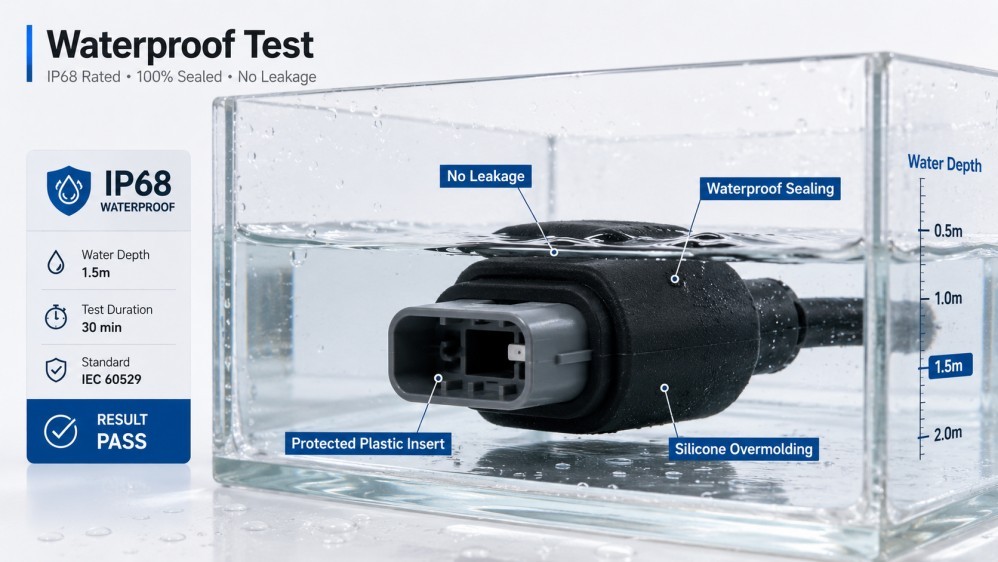
Plastic silicone overmolding can support IP67 or IP68 waterproof sealing when the product design, silicone material, plastic material, mold accuracy, bonding structure, and assembly conditions are properly controlled. However, waterproof performance is not decided by silicone alone.
Waterproof success depends on sealing geometry, silicone compression, plastic surface condition, bonding area, insert positioning, mating part tolerance, and final product assembly. If the structure has an open path for water, even a high-performance silicone material cannot guarantee sealing performance.
For electronic devices, waterproof risk often appears around Type-C interfaces, buttons, SIM trays, battery covers, speaker holes, microphone holes, and plastic housing seams. For automotive applications, sealing risk often appears around connector housings, sensor modules, wire harness interfaces, and charging ports.
For automotive electronics and EV applications, automotive waterproof silicone seals can help protect connector housings, sensor modules, wire harness interfaces, and battery-related electronic structures.
A professional plastic silicone overmolding supplier should review waterproof risk during the DFM stage, not after mass production. Early design review can reduce mold modification, sampling delays, bonding failure, and sealing failure.
People Also Ask: What Design Factors Affect Plastic Silicone Overmolding Quality?
The quality of plastic silicone overmolding depends on several important design and production factors.
The first factor is plastic material selection. Not all plastics bond well with silicone. The supplier must evaluate plastic type, heat resistance, surface condition, shrinkage, and compatibility with the silicone molding process.
The second factor is plastic insert positioning. The plastic part must be accurately fixed inside the mold. Poor positioning can cause uneven silicone thickness, sealing misalignment, blocked functional areas, or assembly interference.
The third factor is surface condition. Oil, dust, moisture, release agents, or poor surface treatment can reduce bonding between silicone and plastic. For bonding-critical projects, surface treatment should be confirmed before mass production.
The fourth factor is silicone flow control. Liquid silicone can flow into small spaces, which is useful for precision molding but also creates flash risk if the mold is not well designed. Mold sealing, venting, insert fit, and parting line control are very important.
The fifth factor is mechanical locking design. In some projects, chemical bonding alone may not be enough. Grooves, holes, ribs, undercuts, or special plastic structures can help improve mechanical retention between silicone and plastic.
The sixth factor is application environment. Plastic overmolded silicone parts may face water, sweat, oil, heat, cold, vibration, repeated assembly, cleaning fluids, or mechanical stress. These conditions should be considered during material and structure design.
People Also Ask: What Defects Can Happen in Plastic Silicone Overmolding?
Common defects include plastic insert displacement, silicone flash, incomplete filling, bubbles, poor bonding, edge lifting, uneven silicone thickness, plastic deformation, contamination, and sealing failure.
Insert displacement is a major risk because plastic parts must stay in the correct position during molding. If the insert moves, the silicone layer may not seal correctly, and the final part may fail assembly.
Flash can happen when liquid silicone flows into tiny gaps around the plastic insert, mold parting line, or functional area. Excess flash may affect appearance, assembly, sealing, or button movement.
Poor bonding can cause peeling, edge lifting, water leakage, or delamination. This is especially dangerous for waterproof parts because even a small separation path may allow moisture to enter the product.
Plastic deformation can happen when the plastic material cannot withstand mold temperature, clamping pressure, or insert stress. This is why plastic material selection and tooling design are important before mass production.
Bubbles or voids may reduce appearance quality, bonding strength, and sealing stability. They can be caused by trapped air, poor venting, contamination, material issues, or process instability.
A reliable manufacturer should prevent these defects through DFM review, mold precision, insert positioning control, plastic material evaluation, material selection, molding parameter optimization, and strict inspection.
People Also Ask: How Do You Choose a Plastic Silicone Overmolding Manufacturer?
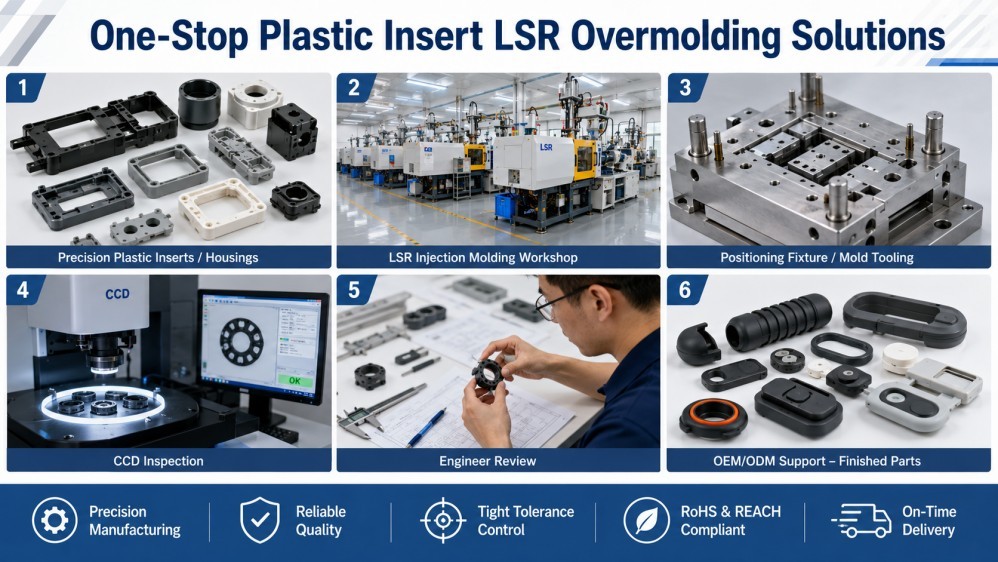
Choosing a plastic silicone overmolding manufacturer requires evaluating both silicone molding capability and plastic insert molding experience. This process is more complex than ordinary silicone molding because the supplier must control insert positioning, bonding, sealing, material compatibility, and long-term reliability.
A capable supplier should provide DFM support before mold opening. This helps identify plastic positioning risks, material compatibility risks, bonding risks, flash risks, sealing problems, deformation risks, and assembly interference.
The manufacturer should also have experience with liquid silicone injection molding, silicone overmolding, insert molding, silicone over plastic, silicone over metal, FPC silicone overmolding, and waterproof silicone seals. For compact or high-reliability parts, small design details can determine whether the final product can pass assembly and waterproof testing.
Shenzhen Liyongan Silicone Rubber Products Co., Ltd. owns a 4500+ square meter silicone processing plant in China, with 12 liquid silicone injection molding machines, 26 compression molding machines, 20 CCD inspection devices, a mold workshop, liquid silicone molding workshop, solid silicone molding workshop, dust-free workshop, engineering team, production team, and quality control team.
For global OEM/ODM buyers, silicone overmolding solutions can be customized for plastic inserts, metal inserts, FPC, silicone, waterproof seals, medical components, wearable electronics, automotive electronics, beauty devices, and industrial custom silicone parts.
People Also Ask: What Information Should Buyers Provide for a Plastic Overmolding Project?
To evaluate a plastic silicone overmolding project accurately, buyers should provide clear technical information. Useful files include plastic insert drawings, 3D assembly files, product photos, samples, silicone coverage area, exposed functional area, bonding requirements, waterproof level, hardness requirement, material requirement, and target application.
For plastic insert projects, the supplier may also need to know the plastic type, surface finish, tolerance, heat resistance, cleaning requirement, and whether the part needs sealing, soft touch, insulation, snap-fit assembly, or anti-slip performance.
Buyers should also provide the application environment. For example, will the part be used in consumer electronics, automotive electronics, medical devices, wearable electronics, beauty devices, industrial equipment, or outdoor products? Will it face sweat, water, oil, high temperature, low temperature, vibration, repeated cleaning, or mechanical stress?
The more complete the project information, the faster the manufacturer can provide DFM suggestions, mold quotation, sampling plan, production risk evaluation, and mass production support.
FAQ About Plastic With Silicone OverMolding Manufacturing
1. What is plastic silicone overmolding used for?
Plastic silicone overmolding is used to produce waterproof, dustproof, soft-touch, anti-slip, and shock-resistant components by molding silicone over plastic inserts. It is commonly used for electronic housings, connector seals, waterproof buttons, medical device parts, wearable electronics, beauty devices, and custom plastic-silicone assemblies.
2. Can silicone bond strongly to plastic?
Yes, silicone can bond to plastic when the plastic material, surface condition, primer or surface treatment, mechanical locking design, mold temperature, and curing process are properly controlled. For waterproof parts, bonding reliability should be evaluated before mass production.
3. Can plastic silicone overmolding achieve IP67 or IP68 waterproof sealing?
Yes. Plastic silicone overmolding can support IP67 or IP68 waterproof sealing when the sealing structure, silicone material, mold accuracy, insert positioning, bonding area, and final assembly are properly designed and tested.
4. What plastics can be used for silicone overmolding?
Common plastic inserts may include PC, PA, PBT, PPS, ABS, PP, and other engineering plastics, depending on the application. The best material depends on heat resistance, bonding requirements, dimensional stability, and final product environment.
5. What information is needed for a plastic silicone overmolding project?
Buyers should provide plastic insert drawings, 3D files, samples, silicone coverage area, functional exposed areas, plastic material, surface treatment, hardness requirement, waterproof level, application environment, estimated quantity, and testing requirements.
6. How do I choose a reliable plastic silicone overmolding manufacturer?
Choose a manufacturer with liquid silicone injection molding equipment, mold design capability, plastic insert molding experience, silicone overmolding expertise, DFM support, quality inspection, and experience in waterproof sealing components.
Conclusion
Plastic with silicone overmolding manufacturing is a valuable process for creating waterproof, dustproof, soft-touch, shock-resistant, and durable components that combine the structural stability of plastic with the flexibility and sealing performance of silicone.
For B2B buyers, the key is not only whether silicone can cover a plastic insert. The real challenge is achieving accurate positioning, strong bonding, reliable waterproof sealing, clean appearance, and repeatable mass production.
Shenzhen Liyongan Silicone Rubber Products Co., Ltd. provides custom plastic silicone overmolding, liquid silicone injection molding, silicone over metal, FPC silicone overmolding, waterproof silicone seals, wearable device silicone parts, medical grade silicone parts, automotive electronic sealing parts, beauty device components, and industrial custom silicone components.
If you are developing waterproof plastic insert parts, electronic housings, connector seals, medical device components, wearable electronic modules, beauty device parts, or custom silicone overmolded components, you can request a custom plastic silicone overmolding quote by sharing your drawings, samples, or project requirements with our engineering team.
What type of plastic silicone overmolding project are you developing? Leave a comment, share this article with your engineering or sourcing team, or contact us to discuss your custom silicone overmolding requirements.