Top 8 Ways to Accelerate B2B Product Development with Liquid Silicone Rubber Overmolding
- Share
- publisher
- siliconeplus
- Issue Time
- Jan 9,2026
Summary
8 proven ways to speed up B2B product development using LSR overmolding, focusing on DFM, and flexible manufacturing.
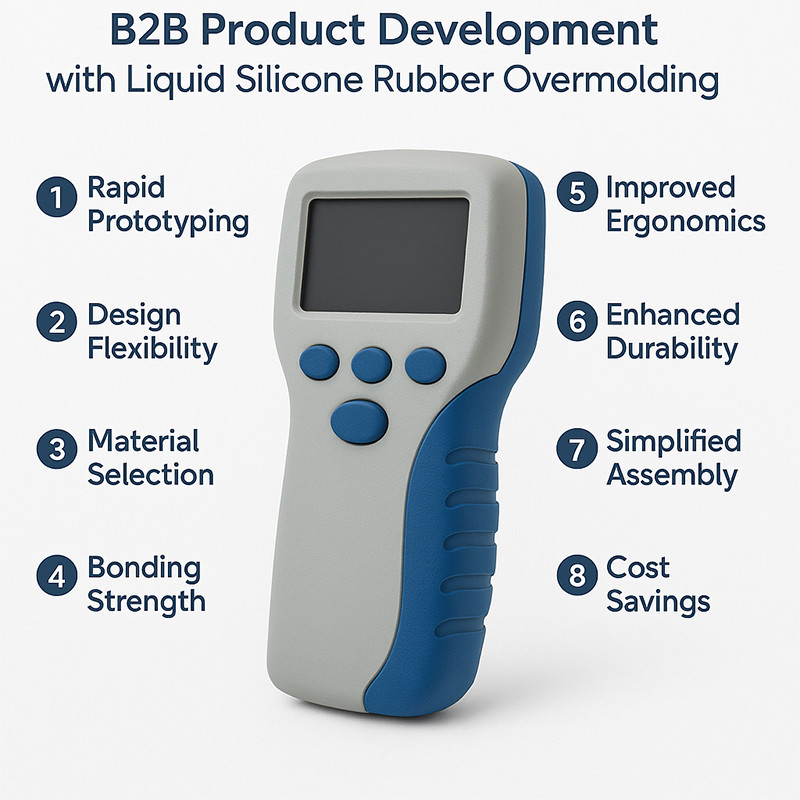
Introduction:
In the competitive landscape of B2B product development, liquid silicone rubber (LSR) overmolding has emerged as a transformative technology. Its ability to combine durability, flexibility, and high-performance characteristics makes it invaluable for creating complex, high-quality products at an accelerated pace. Our comprehensive approach identifies eight critical strategies to leverage LSR overmolding effectively, ensuring faster time-to-market, superior product quality, and cost efficiency.
1. Integrate Advanced Design for Manufacturability (DFM) Principles Early in Development
Design for Manufacturability (DFM) is fundamental when utilizing liquid silicone rubber overmolding. Early integration of DFM principles allows for optimized mold design, reducing iterations, minimizing tooling costs, and streamlining the production process.
Collaborate with experienced mold designers to address potential issues such as venting, mold release, and material flow.
Use computer-aided design (CAD) tools to simulate liquid silicone flow and overmolding interfaces.
Prioritize modular design approaches to facilitate easier assembly and maintenance.
By embedding DFM early, companies can identify and resolve potential manufacturing bottlenecks, significantly reducing product development cycles.
2. Leverage Rapid Prototyping Technologies for Fast Iterations
Rapid prototyping using additive manufacturing enables quick visualization of product concepts and validation of overmolding compatibility with various substrates.
Utilize 3D printing to produce prototype molds or mock-ups for initial testing.
Conduct early-stage overmolding trials to assess adhesion, flexibility, and sealing properties.
Implement iterative testing to refine design features before committing to expensive tooling.
This approach accelerates the feedback loop, allowing teams to make data-driven modifications quickly, thereby shortening development timelines.
3. Optimize Material Selection for Superior Performance and Compatibility
Material compatibility is critical in LSR overmolding. Selecting the right liquid silicone rubber formulation influences product durability, biocompatibility, and aesthetic quality.
Choose high-performance LSR formulations with desired hardness, transparency, and thermal stability.
Consider additives such as colorants, fillers, or flame retardants to meet specific application requirements.
Ensure compatibility with substrate materials (e.g., plastics, metals) to prevent issues like poor adhesion or delamination.
By conducting material compatibility tests early, developers can avoid costly rework and ensure consistent product quality.
4. Implement Advanced Mold Design and Manufacturing Techniques
Innovative mold design is pivotal in speeding up overmolding processes. Embrace state-of-the-art manufacturing methods such as multi-material mold fabrication, rapid tooling, and 3D-printed inserts.
Design multi-cavity molds to produce multiple parts simultaneously, increasing throughput.
Use hard tooling for high-volume production, or quick-turnaround prototypes with additive manufacturing.
Incorporate features like integrated cooling channels and venting to improve cycle times and product consistency.
Investing in advanced mold technology reduces lead times and enables more complex geometries, expanding design possibilities.
5. Adopt Automation and Robotics for Overmolding Processes
Automation significantly enhances production efficiency and product consistency in LSR overmolding.
Implement robotic handling systems for precise placement of substrates and material dispensing.
Use automated mold closing and opening systems to minimize cycle times.
Integrate quality inspection robots for real-time defect detection, such as air entrapment or incomplete overmolding.
Automation reduces human error, increases repeatability, and allows scaling production with minimal delays.
6. Embrace Modular and Flexible Manufacturing Systems
Modular manufacturing platforms enable rapid reconfiguration for different product variants or design changes.
Design flexible molds and equipment that can accommodate multiple product configurations.
Use interchangeable mold inserts to switch between designs swiftly.
Maintain standardized process parameters to facilitate quick setup and changeovers.
This flexibility minimizes downtime during product updates, ensuring timely market launches and adaptability to customer demands.
7. Strengthen Supplier Partnerships and Supply Chain Integration
Efficient supply chain management is essential for accelerated product development.
Partner with reliable material suppliers to ensure consistent quality and supply of liquid silicone rubber and other critical components.
Collaborate with mold manufacturers for rapid tooling and customized solutions.
Integrate supply chain data systems to monitor inventory levels, lead times, and production schedules.
A robust supply chain minimizes delays, reduces costs, and enhances overall project agility.
8. Invest in Skilled Workforce and Continuous Training
Finally, the backbone of accelerated product development lies in a highly skilled team.
Train engineers, mold makers, and operators in the latest overmolding techniques and material handling.
Promote a culture of continuous learning to stay abreast of emerging trends and technological innovations.
Encourage cross-disciplinary collaboration between design, manufacturing, and quality teams.
A knowledgeable workforce accelerates problem-solving, fosters innovation, and ensures smooth project execution.
Comparative Overview of Overmolding Techniques
| Feature | Liquid Silicone Rubber Overmolding | Traditional Overmolding | Benefits |
Material Flexibility | High | Moderate | Superior tactile and aesthetic qualities |
Production Speed | Fast with automation | Slower | Accelerates time-to-market |
| Design Complexity | High | Moderate | Enables intricate geometries |
| Cost Efficiency | Lower tooling costs | Higher tooling costs | Cost-effective for low to medium volumes |
| Durability | Excellent | Good | Longer product lifespan |
Conclusion: Transforming B2B Product Development with Liquid Silicone Rubber Overmolding
Implementing these eight strategic methods positions your organization at the forefront of B2B product innovation. Liquid silicone rubber overmolding offers unparalleled advantages in design flexibility, durability, and aesthetic appeal, but its true potential is unlocked through early planning, advanced technology adoption, and strategic partnerships.
By integrating advanced design practices, leveraging rapid prototyping, optimizing material and mold choices, and embracing automation and flexible manufacturing, companies can significantly reduce development cycles, enhance product quality, and maximize ROI.
The future of B2B product development lies in embracing innovative overmolding techniques, and liquid silicone rubber stands as a cornerstone of this evolution. Through dedicated investment and strategic planning, your organization can outperform competitors and bring groundbreaking products to market faster than ever before.
Website:www.siliconeplus.net
Email:sales11@siliconeplus.net.
Phone:13420974883
Wechat:13420974883