LSR vs Compression Molding: Which Silicone Molding Process Is Right for You?
- Share
- publisher
- Siliconeplus Editor
- Issue Time
- May 20,2026
Summary
A detailed comparison of LSR injection molding and compression molding, including their working principles, advantages, disadvantages and application scenarios, helping you choose the most cost-effective silicone molding process for your project.
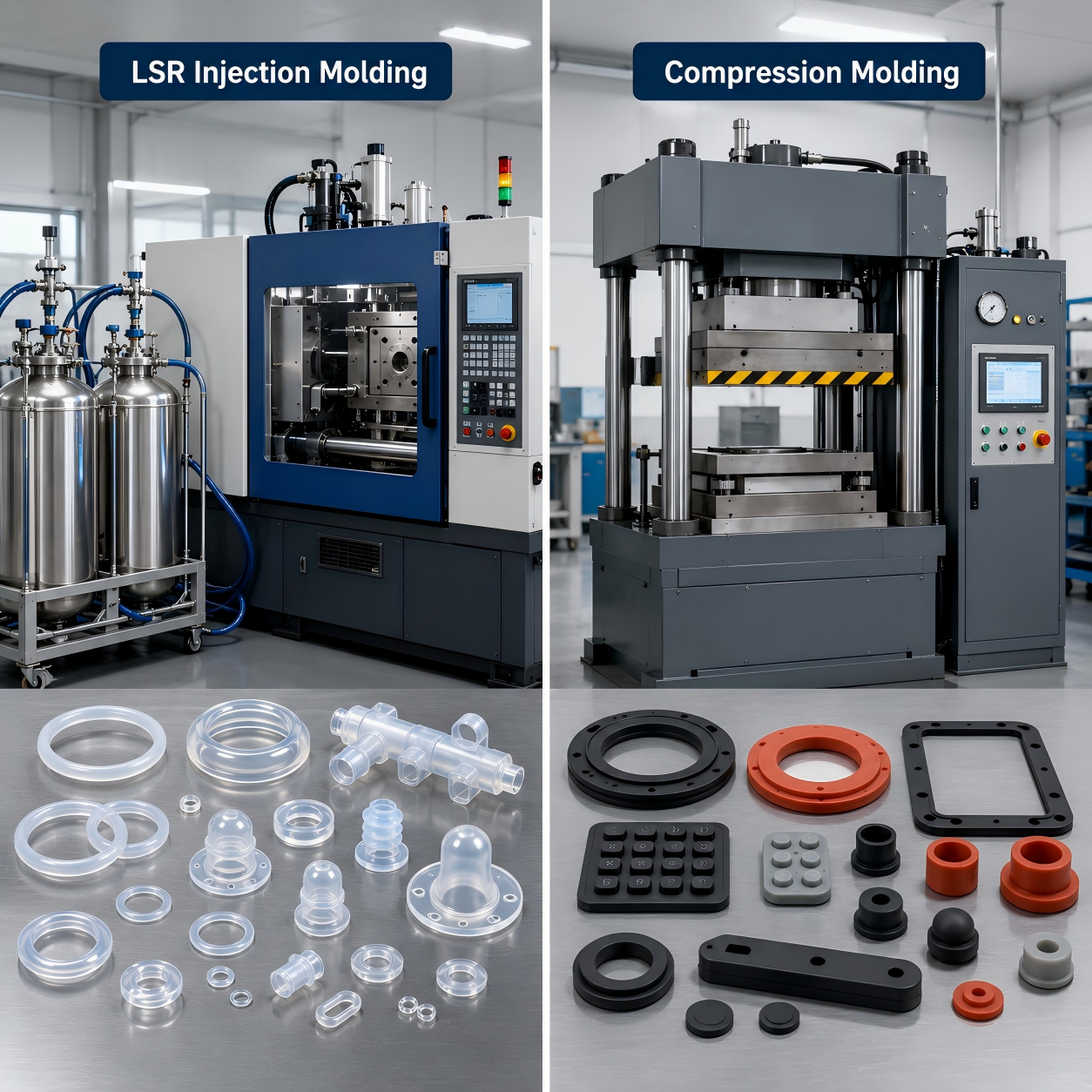
When purchasing silicone parts for medical, automotive, 3C electronics or beauty industries, overseas buyers often face a key question: LSR injection molding vs compression molding—which process is more suitable for their products? Both are mainstream silicone molding technologies, but they differ greatly in efficiency, precision, cost and application scenarios.
Today, we will make a professional and detailed comparison between the two processes, and share practical selection suggestions, even including tips on how to reduce LSR mold cost, to help you make the most cost-effective choice while ensuring product quality.
1. Basic Definition of Two Silicone Molding Processes
1.1 LSR Injection Molding (Liquid Silicone Rubber Injection Molding)
LSR injection molding is an automated precision molding process that uses liquid two-component silicone (A/B components) as raw materials. The raw materials are uniformly mixed in a ratio of 1:1 by a dedicated injection machine, then injected into a high-precision mold under pressure, and rapidly vulcanized and formed at high temperature (170-220°C) to produce finished silicone parts in one shot . It is widely used in high-precision, high-demand and large-batch production scenarios.
1.2 Compression Molding (Silicone Compression Molding)
Compression molding is a traditional silicone molding process. Pre-formed solid silicone (in sheets, pellets or pre-shaped blanks) is manually placed into an open mold, then the mold is closed, and heat and pressure are applied to make the silicone flow and fill the mold cavity, and finally vulcanized and formed . It is more suitable for simple structure, small and medium batch production, and has the advantage of low initial cost.
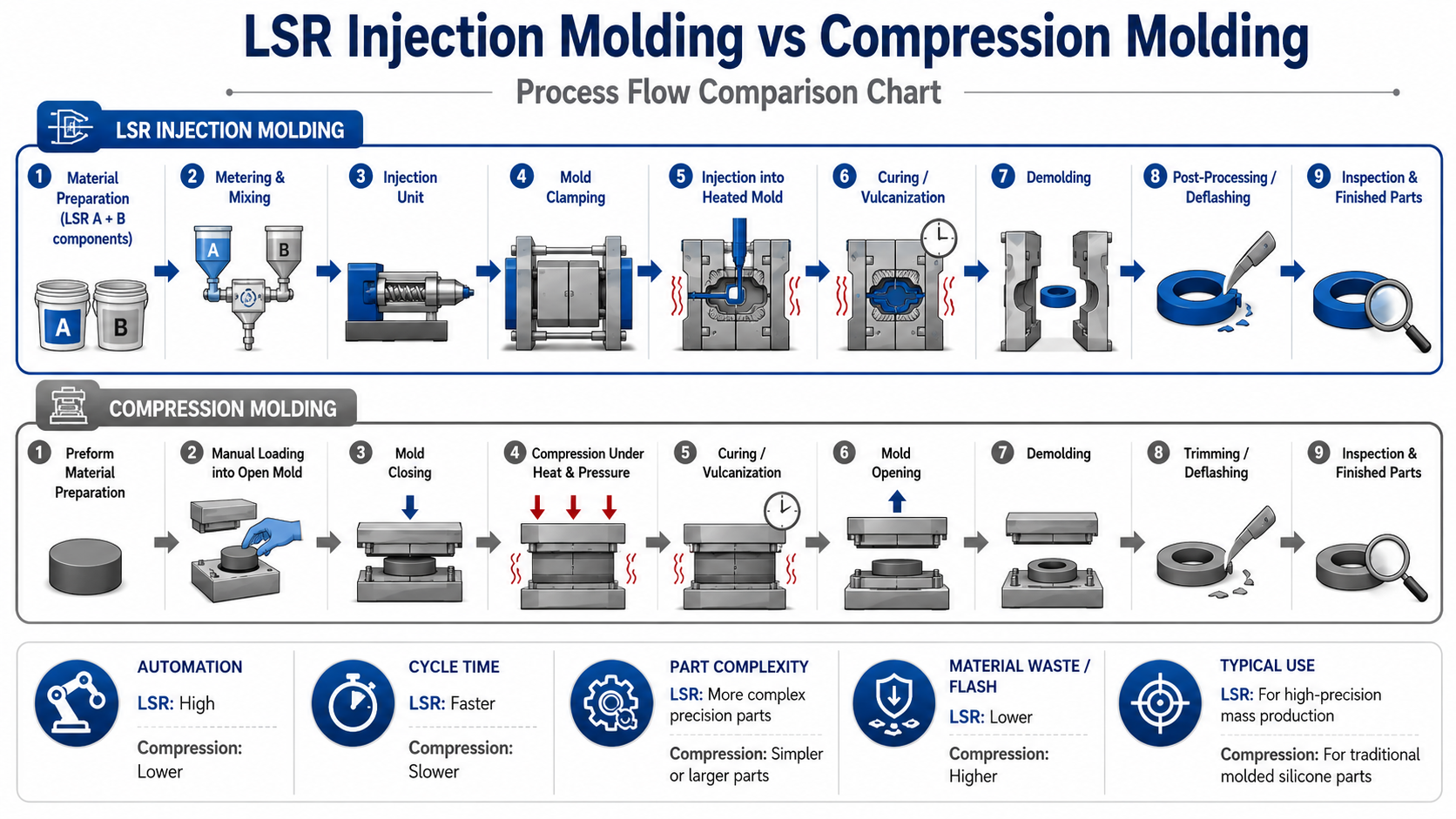
LSR vs Compression Molding process comparison, LSR injection flow, compression molding steps
2. Core Differences Between LSR Injection Molding and Compression Molding (Key for Buyers)
| Comparison Items | LSR Injection Molding | Compression Molding |
|---|---|---|
| Raw Material Form | Liquid two-component silicone (LSR), low viscosity (similar to honey) | Solid silicone (HCR/HTV), high viscosity, need to be kneaded into sheets |
| Processing Method | Automated mixing + cold runner injection + hot mold curing, fully automated production | Manual cutting of rubber material + filling mold + hot pressing vulcanization, manual/semi-automated |
| Molding Precision | High precision, dimensional tolerance ≤±0.01mm, no burrs, smooth surface | General precision, dimensional tolerance ±0.05-0.1mm, easy to have burrs, need secondary trimming |
| Production Efficiency | Fast curing cycle (20-120 seconds per cycle), suitable for multi-cavity mass production, 1 person can control 10 machines | Slow curing cycle (2-10 minutes per cycle), low efficiency, 1 person can only control 2 machines |
| Mold Cost | Higher initial mold cost (requires high-precision CNC mold, cold runner system), suitable for large batches to average cost | Lower mold cost (simple mold structure, no cold runner), suitable for small batches |
| Material Waste | Low waste rate (<2%) due to cold runner design, no unnecessary material loss | High waste rate (15-30%), including trimming burrs and leftover materials |
| Product Complexity | Suitable for complex structures, ultra-thin walls, micro-details and undercut designs | Only suitable for simple structures (gaskets, O-rings, simple covers), difficult to realize complex shapes |
| Application Scenarios | Medical precision parts, 3C electronic waterproof parts, high-end automotive components | Industrial gaskets, simple silicone accessories, low-demand consumer goods |
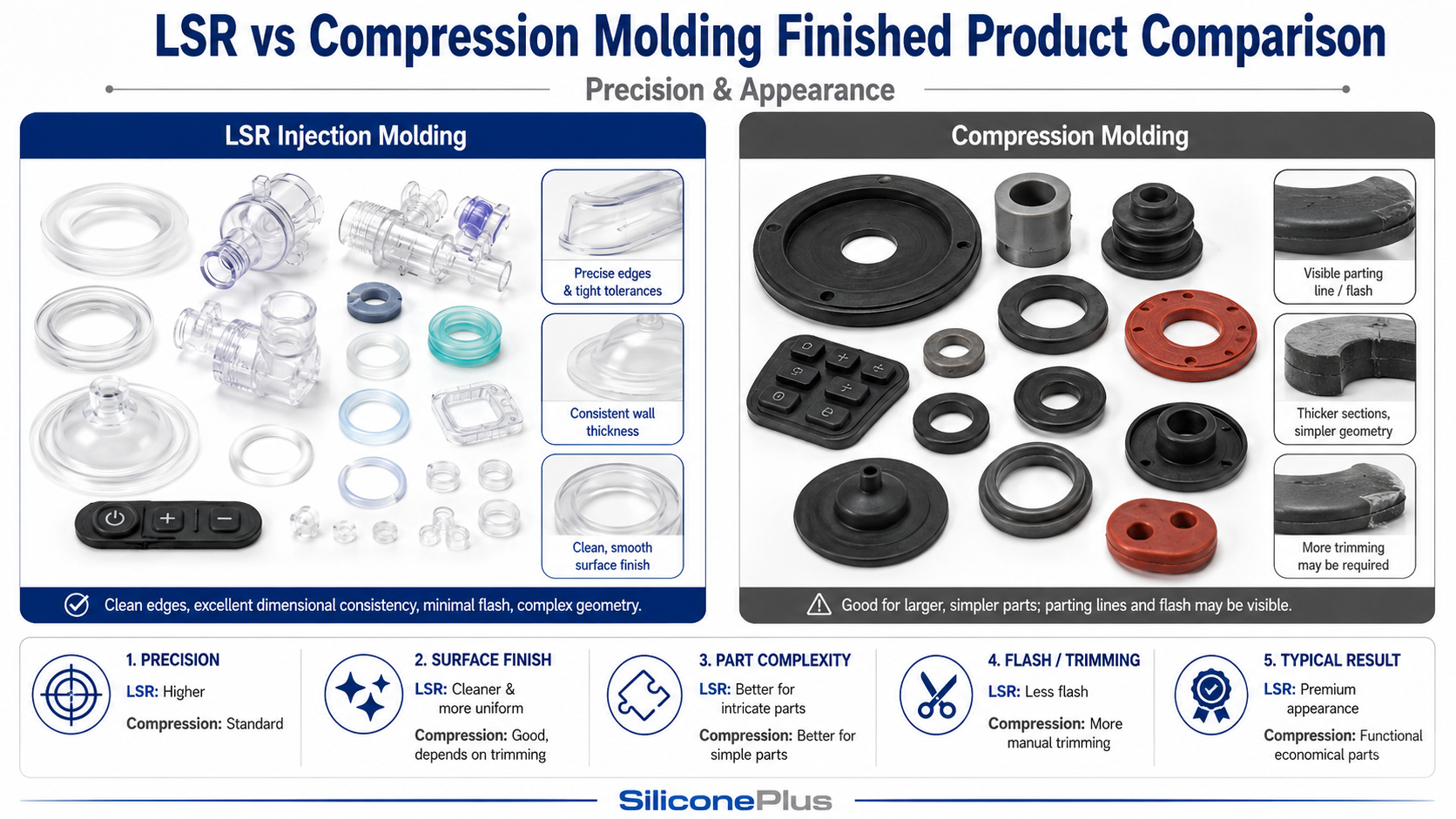
LSR vs Compression Molding finished parts, precision comparison, surface quality
3. Advantages and Disadvantages of Each Process (Help You Make a Decision)
3.1 LSR Injection Molding
✅ Advantages:
- High precision and stable product consistency, meeting the strict requirements of medical, 3C and automotive industries ;
- Fully automated production, high efficiency, saving labor cost and reducing human error;
- Smooth surface, no burrs, no need for secondary trimming, improving production efficiency;
- Pure material, no by-products during vulcanization, easy to pass FDA, ISO and other certification standards ;
- Support complex structure molding, such as micro-channels, thin-walled parts (0.1mm or less) .
❌ Disadvantages:
- High initial mold cost, which is not cost-effective for small-batch sample orders;
- High requirements for equipment and technology, requiring professional LSR injection machines and technical teams;
- Raw material cost is 1.3-2 times that of solid silicone .
3.2 Compression Molding
✅ Advantages:
- Low mold cost and equipment investment (only 1/5 of LSR injection machines), suitable for small-batch trial production ;
- Simple process, low technical threshold, short mold opening cycle;
- Suitable for thick-walled products (>50mm) and products with high filling requirements (such as conductive, wear-resistant parts) ;
- Solid silicone raw material is cheaper, reducing material cost for small batches.
❌ Disadvantages:
- Low production efficiency, not suitable for large-batch mass production;
- Poor product precision, easy to have burrs and uneven thickness, requiring secondary trimming;
- High manual labor intensity, easy to cause product inconsistency due to human operation ;
- Difficult to produce complex-shaped products, limited design flexibility.
4. Practical Selection Suggestions (Key for Purchasers)
- If you need high-precision, complex-structured silicone parts (such as medical catheters, 3C electronic waterproof seals, automotive high-voltage connectors) and have large-batch production needs, choose LSR injection molding. At this time, you can refer to our tips on how to reduce LSR mold cost (such as optimizing product structure to simplify mold design, choosing reasonable mold materials according to order quantity, and using multi-cavity molds) to control the overall budget .
- If you only need simple-structured silicone parts (such as ordinary gaskets, O-rings, simple silicone covers) and have small-batch (less than 10,000 pieces) or sample production needs, choose compression molding to save mold and production costs .
- If your products need to meet FDA, ISO and other high-standard certification (such as food-grade, medical-grade silicone parts), LSR injection molding is preferred, because its pure material and pollution-free production process are easier to pass strict certification tests .
- If you need IP67 waterproof silicone parts (such as outdoor electronic seals), LSR injection molding is more suitable, because its seamless integrated molding can achieve better waterproof effect, avoiding water seepage caused by splicing gaps in compression molding .
5. How to Reduce LSR Mold Cost (Supplementary Long-Tail Content)
For buyers who choose LSR injection molding, the high mold cost is often a key concern. Here are 3 practical tips to help you reduce LSR mold cost without reducing product quality :
- Optimize product structure: Simplify complex undercut and curved structures, cancel unnecessary details, reduce mold processing difficulty and cost;
- Choose mold materials reasonably: For small-batch samples, choose economical domestic mold steel; for large-batch mass production, use high-hardness anti-rust mold steel to extend mold life and average cost;
- Adopt multi-cavity mold design: If you have multiple similar small silicone parts, design a set of multi-cavity molds to produce multiple products at one time, greatly reducing the average mold cost per product.
Conclusion
LSR injection molding and compression molding have their own advantages and applicable scenarios. The key to choosing is to combine your product’s precision requirements, production batch, budget and industry standards. LSR injection molding is the first choice for high-end, high-precision and large-batch products, while compression molding is more cost-effective for simple, small-batch products.
No matter which process you choose, we can provide professional one-stop solutions, from mold design, sample proofing to mass production, and even help you control mold and production costs.