How Top Silicone Overmolding Factories Manage Complex Designs
- Share
- publisher
- siliconeplus
- Issue Time
- Dec 24,2025
Summary
Top silicone overmolding factories use advanced design, precision molding, and strict QA to master complex, high-precision silicone parts.
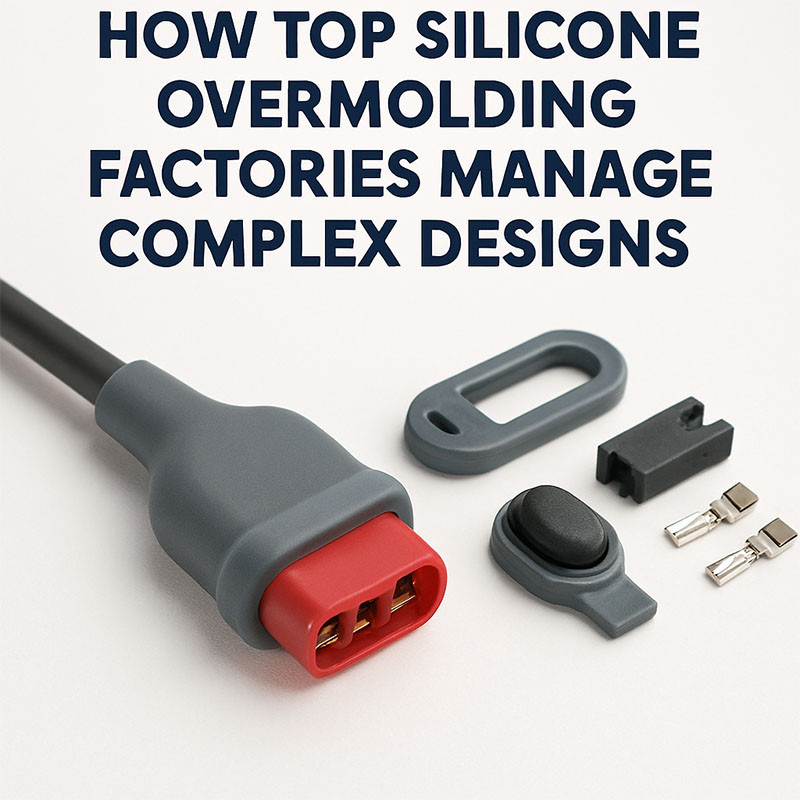
Introduction:
In the highly competitive world of silicone overmolding, leading factories distinguish themselves through their meticulous management of complex designs. These factories leverage advanced technologies, rigorous quality control, and innovative manufacturing strategies to produce high-precision, reliable, and scalable silicone components. This comprehensive guide explores the intricate processes and key practices employed by top-tier silicone overmolding factories to master complex design challenges.
Understanding the Complexity of Silicone Overmolding Designs
Silicone overmolding involves creating a multi-material composite where silicone is molded over or around other components, often with intricate geometries, tight tolerances, and specific functional requirements. Complex designs may include:
Multiple internal cavities
Fine detail features
Flexible and rigid component integration
Custom textures and surface finishes
Embedded electronics or sensors
Successfully managing these complexities requires a strategic approach, combining technological innovation with rigorous process control.
Advanced Design and Prototyping for Precision Execution
Top silicone overmolding factories prioritize comprehensive design validation before production. This involves:
3D CAD modeling with detailed simulations to predict material flow and identify potential issues.
Finite Element Analysis (FEA) to evaluate stress points, deformation, and durability under real-world conditions.
Rapid prototyping through 3D printing to create physical models for fit and function testing.
By integrating these steps, factories can detect and resolve design flaws early, minimizing costly revisions and ensuring that the final product precisely meets client specifications.
State-of-the-Art Molding Technologies for Complex Geometries
Managing complex designs demands cutting-edge equipment and processes:
Multi-Shot and Two-Shot Molding
Multi-shot molding enables simultaneous or sequential overmolding of different materials within a single cycle, allowing for multi-color, multi-material, and multi-functionality in a single part. This technique is essential for complex assemblies that require distinct tactile or electrical properties.
Precision Injection Molding
Utilizing high-precision injection molding machines with tight tolerances (±0.02mm or better), factories can produce intricate details and consistent quality even in small batch runs.
Micro-Molding and Fine Detail Overmolding
For features such as micro-textures, tiny channels, or embedded sensors, micro-molding equipment with specialized tooling ensures ultra-fine detail replication, critical in medical, electronic, and consumer device applications.
Innovative Tooling and Mold Design for Complex Features
Effective tooling is the backbone of managing complex designs:
Multi-cavity molds maximize output efficiency while maintaining precision.
Modular mold components allow for flexible adjustments and quick retooling for different designs.
Advanced cooling systems and venting techniques prevent defects like warping, bubbles, or incomplete fills.
Electrodes and insert molding enable the integration of metal components, electronic parts, or textured surfaces directly into the silicone.
Material Selection and Compatibility for Complex Overmolds
Choosing the right silicone material is critical for performance and manufacturability:
High-consistency silicone rubbers (HCR) for durability and flexibility.
Room Temperature Vulcanizing (RTV) silicones for detailed features and rapid production.
Medical-grade silicones for biocompatibility.
Specialized formulations with adhesion promoters to improve bonding with substrates or embedded components.
Material compatibility with other substrates, such as plastics or metals, is carefully tested through adhesion tests, aging simulations, and chemical compatibility assessments.
Precision Assembly and Post-Processing for Complex Assemblies
Post-molding processes are crucial for managing complex designs:
Automated assembly lines ensure consistent placement of embedded components.
Surface finishing techniques like tumbling, polishing, or texturing enhance aesthetics and tactile feel.
Ultrasonic welding and adhesive bonding for assembling multi-part silicone components.
Quality inspection using CMM (Coordinate Measuring Machines) and vision systems guarantees dimensional accuracy and defect detection.
Rigorous Quality Control and Testing Protocols
Top factories implement multi-layered quality assurance:
Visual inspections for surface defects and surface finish consistency.
Dimensional verification using precision metrology tools.
Mechanical testing for tensile strength, tear resistance, and compression set.
Environmental testing to assess temperature, humidity, and UV exposure effects.
Electrical testing for components with embedded electronics.
Data-driven quality management ensures each batch adheres to strict standards, reducing rework and warranty claims.
Scalability and Flexibility in Production
Managing complex designs at scale requires:
Flexible manufacturing systems capable of rapid changeover between different designs.
Batch size customization with minimal tooling adjustments.
Automation and robotics to maintain precision and repeatability.
Supply chain integration to ensure material availability and just-in-time delivery.
Case Study: Managing a Complex Medical Device Overmold
A leading silicone overmolding factory recently managed the production of a medical wearable device featuring intricate internal channels, embedded sensors, and multiple textured surfaces. The process involved:
Custom mold fabrication with multi-cavity and insert features.
Advanced micro-molding techniques to achieve micro-textures on the silicone surface.
Adhesion enhancement through specialized surface treatments.
Rigorous sterilization compatibility testing.
Automated assembly integrating electronic components seamlessly.
This project demonstrated how integrated technological solutions and strict quality protocols enable the successful management of highly complex designs in demanding industries.
Conclusion: The Future of Managing Complex Silicone Overmolding Designs
Top silicone overmolding factories continuously innovate by adopting digital twin technology, AI-driven process optimization, and advanced materials to further enhance their ability to manage complex designs. Their commitment to precision engineering, quality assurance, and technological integration positions them as leaders in delivering customized silicone solutions for a broad spectrum of industries, from medical devices to consumer electronics.
By leveraging state-of-the-art equipment, comprehensive design validation, and rigorous quality control, these factories ensure that even the most intricate designs are brought to life with exceptional accuracy, durability, and aesthetic appeal.
Website:www.siliconeplus.net
Email:sales11@siliconeplus.net.
Phone:13420974883
Wechat:13420974883