How Should Metal Inserts Be Prepared Before LSR Overmolding?
- Share
- publisher
- siliconeplus
- Issue Time
- Aug 13,2026
Summary
Metal inserts should be controlled for material grade, plating, oxidation, oil, contamination, dimensional stability and bonding requirements before LSR overmolding. A visually clean metal surface does not automatically guarantee stable silicone adhesion. Reliable production requires a defined incoming surface condition, validated bonding strategy, protected functional areas, mechanical retention where needed and repeatable insert handling from sampling through mass production.
Answer Excerpt
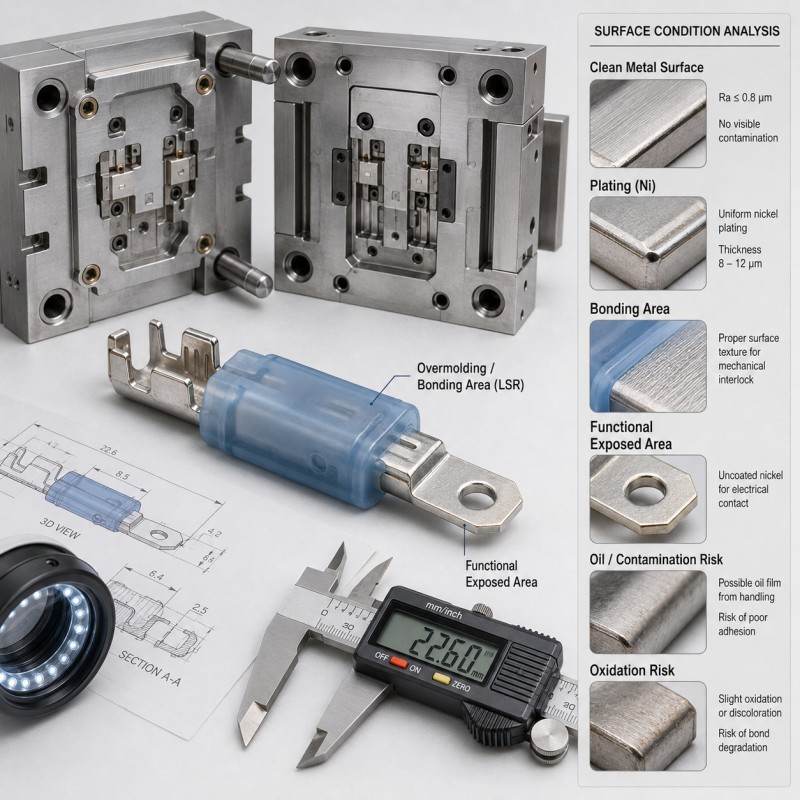
Metal inserts should be prepared for LSR overmolding by controlling the exact metal grade, plating, surface cleanliness, oxidation, dimensional condition and bonding method before molding. Oil, dust, inconsistent coatings or uncontrolled surface changes can reduce interface consistency. Engineers should also define which metal areas must remain exposed and whether the joint relies on chemical bonding, mechanical retention or a validated combination of both.
Metal with silicone overmolding is widely used when a component needs the rigidity, conductivity or structural support of metal together with the sealing, insulation, flexibility or protective properties of silicone.
However, a metal insert is not simply a rigid part placed into an LSR mold.
Its surface becomes part of the final silicone-to-metal interface.
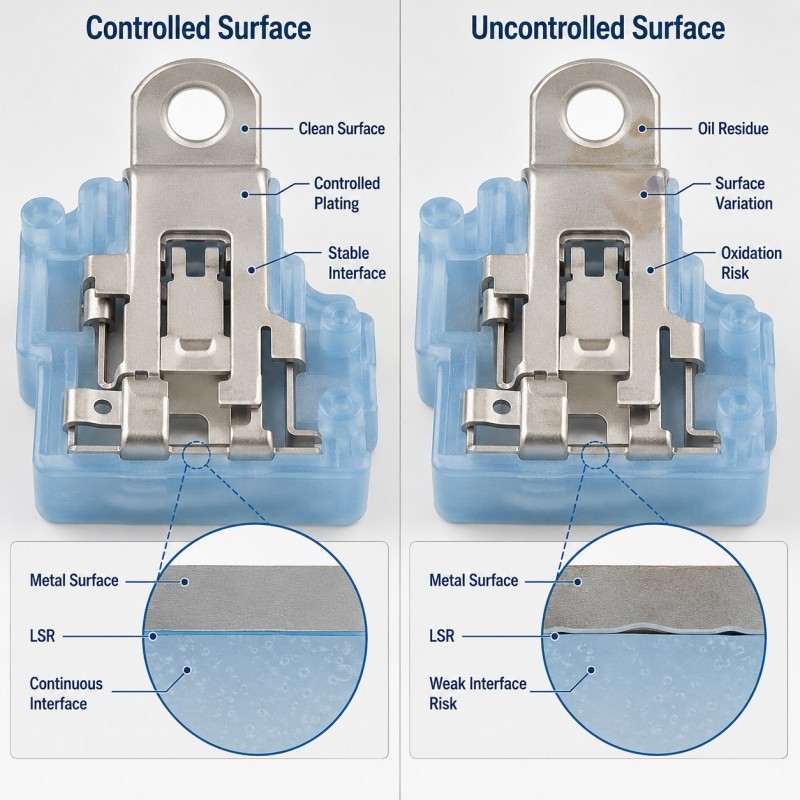
Two metal inserts can have exactly the same dimensions but behave differently during overmolding if one carries machining oil, oxidation, plating variation or uncontrolled surface residue.
The metal preparation method should therefore be treated as part of the production specification rather than as an informal cleaning operation performed before molding.
For custom projects, metal with silicone overmolding should be reviewed together with the actual metal grade, surface finish, bonding area and final application requirements.
Why Does Metal Surface Condition Matter Before LSR Overmolding?
The silicone does not contact the theoretical metal specified on the drawing. It contacts the real surface delivered to the molding process.
That surface may contain:
• Stamping or machining oil
• Grease
• Fingerprints
• Dust
• Polishing residue
• Oxidation
• Plating variation
• Cleaning-agent residue
• Packaging contamination
• Burrs or sharp edges
These conditions may affect bonding, silicone coverage, appearance or long-term interface stability.
This is especially important when the project depends on silicone-to-metal adhesion rather than mechanical retention alone.
The metal surface requirement should therefore answer several practical questions:
What exact metal grade is approved?
Is the surface bare, plated or coated?
Which areas are bonding surfaces?
Which areas must remain electrically or mechanically exposed?
What contamination is unacceptable?
What changes require revalidation?
A stable mass-production process requires these conditions to remain consistent from sample approval through later production lots.
What Should Be Checked on the Incoming Metal Insert?
The incoming metal insert should be checked before the bonding process is finalized.
1. Confirm the Exact Metal Material
Do not define the substrate only as “metal.”
The drawing should identify the actual metal grade and the surface that the silicone will contact.
Stainless steel, aluminum, copper, brass, steel and plated terminals can require different bonding evaluations.
2. Confirm Plating or Surface Finish
If the insert is plated, the silicone contacts the plating rather than the base metal.
Important factors may include:
• Plating type
• Plating thickness
• Surface consistency
• Plating damage
• Oxidation or discoloration
• Supplier changes
Electrical terminals require additional attention because one part of the metal may be intended for bonding while another part must remain electrically exposed.
3. Check Burrs and Sharp Edges
Stamped and machined metal inserts may contain sharp edges, hole burrs, slots or corners.
These features can damage thin silicone during molding or demolding.
Critical metal edges should therefore be reviewed together with silicone thickness and demolding direction.
4. Confirm Dimensional Stability
Metal inserts are rigid, but stamping, bending, plating and handling can still change flatness, thickness or position.
Insert tolerance must be compatible with mold positioning and shut-off surfaces.
How Should Oil and Contamination Be Controlled?
Oil contamination is a common risk because metal parts often pass through stamping, CNC machining, polishing, forming or other manufacturing processes before overmolding.
A metal insert can look visually clean while still carrying a thin residue on the bonding area.
Possible contamination sources include:
• Stamping oil
• Cutting fluid
• Grease
• Polishing compound
• Fingerprints
• Dust
• Packaging materials
• Previous cleaning chemicals
For bonding-critical parts, cleaning should therefore be a defined and repeatable process.
The project should specify:
• Which surfaces must be cleaned
• Which cleaning method is approved
• How cleaned parts are handled
• Maximum storage time before molding where relevant
• How parts are packaged after preparation
• What happens if the surface is touched or contaminated again
The objective is not simply to make the insert look clean.
The objective is to create a repeatable incoming surface condition for every production batch.
Does Every Metal Insert Need Primer or Surface Treatment?
No single bonding method should be assumed for every metal insert.
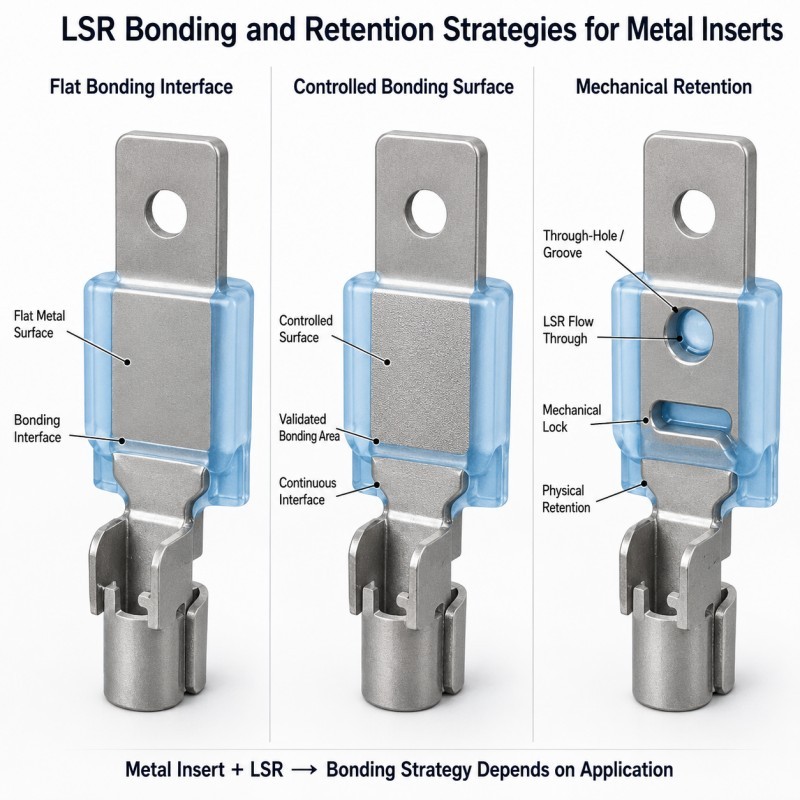
Depending on the exact silicone grade, metal surface and application, the project may use:
• A validated self-bonding LSR system
• Primer-assisted bonding
• A validated surface activation process
• Mechanical retention
• A combination of chemical and mechanical retention
The correct strategy should be confirmed using the actual production metal surface rather than only a generic material name.
For example, changing from one plating system to another may change the surface that the LSR contacts even if the base metal remains unchanged.
Similarly, changing a metal supplier may introduce different processing oils, surface roughness or storage conditions.
Material changes should therefore be included in the change-control and revalidation plan.
For a broader substrate review, see how material compatibility affects silicone overmolding.
When Should Mechanical Retention Be Added?
Chemical bonding and mechanical retention solve different parts of the joint-design problem.
Chemical bonding acts at the silicone-to-metal interface.
Mechanical retention allows the cured silicone to physically lock through or around the metal geometry.
Typical structures include:
• Through-holes
• Slots
• Grooves
• Undercuts
• Edge wraparound
• Retention windows
Mechanical retention becomes particularly useful when:
• Peel loading is expected
• Pulling or torsion occurs
• The component experiences vibration
• Thermal cycling stresses the interface
• Waterproof failure would be critical
• Surface-bonding consistency is uncertain
The retention geometry still needs to be manufacturable.
Very small holes, deep blind grooves or sharp metal edges may introduce short shots, trapped air or silicone tearing.
For detailed structure design, review when LSR overmolding needs mechanical retention.
Metal Insert Preparation DFM Checklist
| DFM Item | What Engineers Should Confirm | Main Risk |
| Metal grade | Exact substrate material is defined | Bonding strategy based on wrong material |
| Plating | Type and surface condition are controlled | Lot-to-lot interface variation |
| Oil contamination | Processing residue is controlled | Weak or unstable bonding |
Oxidation | Storage and surface condition are defined | Surface changes before molding |
Functional metal area | No-silicone zones are clearly marked | Electrical or assembly interference |
Burrs and edges | Sharp areas are reviewed | Silicone cutting or tearing |
Bonding method | Surface bonding strategy is validated | Sample adhesion cannot be repeated |
Mechanical retention | Load direction and lock geometry are reviewed | Peel or pull separation |
Insert tolerance | Flatness and dimensions fit the mold strategy | Flash or coverage variation |
Validation | Bonding and environmental tests are defined | Sample passes but production fails |
The silicone mold design and tooling review should confirm metal positioning, protected functional areas, bonding boundaries, mechanical retention, gate location, shut-off and demolding direction before mold steel is finalized.
How Should Metal Insert Preparation Be Validated?
Metal insert preparation should be validated together with the molded component rather than judged only by the appearance of the bare metal.
Recommended validation includes:
1. Incoming Surface Inspection
Check the insert for visible oil, oxidation, plating damage, contamination, burrs and dimensional problems.
2. Bonding Boundary Inspection
After molding, inspect the silicone-to-metal edge for lifting, incomplete coverage and contamination-related defects.
3. Pull or Peel Testing
Where the geometry permits, test the interface in the load direction expected during actual use.
4. Cross-Section Inspection
Section selected samples through critical bonding and mechanical-retention areas to confirm complete silicone filling.
5. Functional Area Inspection
Confirm that silicone has not entered electrical contacts, threads, assembly faces or other protected metal areas.
6. Thermal and Environmental Validation
Where required by the application, repeat bonding and functional inspection after thermal cycling, humidity, fluid exposure or mechanical loading.
7. Multi-Lot Validation
Use more than one incoming metal lot when surface or plating variation may influence the result.
A bonding process should not be approved only because one carefully prepared sample performs well.
How SiliconePlus Supports Silicone Over Metal Projects
SiliconePlus supports custom silicone-over-metal projects from metal insert and bonding review through tooling, sampling, inspection and mass production.
Project support can include:
• Metal insert DFM review
• Silicone coverage definition
• Surface-condition review
• Bonding-method evaluation
• Mechanical-retention design
• Insert-positioning and support review
• Gate, venting and shut-off analysis
• Precision mold manufacturing
• LSR injection molding
• Dimensional and interface inspection
• Functional and pilot-production validation
SiliconePlus has 25 years of silicone manufacturing experience, more than 6,000 developed silicone projects, in-house CNC and EDM mold-processing capability, liquid silicone injection equipment and precision measuring resources.
Specific surface preparation, bonding performance, dimensional tolerance and test requirements should be confirmed according to the actual metal insert, silicone grade and final application.
FAQ
Can LSR Bond Directly to Metal?
It may be possible with a validated material and surface combination, but the exact metal, plating, silicone grade and process should be confirmed during sampling.
Is Cleaning the Metal Enough to Guarantee Good Bonding?
No. Cleaning controls contamination, but bonding also depends on the actual silicone grade, metal surface, process and joint structure.
Can Oil on the Metal Cause Bonding Problems?
Oil or other surface residue can interfere with a consistent interface and should be controlled before bonding-critical overmolding.
Does Metal Plating Matter?
Yes. The silicone contacts the actual plated surface, so plating type and consistency should be included in the project review.
Should Electrical Terminals Be Completely Covered with Silicone?
Not when part of the terminal must remain electrically or mechanically functional. Exposed areas should be clearly defined as protected no-silicone zones.
Can Mechanical Retention Replace Surface Preparation?
Not completely. Mechanical retention provides physical anchoring, but contamination can still create voids, poor appearance or an unstable interface.
Conclusion
Reliable LSR overmolding on metal starts before the insert enters the mold.
Engineers should control:
• Metal grade
• Plating and surface finish
• Oil and contamination
• Oxidation
• Burrs and sharp edges
• Functional exposed areas
• Bonding method
• Mechanical retention
• Insert tolerance
• Validation testing
The key requirement is not simply to make the metal look clean.
The metal surface condition, bonding strategy, mold structure and final application should be treated as one manufacturing system.