How Should LSR Medical Sensor Probe Seals Be Designed for Repeated Cleaning?
- Share
- publisher
- SiliconePlus Engineering Team
- Issue Time
- Oct 12,2026
Summary
LSR overmolded medical probe seals must be designed for the device's specified cleaning process, not just initial waterproofing. This guide explains wipeable geometry, fluid-trapping gaps, silicone-to-plastic interfaces, exposed sensing areas, material compatibility and repeated-cleaning validation for custom medical sensor probe housings.
Answer Excerpt
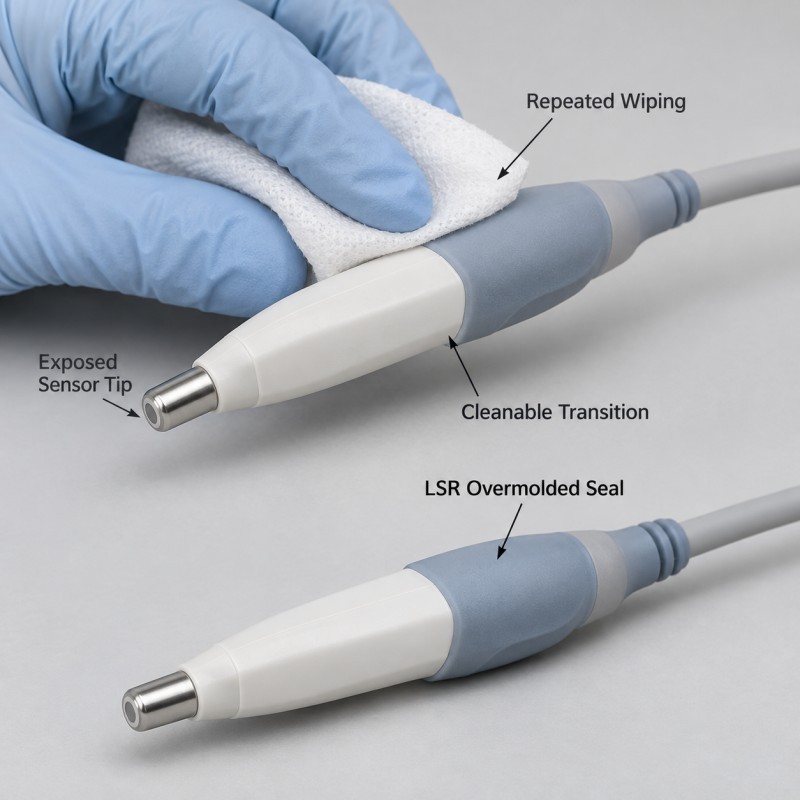
An LSR overmolded medical sensor probe seal should be designed around the device's actual cleaning instructions, exposed sensing areas, housing geometry and required service life.
For a probe that may undergo repeated wipe cleaning, a suitable design should minimize difficult-to-access gaps while maintaining a stable silicone-to-housing interface after the specified cleaning exposure.
Important engineering considerations include:
• Accessible and wipeable external surfaces
• Controlled silicone termination edges
• Minimal fluid-trapping gaps
• Protected housing joints
• Exposed and unobstructed sensor tips
• Compatible silicone and plastic materials
• Defined cleaning-agent exposure
• Repeated wiping and handling loads
• Dimensional and sealing stability
• Customer-defined cleaning and device validation
Cleaning, disinfection and sterilization are different processes. Not every medical probe requires all three, and no silicone material should be assumed compatible with every method.
The correct approach is to define the intended use and cleaning conditions first, then design and validate the complete probe housing and overmolded seal.
Why Does Repeated Cleaning Change the Design of a Medical Probe Seal?
A probe housing may pass initial dimensional and sealing inspection but still require further evaluation after repeated cleaning.
Cleaning can introduce several conditions that do not occur during ordinary dry handling.
Depending on the device and its instructions, the overmolded interface may experience:
• Repeated wiping friction
• Local pressure from cleaning cloths
• Exposure to detergents or disinfectants
• Wetting of housing joints
• Temporary liquid retention around edges
• Drying cycles
• Repeated gripping and rotation
• Temperature changes during cleaning
• Mechanical stress near the cable exit
The potential risks are different from those of a component that remains permanently enclosed inside equipment.
For example, a thin silicone termination edge at a frequently wiped location may experience repeated tangential loading.
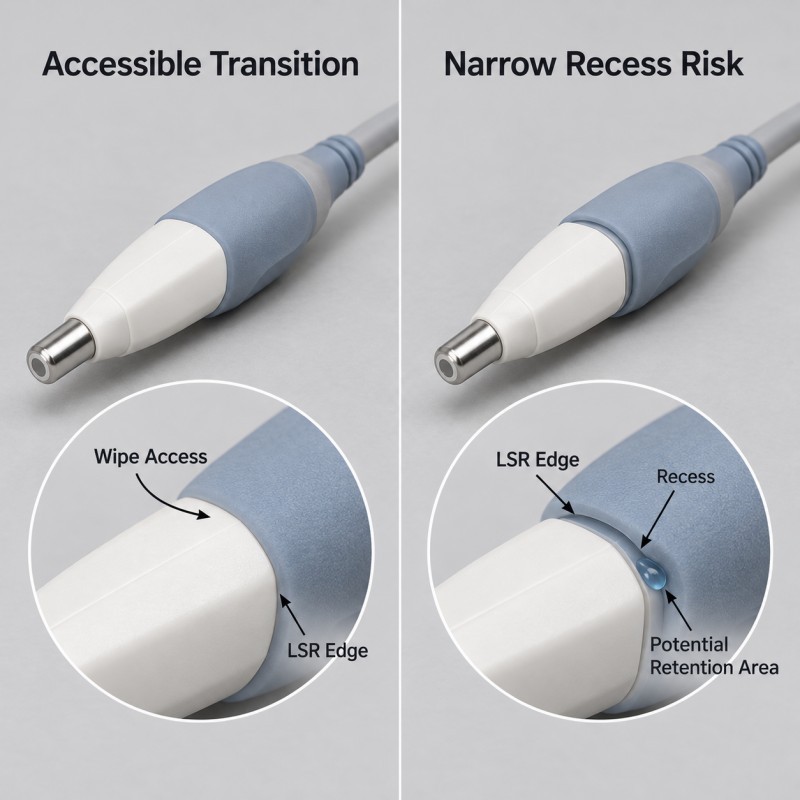
A narrow recess beside the plastic housing may also be difficult to access with the specified cleaning method.
The aim is not to eliminate every visible seam. The engineering team should define which interfaces are exposed, how they can be cleaned, and whether their geometry remains acceptable throughout the intended service life.
1.Identify Cleaning Exposure and Potential Fluid-Trapping Areas
The first step is to map the probe surfaces that are actually exposed during cleaning.
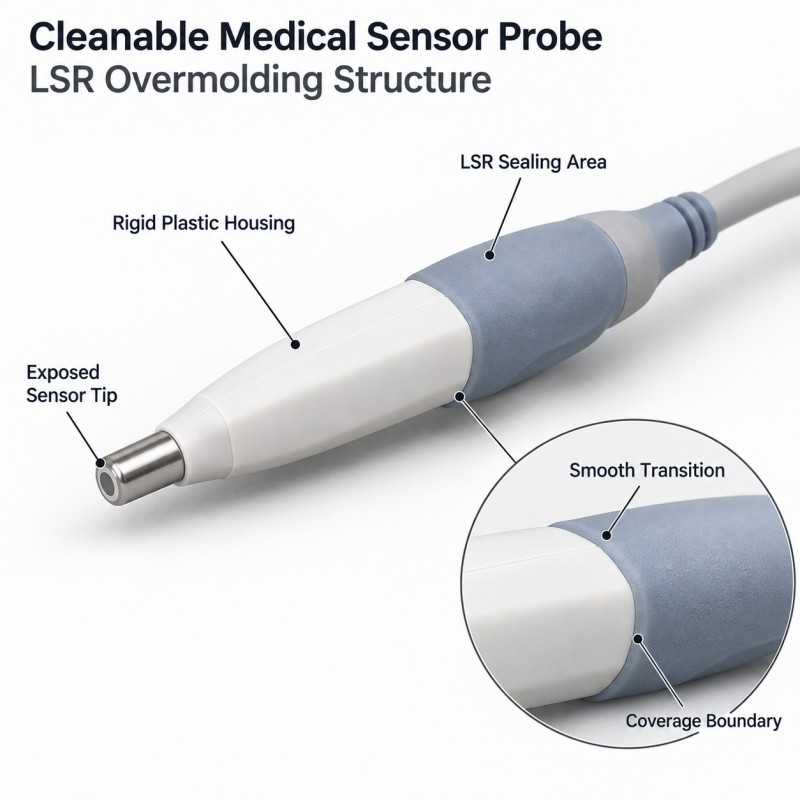
A medical probe may contain a rigid plastic housing, a molded silicone transition, an exposed sensing tip and a cable or connector interface.
A silicone over plastic design can integrate a flexible sealing or protective section directly onto the rigid housing.
However, integration alone does not guarantee that every external gap is cleanable or sealed.
Engineers should review:
• Housing-to-silicone transitions
• Steps between rigid and flexible materials
• Narrow circumferential recesses
• Cable-entry boundaries
• Exposed housing joints
• Sensor-window surroundings
• Areas shielded by protruding features
• Locations where cleaning liquid may remain
A useful design review asks:
Can the specified cleaning tool reach the surface?
Could liquid or debris remain in a narrow gap?
Does the gap lead toward a protected internal cavity?
Can the interface be inspected after cleaning?
The answers depend on the actual device geometry and cleaning procedure.
2.Preserve Exposed Sensor Tips and Detection Windows
A medical sensor probe may need direct access to a sensing surface, optical window, electrical contact or other functional region.
These areas must not be covered by silicone unless the sensor design specifically requires a defined intermediate material.
Typical exposed functional features may include:
• Temperature-sensing tips
• Pressure-sensing interfaces
• Optical detection windows
• Electrical contact surfaces
• Calibration reference surfaces
• Fluid-access openings
• Customer-defined sensing regions
The overmolded silicone should stop at a clearly dimensioned boundary.
This boundary must account for both molding accuracy and the final cleaning process.
For example, a raised silicone edge near an optical window may complicate wiping or create a narrow recess where liquid remains.
The design should consider whether the sensing region can be cleaned according to the device's instructions without applying excessive force to the silicone edge.
The mold shut-off must also prevent silicone flash from entering a critical functional area.
A clean-looking part is not sufficient if the actual sensing or calibration function is affected.
3.Design Smooth, Accessible Silicone-to-Housing Transitions
The boundary between a rigid plastic probe housing and flexible silicone deserves particular attention.
A sudden height change, poorly supported edge or narrow recessed seam can make cleaning and inspection more difficult.
Depending on the product geometry, suitable design considerations may include:
• Rounded external transitions
• Controlled silicone edge height
• Accessible perimeter boundaries
• Avoidance of unnecessary narrow recesses
• Consistent surface finish
• Adequate support beneath flexible edges
• Defined parting-line locations
• Protection of exposed functional surfaces
A flush-looking silicone transition is not automatically a sealed transition.
Its mechanical retention, adhesion, underlying interface and possible liquid path still require evaluation.
Likewise, a small external step is not automatically unacceptable if it is accessible and compatible with the validated cleaning method.
The correct geometry should balance cleanability, molding feasibility, seal function and inspection requirements.
Engineers should assess the complete transition rather than judging surface appearance alone.
4.Evaluate the Actual Cleaning Agent Against Every Exposed Material
A medical probe assembly may include more than one material.
The external interface can contain:
• Liquid silicone rubber
• Engineering plastic
• Metal sensing components
• Surface coatings
• Adhesive or primer systems
• Cable jacket materials
• Sealing or potting materials elsewhere in the assembly
Chemical compatibility must be assessed for the actual material grades and cleaning formulation.
The project should define:
• Cleaning-agent identity
• Concentration
• Application method
• Contact duration
• Wiping frequency
• Drying conditions
• Expected total number of cleaning cycles
• Any additional thermal or humidity exposure
Potential changes to monitor include:
• Silicone swelling or dimensional change
• Hardness change
• Surface tackiness
• Discoloration
• Plastic stress cracking
• Interface lifting
• Reduced adhesion
• Changes in sealing performance
A silicone compound that appears unchanged after a short exposure may still require additional testing under repeated-use conditions.
Compatibility should not be inferred from a generic claim that silicone is chemically resistant.
5.Protect the LSR Edge Against Repeated Wiping Forces
Repeated wiping can introduce shear and peel loads at the silicone termination.
The exact loading depends on wipe direction, contact pressure, surface shape and operator handling.
A thin unsupported edge may be more vulnerable to lifting or tearing when wiping force repeatedly acts across the transition.
Design review should consider:
• Silicone edge thickness
• Transition radius
• Direction of wiping
• Housing support underneath the silicone
• Bonding or retention method
• Repeated mechanical handling
• Local bending of the probe
• Inspection after cleaning
Silicone-to-plastic adhesion should be evaluated using the actual material combination and production process.
Where mechanical retention is required, its geometry should be reviewed for both manufacturing feasibility and cleanability.
Adding a deep external retention groove may improve mechanical holding in one direction but create an unnecessary hard-to-clean surface recess.
The objective is to maintain the required interface integrity without introducing new cleaning or assembly problems.
6.Pay Special Attention to the Cable Exit and Grip Area
Cable-connected probes may experience repeated handling during use and cleaning.
The operator may hold the rigid housing, wipe near the cable exit, rotate the probe or move the cable while cleaning the surrounding surface.
This introduces combined mechanical and environmental loading.
Possible risks include:
• Cable bending near the housing
• Local tensile force
• Seal movement at the exit
• Edge peeling
• Liquid accumulation around the transition
• Cleaning damage to a thin silicone section
• Local stress on the cable jacket
The cable exit should be designed according to the expected movement and cleaning access.
A flexible overmolded section may provide strain relief where appropriate, but strain relief and liquid sealing are not identical functions.
Each should have its own acceptance requirements.
The design should also preserve the required cable jacket, connector and internal electrical structure.
A local silicone transition should not be treated as evidence that the complete probe cable assembly is waterproof.
7.Cleaning, Disinfection and Sterilization Require Different Validation
The manufacturing process and the device reprocessing method address different requirements.
LSR injection molding can create a repeatable silicone sealing structure on the selected plastic housing, but the molding process does not establish that the finished medical device is suitable for a specific cleaning, disinfection or sterilization procedure.
Cleaning is intended to remove contamination or residue according to a defined method.
Disinfection and sterilization have different purposes and may require additional validated procedures depending on the intended device use.
The project team should identify which processes actually apply.
For example, routine external wiping with a specified disinfectant is not equivalent to steam sterilization.
Nor should compatibility with one disinfectant be taken as proof of compatibility with every disinfectant.
The device manufacturer should establish the required instructions and validate them for the finished device, including the relevant materials, geometry, functional interfaces and intended use.
SiliconePlus can manufacture the custom overmolded seal according to the agreed drawing, material and inspection requirements. Final device reprocessing validation remains the responsibility of the appropriate medical device manufacturer.
8.Validate Sealing and Material Integrity After Repeated Cleaning
An initial sealing test cannot demonstrate how the interface will behave after repeated cleaning exposure.
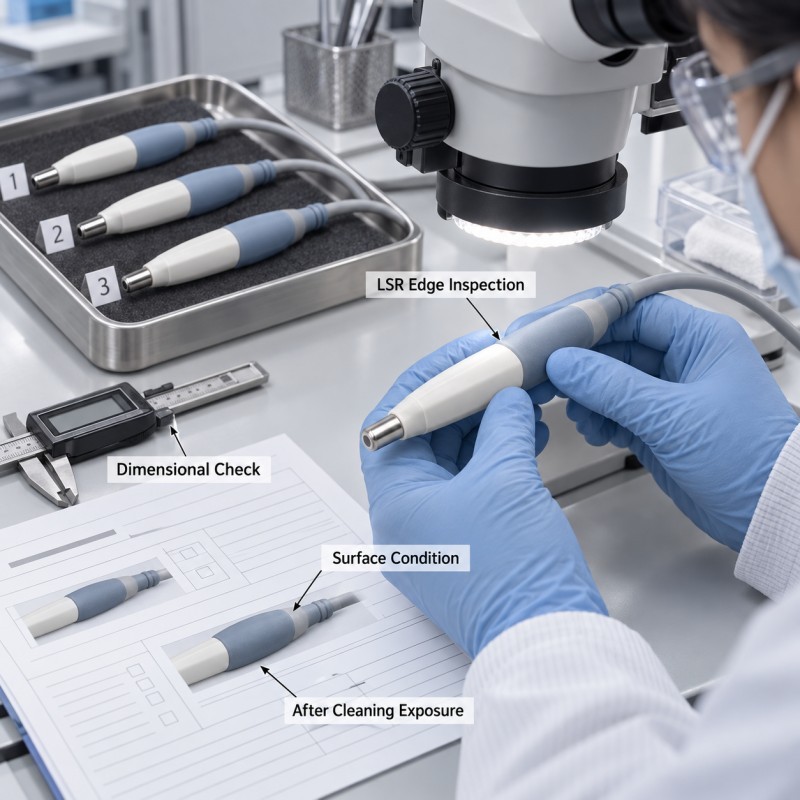
A suitable engineering validation plan may include tests before and after the specified cleaning cycles.
Before exposure, record:
• Silicone material and batch
• Plastic housing grade
• Critical dimensions
• Surface condition
• Bonding or retention condition
• Sensing-tip clearance
• Initial assembly fit
• Initial sealing performance, where required
During exposure, follow the defined cleaning method using representative devices or assemblies.
Record the cleaning agent, concentration, application procedure, duration, cycle count and drying conditions.
After exposure, inspect for:
• Silicone edge lifting
• Swelling or shrinkage
• Cracks or tears
• Surface changes
• Loss of sealing contact
• Changes in assembly dimensions
• Trapped residue or liquid
• Damage near the sensing region
• Changes in the functional performance of the completed probe
Where appropriate, testing may also include adhesion, leak testing, environmental cycling and device-specific performance evaluation.
The finished medical device should meet its own acceptance criteria after the required sequence of exposures.
Test quantities, limits and methods should be specified by the customer rather than invented from a general LSR material property.
| Design / Validation Item | Main Risk | Engineering Control | Verification |
External silicone edge | Lifting during repeated wiping | Supported, controlled termination | Post-wipe edge inspection |
Housing seam | Residue or liquid retained in a gap | Accessible transition geometry | Cleaning access assessment |
Sensor tip | Silicone or residue interferes with sensing | Defined exposed functional zone | Functional inspection |
Cleaning chemistry | Material degradation | Grade-specific compatibility review | Material exposure testing |
Plastic substrate | Stress cracking or distortion | Suitable housing grade | Dimensional and visual checks |
Silicone adhesion | Separation after repeated use | Validated bonding or retention | Interface testing |
| Cable exit | Bending, peeling or liquid entry | Defined strain relief and sealing design | Mechanical and leak testing |
| Cleaning sequence | Inconsistent validation | Controlled procedure and cycle count | Documented test protocol |
| Finished device | Seal passes but device function fails | Complete assembly verification | Customer device testing |
When Is Medical Silicone Overmolding Suitable for Probe Housings?
Medical silicone overmolding may be evaluated when a probe requires a defined flexible sealing or cushioning area around a rigid housing.
Potential applications include:
• Diagnostic probe housings
• Medical monitoring sensors
• Handheld measurement devices
• Cable-connected probe assemblies
• Laboratory detection equipment
• Healthcare electronics interfaces
Compared with a separate loose gasket, an integrated silicone structure may help maintain a repeatable position during handling and assembly.
However, integrated overmolding is not automatically preferable for every device.
The choice should consider cleaning access, material compatibility, sensing function, service requirements, assembly method and tooling feasibility.
Where the device must be disassembled for its validated cleaning procedure, that requirement should influence the housing and sealing concept before tooling.
How SiliconePlus Supports Custom Medical Probe Housing Seals
SiliconePlus manufactures custom LSR overmolded medical sensor probe housing seal components according to customer drawings, material requirements and production specifications.
The manufacturing scope focuses on the silicone sealing and protective structure, not on supplying a complete medical sensor or finished diagnostic device.
Project review can include:
• Plastic probe housing geometry
• Silicone coverage and exposed sensing areas
• Wipeable external transitions
• Material and cleaning-condition discussion
• Silicone-to-plastic interface design
• Insert positioning
• Mold shut-off feasibility
• Cable exit protection
• Critical dimensions
• Visual and functional inspection requirements
• Sampling and pilot-production review
For applications with repeated cleaning, customers should provide the actual cleaning or disinfection procedure so the relevant material and geometry requirements can be discussed before tooling.
Final cleaning validation, regulatory requirements and medical device performance must be confirmed for the customer's completed device.
Frequently Asked Questions
Can an LSR Overmolded Medical Probe Seal Be Cleaned Repeatedly?
Potentially, depending on the silicone grade, plastic substrate, bonding or retention structure, cleaning method and expected number of cycles. Compatibility and final assembly performance must be validated for the actual device.
Does Medical-Grade LSR Automatically Resist Every Disinfectant?
No. Compatibility depends on the specific LSR formulation, chemical agent, concentration, contact time, temperature and exposure frequency. The actual combination requires evaluation.
Can Silicone Overmolding Make a Probe Easier to Clean?
It may help reduce separate gasket-placement features and allow controlled transitions between rigid and flexible areas. However, cleanability depends on the complete housing geometry, including accessible surfaces, gaps and external interfaces.
Can the Sensor Tip Remain Exposed During LSR Overmolding?
Yes. The mold and silicone coverage boundary can be designed to keep the required sensing region exposed. The actual geometry, insert tolerance and functional clearance must be confirmed before tooling.
Is Repeated Wipe Cleaning Equivalent to Sterilization?
No. Cleaning, disinfection and sterilization are different processes. The device manufacturer must specify and validate the method appropriate to the intended medical application.
Conclusion
A reliable LSR medical sensor probe seal should be designed for more than initial appearance and sealing performance.
For devices exposed to repeated cleaning, engineers should consider:
• Cleaning access
• Housing transition geometry
• Fluid-trapping gaps
• Exposed sensing regions
• Silicone edge support
• Chemical compatibility
• Cable exit movement
• Cleaning-cycle validation
• Complete device functionality
The best design balances manufacturability, sealing requirements and the cleaning procedure defined for the actual device.
The correct material grade, test method and acceptance criteria should be agreed before tooling and validated using representative finished assemblies.
Developing a Medical Sensor Probe With Custom LSR Sealing?
If you are developing a medical sensor probe or diagnostic equipment component that requires localized LSR sealing, please share your 2D/3D drawings, plastic housing material, exposed sensing areas, silicone coverage requirements, cleaning conditions, validation criteria and estimated production quantity.
You can contact SiliconePlus to review silicone overmolding feasibility, material selection, tooling, sampling and production requirements.