How Should Insert Loading and Automation Be Designed for High-Volume LSR Overmolding?
- Share
- publisher
- SiliconePlus Engineering Team
- Issue Time
- Sep 14,2026
Summary
High-volume LSR overmolding requires more than a fast molding cycle. Plastic, metal, FPC or connector inserts must be loaded in the correct position without damaging functional areas or slowing production. This guide explains manual, fixture-assisted and automated insert-loading strategies, error-proofing, cycle-time planning and validation before mass production.
Answer Excerpt
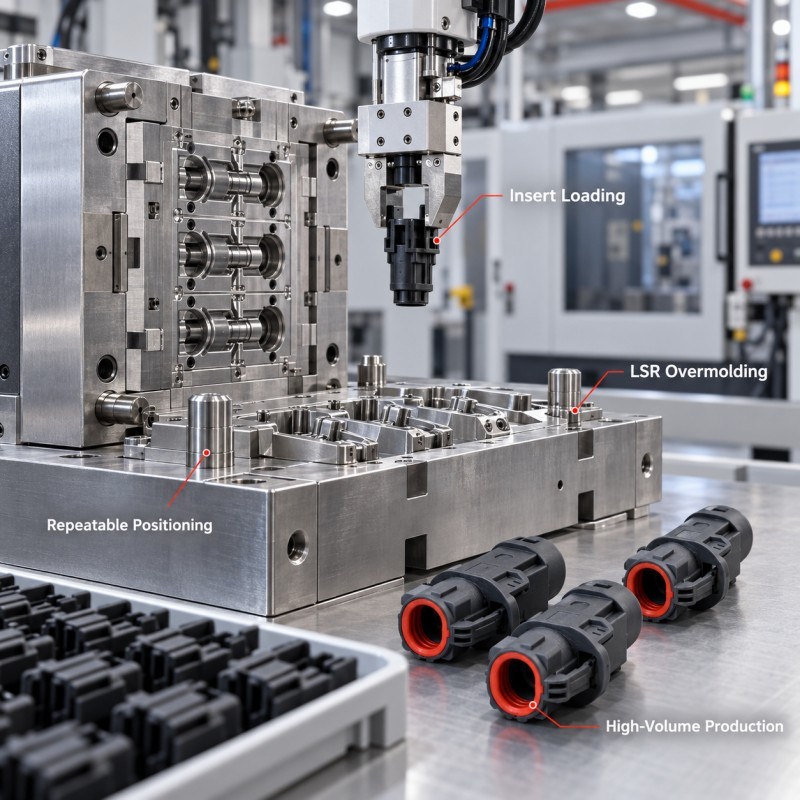
High-volume LSR overmolding depends on more than injection speed.
Every plastic, metal, FPC, connector or other insert must enter the mold in the correct orientation, reach the intended locating surfaces and remain stable during mold closing and silicone injection.
An insert-loading strategy should control:
• Orientation
• Position
• Seating depth
• Loading repeatability
• Functional-area protection
• Loading time
• Operator error
• Automation feasibility
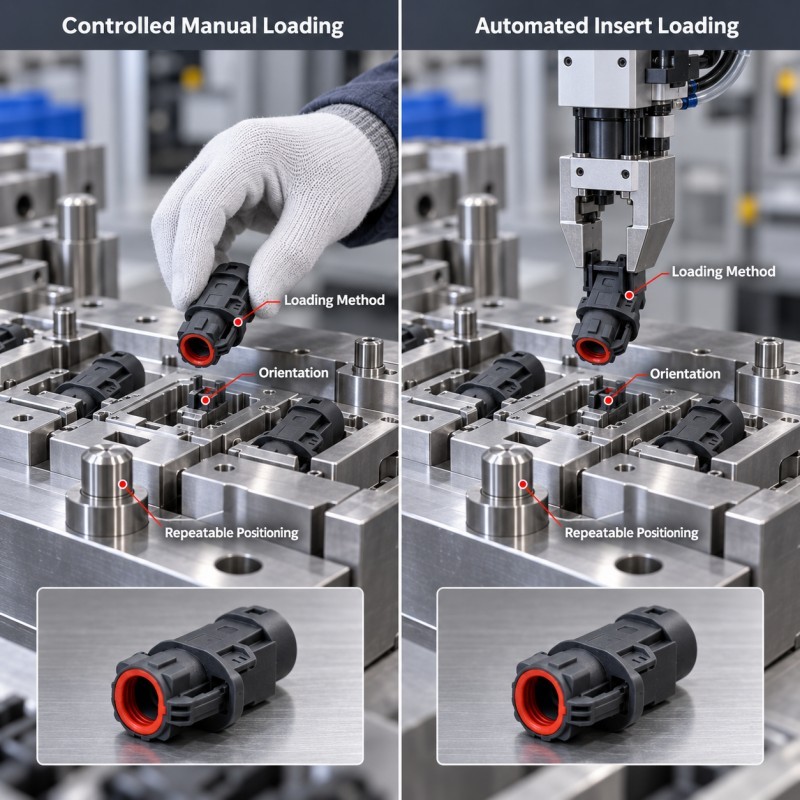
Manual loading may be practical for prototypes and lower volumes, while fixture-assisted or automated loading may become more suitable when production volume, cavity count and repeatability requirements increase.
The correct solution should be evaluated together with the LSR injection molding process, tooling concept and final production requirement.
Why Does Insert Loading Become More Critical at Higher Production Volumes?
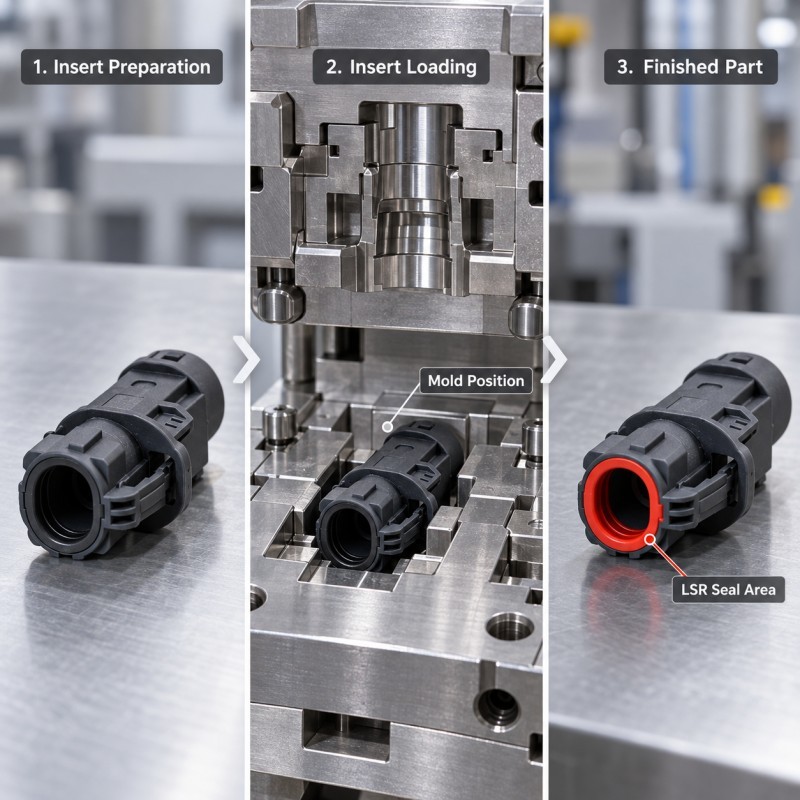
During early sampling, an engineer may carefully load each insert and visually confirm that it is seated correctly.
That method may produce acceptable samples but become difficult to repeat during continuous production.
Higher production volume introduces:
• More insert-loading cycles
• More operators or shifts
• Faster takt requirements
• Multiple mold cavities
• More incoming insert lots
• More opportunities for incorrect orientation
• Greater cumulative handling variation
A loading method should therefore make the correct condition easy to achieve and the incorrect condition difficult to create.
If operators must repeatedly rotate, align or visually judge a small insert before every molding cycle, the loading operation itself may become a source of quality variation.
Manual, Fixture-Assisted or Automated Loading: Which Method Fits the Project?
There is no single insert-loading method that is correct for every LSR overmolding project.
Manual loading may be suitable when:
• Production volume is relatively low
• Inserts are easy to handle
• Orientation is obvious
• Loading time does not control total output
• Product changes are frequent
Fixture-assisted loading may be useful when:
• Several inserts must be aligned together
• Operators need a stable pre-positioning method
• Small parts are difficult to handle directly
• Orientation mistakes must be reduced
• Multiple cavities are loaded at the same time
Automated loading may become attractive when:
• Production volume is high
• Insert geometry is consistent
• Cycle-time reduction has significant value
• Part orientation can be detected reliably
• Repetitive manual handling creates variation
• Multiple cavities require synchronized loading
Automation should solve a real production problem rather than being added only because the part is manufactured with LSR.
1. Design the Insert for Repeatable Orientation
An insert that can be loaded in several similar orientations increases the risk of operator or automation error.
Where the real product structure allows it, the design should provide clear orientation references such as:
• Asymmetric external geometry
• A defined flat surface
• A rigid shoulder
• A stable locating feature
• A clear top and bottom condition
• Repeatable datum surfaces
The locating method should reference rigid features rather than flexible silicone areas or unstable cosmetic surfaces.
Good insert positioning should control translation, height, angle and rotation without damaging the part.
2. Make Incorrect Loading Difficult
A reliable loading system should not depend only on operator attention.
The mold or loading fixture can be designed so that an insert that is reversed, tilted or incompletely seated cannot easily reach the normal loading position.
Possible error-proofing principles include:
• One-direction loading
• Asymmetric locating geometry
• Positive seating surfaces
• Mechanical presence checks
• Vision confirmation where appropriate
• Defined insertion depth
• Fixture nests that match the actual insert outline
The objective is not to create unnecessary tooling complexity.
The objective is to prevent an incorrect insert condition from reaching the molding cycle.
This is particularly important when incorrect loading could allow silicone to enter a connector opening, contact area or other functional no-silicone zone.
3. Loading Features Must Not Damage Functional Areas
Insert-loading equipment must hold the component without damaging the features that matter after molding.
For a plastic connector, the loading system should avoid scratching or deforming sealing datums and mating surfaces.
For a metal insert, clamping should not bend thin sections or damage critical surface areas.
For an FPC component, handling should avoid uncontrolled bending, exposed contact damage or pressure on sensitive regions.
For cable or wire-related structures, the loading method should maintain the required orientation without creating local stress.
The best gripping or locating point is therefore not simply the easiest surface to reach.
It should be a feature that can tolerate repeated handling while preserving final product function.
4. Insert Loading Time Must Be Evaluated Together With Mold Cycle Time
A faster molding cycle does not automatically create higher production output if the mold waits for inserts to be loaded.
The production team should separate the cycle into:
• Insert preparation
• Insert loading
• Mold closing
• LSR injection
• Curing
• Mold opening
• Part removal
• Inspection or transfer
For multi-cavity tooling, loading several inserts may become a significant part of the total cycle.
This is one reason why LSR injection molding cost cannot be evaluated only from silicone weight or machine time.
Labor, fixtures, automation, cavity count and insert-handling complexity may all affect the final manufacturing cost.
| Loading Method | Best Fit | Main Advantage | Main Risk |
Manual loading | Prototype / lower volume | Flexible and low initial complexity | Operator variation |
| Fixture-assisted loading | Medium volume / multi-insert parts | Better alignment and repeatability | Additional fixture handling |
| Semi-automated loading | Repetitive medium-high volume | Reduces manual positioning work | Process still depends on operator transfer |
| Automated loading | High-volume stable product | Higher repeatability and output potential | Higher equipment and validation complexity |
5. Automation Must Match Real Insert Variation
Automation is easier when every insert arrives in a repeatable condition.
The loading system may be affected by variation in:
• Plastic warpage
• Metal flatness
• Part dimensions
• Burrs
• FPC shape
• Cable position
• Surface contamination
• Orientation in incoming packaging
A robot or fixture cannot automatically correct an unstable upstream insert.
Before automation is finalized, the project should confirm which insert dimensions and surfaces control feeding, gripping, locating and final mold seating.
Incoming insert quality therefore becomes part of the automation strategy.
6. Gate Direction and Silicone Flow Must Not Displace the Loaded Insert
Correct loading is only the first step.
Once the mold closes, incoming silicone flow can still push, lift or rotate an insufficiently supported insert.
The tooling review should consider:
• Flow direction
• Gate position
• Insert support
• Local cavity pressure
• Vent location
• Final-fill area
Gate location should allow the required silicone region to fill without directing unnecessary force toward a weak insert feature.
How Should Insert Loading Be Validated Before Mass Production?
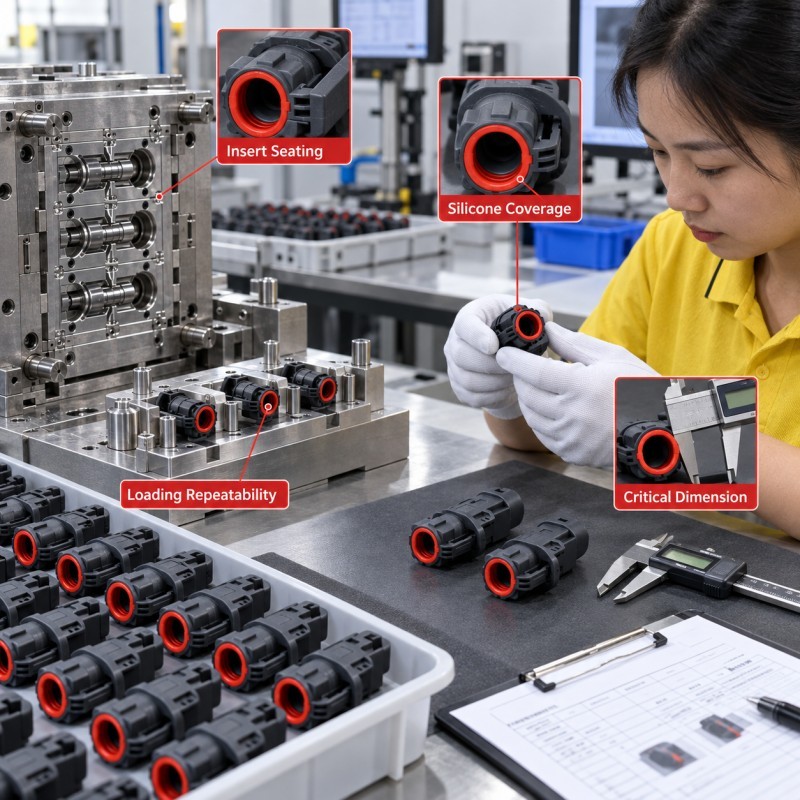
Insert-loading validation should use repeated production cycles rather than a few carefully prepared samples.
A practical validation plan can include:
Load inserts across consecutive molding cycles.
Use representative incoming insert lots.
Confirm every mold cavity where multi-cavity tooling is used.
Record incorrect-loading or seating events.
Check silicone coverage and critical exposed areas.
Measure critical dimensions related to insert position.
Confirm that loading tools do not damage the insert.
Compare loading time with the planned production cycle.
Recheck the system after tool cleaning or maintenance.
Confirm operator instructions or automation alarms before mass-production approval.
The goal is to prove that the loading method remains repeatable under realistic production conditions.
What Should Buyers Provide When Automation Is Part of the Project?
When automation or high-volume insert handling may influence the project, the RFQ should provide more than the finished product drawing.
Useful information includes:
• 3D CAD
• 2D drawing
• Insert material
• Insert drawing and tolerance
• Silicone coverage area
• Protected functional areas
• Expected annual or monthly volume
• Target production quantity
• Packaging condition of incoming inserts
• Inspection requirements
• Automation preference, if already defined
A complete LSR overmolding RFQ helps the engineering team evaluate tooling, insert loading and production strategy before quotation is finalized.
How SiliconePlus Supports High-Volume LSR Overmolding Projects
SiliconePlus supports custom LSR overmolding projects from early engineering review through tooling, sampling and mass production.
Project review can include:
• Insert orientation and loading evaluation
• Mold locating and support review
• Silicone coverage analysis
• Functional no-silicone-zone review
• Gate and venting discussion
• Fixture and automation feasibility review
• Cavity and cycle-time planning
• Pilot-production validation
• Dimensional and functional inspection
The appropriate loading strategy should match the real product geometry, production quantity, insert consistency and quality requirements.
A more automated process is not automatically a better process.
The best manufacturing system is the one that produces the required part repeatedly with controlled quality and practical production efficiency.
FAQ
Does Every High-Volume LSR Overmolding Project Need Automated Insert Loading?
No. Automation should be evaluated according to production volume, insert complexity, cavity count, loading time, quality risk and required repeatability. Some projects remain more practical with controlled manual or fixture-assisted loading.
Can Insert Loading Affect Silicone Flash and Coverage?
Yes. An insert that is tilted, reversed or not fully seated can change mold shut-off conditions, silicone thickness and coverage boundaries, which may increase flash or allow silicone into protected areas.
Can FPC Inserts Be Loaded Automatically?
Automation may be possible, but the handling concept must protect flexible circuitry, exposed contact areas and bending-sensitive regions. Feasibility depends on the real FPC structure and required positioning accuracy.
Should Automation Be Decided Before Tooling?
Ideally, the expected loading method should be discussed before tooling because insert orientation, mold access, cavity spacing, locating features and cycle-time planning may affect the mold concept.
Conclusion
High-volume LSR overmolding requires the insert-loading process to be designed as part of the manufacturing system, not treated as a separate manual step after the mold is finished.
Repeatable orientation, stable locating, error-proofing, functional-area protection, cycle-time planning and incoming insert consistency all influence production quality.
Manual, fixture-assisted and automated loading can all be valid solutions.
The correct choice depends on the actual part structure, production volume and required process stability.
These requirements should be reviewed before tooling so the mold and loading method are developed around the same production strategy.
Planning a High-Volume LSR Overmolding Project?
If you are developing a high-volume LSR overmolding project, send your 3D drawing, insert material, silicone coverage requirements, production volume and critical inspection requirements to our engineering team.
You can contact SiliconePlus to review insert loading, tooling, production strategy and mass-production risks before mold development.