How Do You Design Waterproof Silicone Seals for Overmolded Parts?
- Share
- publisher
- siliconeplus
- Issue Time
- Jun 15,2026
Summary
Learn how to design waterproof silicone seals for overmolded parts, including sealing lips, compression ratio, groove design, silicone hardness, material selection, DFM review, LSR injection molding, insert bonding, flash control, and IP67/IP68 waterproof validation for custom OEM/ODM silicone projects.
Introduction
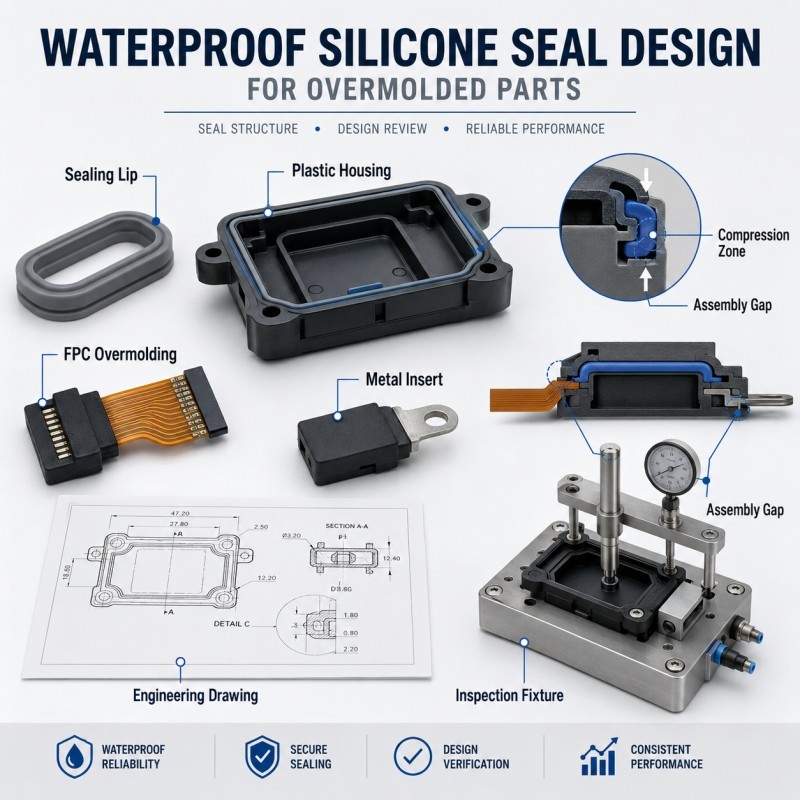
Waterproof silicone seals may look simple, but a reliable sealing structure depends on much more than choosing a soft material. Engineers need to consider compression ratio, sealing lip geometry, groove design, material hardness, tolerance stack-up, parting line position, insert bonding, and final assembly conditions. This guide explains how to design waterproof silicone seals for custom overmolded parts before tooling and mass production.
Answer Excerpt
To design waterproof silicone seals for overmolded parts, engineers should review the full assembly structure, sealing path, silicone hardness, groove size, compression ratio, parting line, tolerance stack-up, substrate material, bonding method, flash control, and waterproof test conditions. A reliable design must match the real product environment, not only the silicone part drawing.
Transition Paragraph
Below are the key questions engineers, product developers, sourcing managers, and OEM/ODM buyers usually ask when developing waterproof silicone overmolded parts.
People Also Ask: What makes a waterproof silicone seal reliable?
A waterproof silicone seal is reliable when it creates a continuous and controlled barrier between the product interior and the external environment. The seal must compress properly, recover after assembly, stay in the correct position, resist aging, and maintain contact with the mating surface during real use.
A waterproof seal does not work only because the material is silicone. Silicone provides flexibility, elasticity, and compression recovery, but the final sealing result depends on the structure. If the groove is too shallow, the silicone may be over-compressed. If the groove is too deep, the seal may not compress enough. If the sealing lip is too thin, it may tear. If the parting line is placed on the sealing surface, leakage risk may increase.
For overmolded parts, the bonding between silicone and substrate also matters. If silicone separates from plastic, metal, FPC, or another silicone substrate, water can travel through the lifted edge. This is why waterproof sealing design must include both compression sealing and bonding reliability.
A strong waterproof silicone design should answer three basic questions:
Where can water enter?
Where should silicone compress?
How will the seal remain stable after assembly and long-term use?
Before designing the seal structure, silicone material selection should be reviewed together with hardness, compression recovery, temperature resistance, bonding requirement, and application environment.
People Also Ask: Why should seal design start from the full assembly?
Seal design should start from the full assembly because a silicone seal cannot be judged alone. The groove, housing, cover, screws, clips, connector, FPC, metal insert, plastic frame, mating surface, and assembly force all affect waterproof performance.
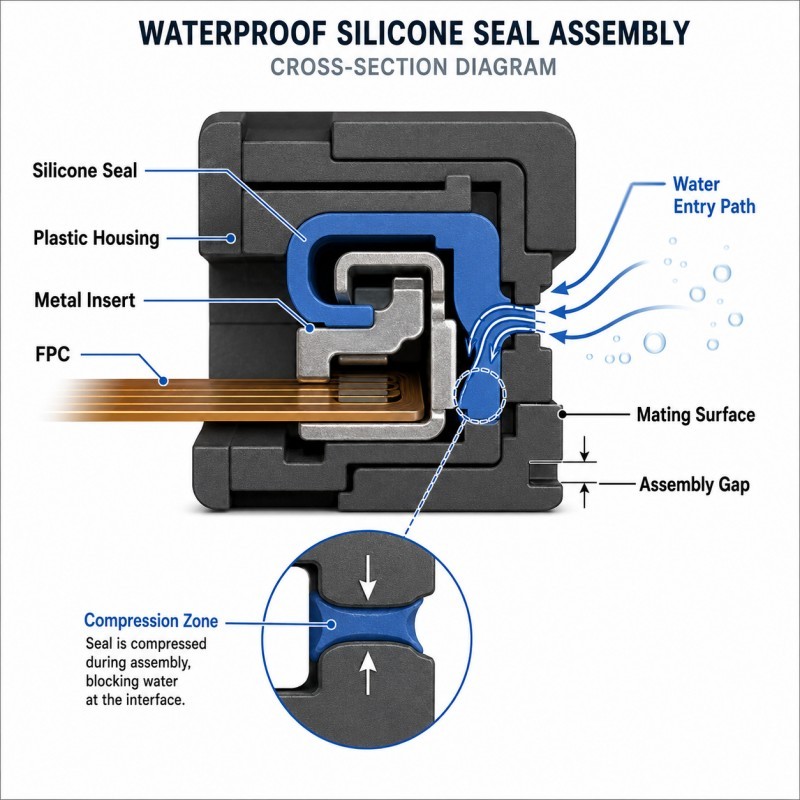
A common mistake is designing the silicone gasket first and checking the assembly later. This can lead to poor compression, unstable sealing, difficult assembly, or unexpected leakage paths. In a real product, the silicone seal works together with the surrounding structure.
For electronic products, water may enter through Type-C ports, SIM trays, buttons, speakers, microphones, cable exits, housing seams, or sensor openings. For automotive connectors, water may enter through terminal areas, wire exits, connector housing gaps, locking structures, or seal interfaces. For medical devices, leakage risk may appear around fluid paths, device housings, tubing interfaces, handles, and sensor modules.
The seal design should define the sealing path first. After that, engineers can decide where the silicone should sit, how much it should compress, which surface it should contact, and how the part should be assembled.
This assembly-first approach helps reduce mold changes because the sealing logic is confirmed before tooling starts.
People Also Ask: How do compression ratio and groove design affect waterproof sealing?
Compression ratio and groove design are two of the most important factors in waterproof silicone seal performance. The silicone must be compressed enough to block water, but not so much that it deforms, tears, loses recovery, or creates excessive assembly force.
If the seal is under-compressed, it may not fully contact the mating surface. Water can pass through small gaps. If the seal is over-compressed, the material may be damaged or lose long-term elasticity. Over-compression can also make assembly difficult, especially for small electronic parts, thin plastic housings, or precision connectors.
Groove design controls the position and deformation of the seal. A good groove supports the silicone seal, limits movement, and allows controlled compression. A poor groove may let the seal twist, move, fold, or squeeze out during assembly.
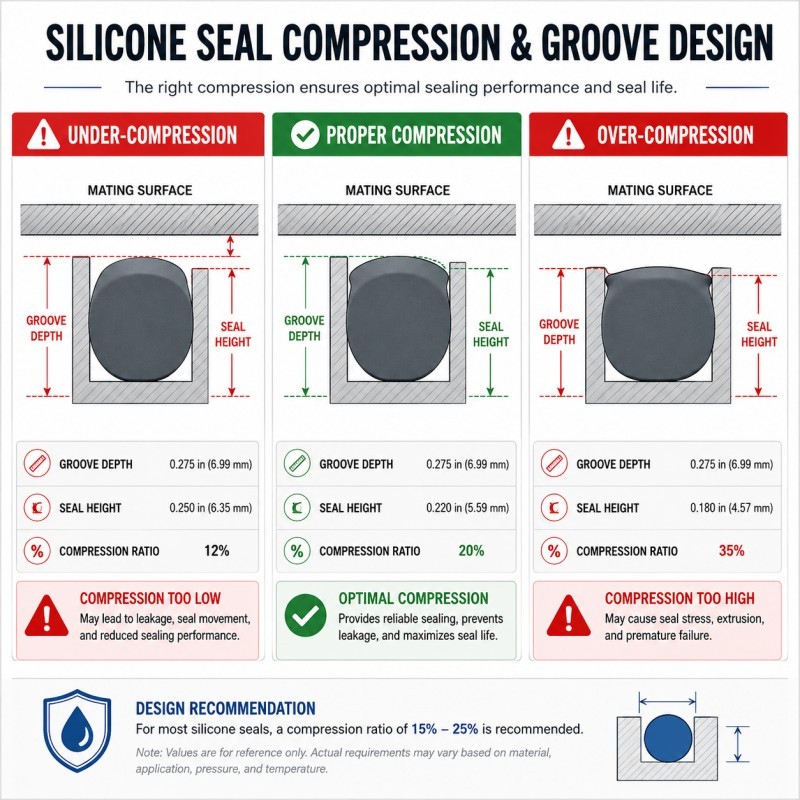
For waterproof overmolded parts, groove design may be part of the plastic housing, metal insert, FPC module, or molded silicone structure. Engineers should check the tolerance of both the silicone and the mating part. Even if the silicone part is accurate, the final assembly may fail if the mating plastic or metal part has unstable tolerance.
A practical seal design should consider:
Seal height
Groove depth
Groove width
Compression ratio
Mating surface flatness
Assembly force
Material hardness
Tolerance stack-up
Long-term compression set
Waterproof test condition
People Also Ask: How should silicone hardness be selected for waterproof seals?
Silicone hardness should be selected according to the sealing structure, compression requirement, assembly force, touch feel, deformation risk, and application environment. A softer silicone is easier to compress, while a harder silicone may offer better support and dimensional stability.
Soft silicone can help fill small gaps and reduce assembly force. It is often useful for delicate electronics, wearable devices, medical components, soft-touch structures, or low-force assemblies. However, if the material is too soft, it may deform, tear, or shift during assembly.
Harder silicone may be useful for structural seals, larger gaskets, automotive connectors, industrial components, or parts that need better support. However, if the material is too hard, it may not compress enough to seal properly.
Material selection should not be made by hardness alone. Engineers should also consider tear strength, compression set, temperature resistance, aging resistance, chemical exposure, bonding performance, color, transparency, and regulatory requirements.
For overmolded parts, hardness also affects bonding and flow behavior. A material that seals well may still fail if it cannot bond well to the substrate or fill the mold correctly.
For small waterproof seals with complex geometry, liquid silicone injection molding can support thin sealing lips, stable dimensions, fine details, and repeatable production when tooling and process control are properly managed.
People Also Ask: When should waterproof sealing use silicone overmolding instead of a separate gasket?
Silicone overmolding should be considered when a separate gasket is difficult to position, easy to lose, unstable during assembly, or unable to seal a complex interface. It is also useful when silicone needs to bond directly with plastic, metal, FPC, or silicone substrate to form an integrated waterproof structure.
Separate gaskets are useful in many applications. They can be simple, replaceable, and cost-effective. However, they may shift during assembly, require extra positioning features, or create more manual assembly steps.
Silicone overmolding can reduce these risks by molding the seal directly onto the substrate. This can improve positioning accuracy, reduce assembly steps, and create a more integrated sealing structure. It is especially useful for compact electronics, automotive connectors, medical device modules, wearable sensors, and waterproof interface parts.
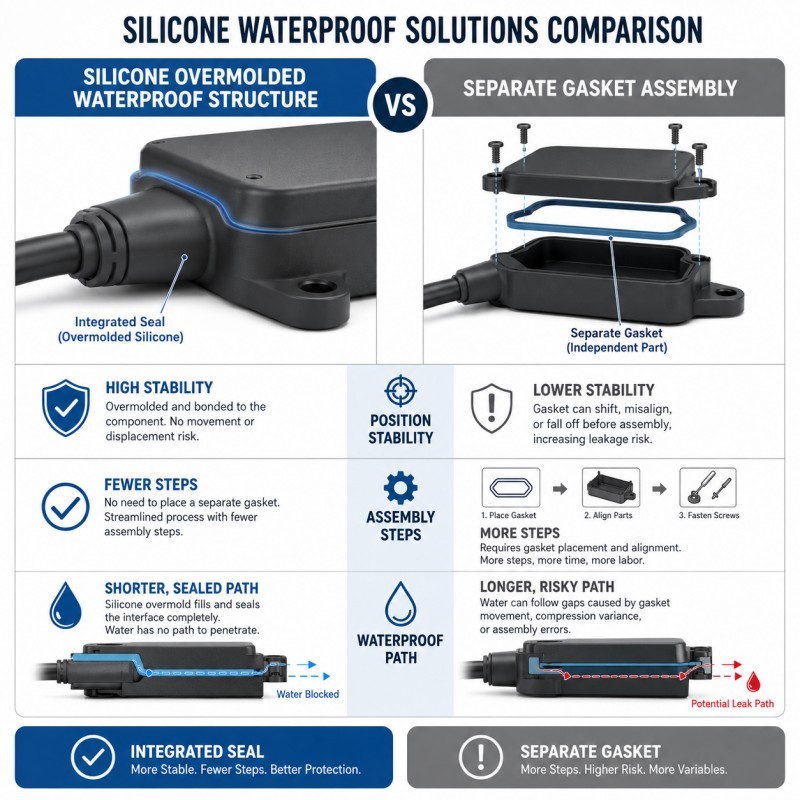
For connector housings, electronic enclosures, buttons, handles, and waterproof modules, plastic with silicone overmolding can integrate sealing, soft-touch, dustproofing, and assembly functions into one component.
Overmolding is not always the best choice. If the sealing structure is simple and easy to assemble, a separate gasket may be more economical. If the seal requires high bonding strength, accurate positioning, or compact assembly, overmolding may be a better option.
A professional silicone manufacturer should help buyers compare the two methods before tooling.
People Also Ask: How do parting line and flash affect waterproof sealing?
Parting line and flash control are critical for waterproof silicone seals. If the mold parting line is located on a functional sealing surface, even a small flash or mismatch may become a leakage path. Because liquid silicone rubber flows easily before curing, flash control must be considered during mold design.
For simple silicone parts, flash may only affect appearance or trimming cost. For waterproof seals, flash can affect sealing function. Flash on a sealing lip, compression surface, groove contact area, button movement area, connector interface, or FPC pad area may cause assembly failure.
Mold design should place the parting line away from critical sealing surfaces whenever possible. Venting should be designed carefully so trapped air can escape without creating uncontrolled flash. Shut-off areas should be precise, especially around inserts, edges, holes, and thin sealing ribs.
Insert tolerance also affects flash. If a plastic insert, metal insert, or FPC is not consistent, the gap between the insert and mold may change. This can allow silicone to flow into unwanted areas.
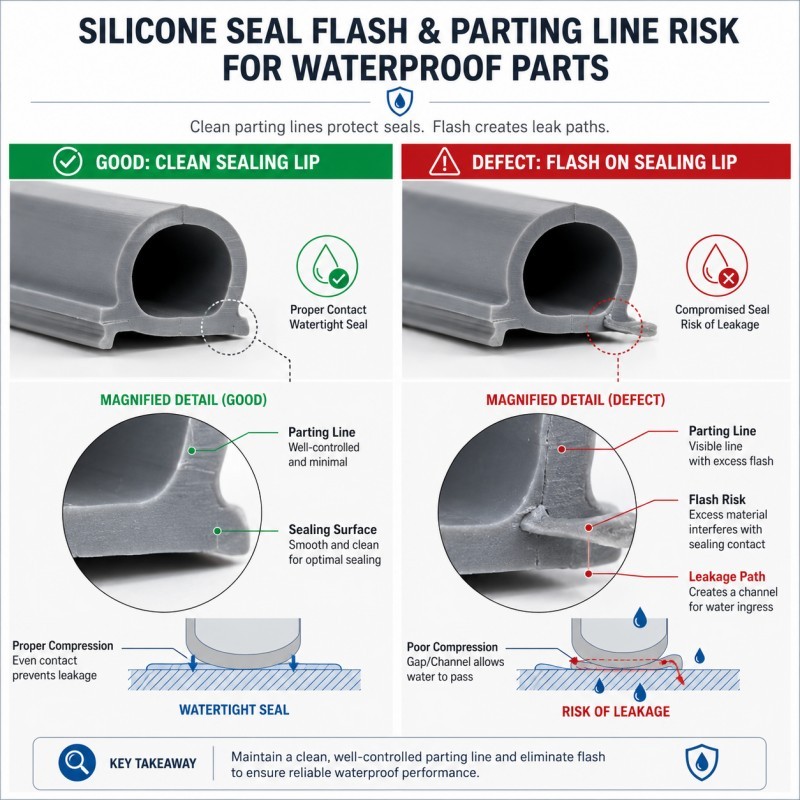
For high-reliability waterproof seals, flash acceptance standards should be defined before production. The buyer and supplier should agree on which areas are cosmetic, which areas are functional, and which areas cannot accept flash.
People Also Ask: How should waterproof silicone seal designs be tested?
Waterproof silicone seal designs should be tested under conditions that reflect the real product application. Testing may include assembly fit, compression test, water immersion, pressure test, IP67/IP68 validation, aging test, vibration test, bending test, or repeated assembly test.
A simple water dip test may not be enough for automotive, medical, outdoor electronics, or wearable device applications. The test method should define water depth, time, pressure, temperature, sample quantity, assembly condition, and pass/fail criteria.
For overmolded waterproof parts, testing should check both the silicone seal and the substrate bonding. A seal may pass water immersion at first but fail after bending, aging, vibration, or repeated assembly if bonding is weak.
The test should also consider the final assembly. A silicone component may work well in a test fixture but fail in the customer’s product if the mating surface, screw force, tolerance, or assembly method is different.
For waterproof electronic modules, FPC with silicone overmolding requires accurate positioning, protected contact areas, controlled silicone flow, and validation of both sealing and electrical function.
Testing should start at the sample stage and continue through pilot production when needed. A single good sample is not enough for high-volume waterproof products.
People Also Ask: What should buyers confirm before opening a waterproof silicone seal mold?
Before opening a waterproof silicone seal mold, buyers should confirm the full assembly structure, material hardness, sealing path, groove design, compression ratio, tolerance, substrate material, bonding requirement, waterproof test method, appearance standard, and production quantity.
| Project Item | What Buyers Should Confirm | Why It Matters |
|---|---|---|
| Application | Medical, automotive, 3C electronics, wearable, industrial, or beauty device | Different industries have different sealing and testing requirements |
| Sealing Path | Where water may enter and where silicone should compress | Determines the real waterproof structure |
| Silicone Hardness | Soft, medium, or hard silicone according to compression and assembly force | Affects sealing performance, deformation, and assembly feel |
| Groove Design | Groove depth, width, mating surface, and compression space | Controls seal position and compression stability |
| Substrate Material | Plastic, metal, FPC, silicone, or other insert material | Affects bonding, mold design, and process risk |
| Parting Line | Location of mold parting line and flash-sensitive areas | Prevents leakage risk on functional sealing surfaces |
| Testing Standard | IP67, IP68, pressure, aging, vibration, or customer test | Ensures the design matches the real validation method |
| Production Quantity | Sample, pilot run, first order, and annual volume | Affects tooling plan, cavity number, inspection, and cost |
This checklist helps avoid common mistakes before mold development. Once tooling begins, changing the sealing structure can be expensive and time-consuming.
For waterproof silicone projects, design and tooling services help review DFM risks, sealing surfaces, parting line, insert positioning, mold feasibility, and mass production stability before mold opening.
People Also Ask: How does SiliconePlus support waterproof silicone seal design?
SiliconePlus supports waterproof silicone seal design by reviewing product structure, sealing path, material requirement, substrate type, mold feasibility, overmolding method, tolerance, and testing conditions before production.
Shenzhen Liyongan Silicone Rubber Products Co., Ltd. focuses on custom silicone overmolding manufacturing solutions, including liquid silicone injection molding, silicone over plastic, silicone over metal, FPC silicone overmolding, silicone over silicone, compression molding, mold development, sample production, inspection, and OEM/ODM mass production support.
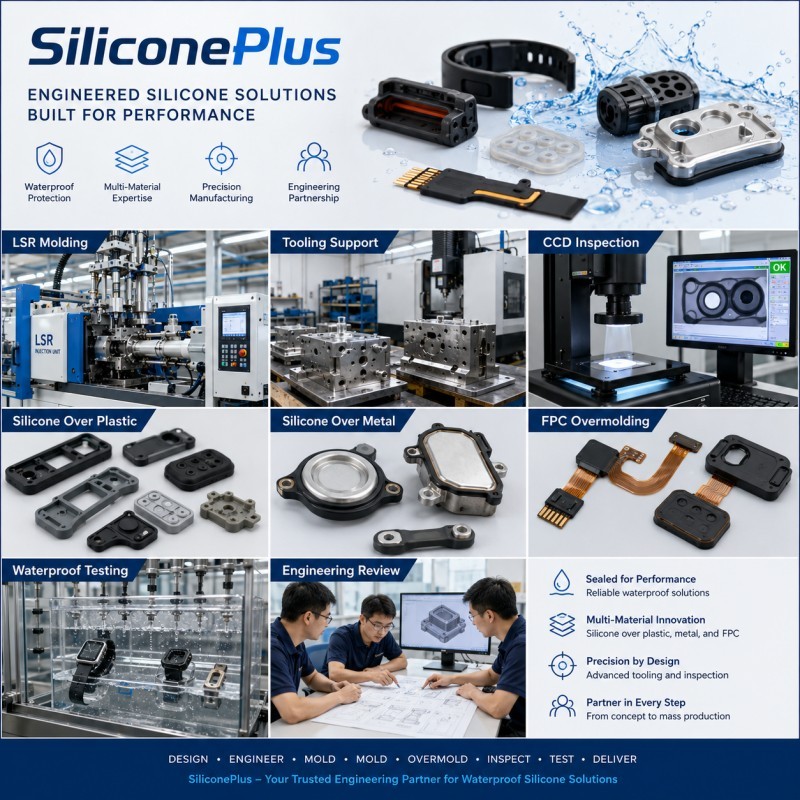
The company can support projects for medical devices, automotive and transportation, 3C electronics, mobile phone waterproofing, wearable electronics, beauty and health care devices, and industrial silicone applications.
For early-stage designs, the engineering team can help buyers review whether the part should use a separate gasket, LSR molded seal, silicone over plastic, silicone over metal, FPC silicone overmolding, or silicone over silicone structure. For existing parts, the team can evaluate drawings or samples to improve sealing performance, manufacturability, and production stability.
A reliable waterproof silicone supplier should not only quote a part price. It should help buyers identify leakage paths, select suitable silicone material, optimize sealing geometry, reduce flash risk, and prepare for validation before mass production.
FAQ About Waterproof Silicone Seal Design
1. What is the most important factor in waterproof silicone seal design?
The most important factor is the full sealing structure, including sealing path, compression ratio, groove design, material hardness, mating surface, tolerance, and assembly force. Silicone material alone cannot guarantee waterproof performance.
2. How much should a silicone seal be compressed?
The correct compression depends on seal shape, silicone hardness, groove design, application, and assembly force. Over-compression may damage the seal, while under-compression may cause leakage. The compression design should be reviewed during DFM.
3. Can silicone overmolding improve waterproof performance?
Yes. Silicone overmolding can improve waterproof performance by integrating the seal directly onto plastic, metal, FPC, or silicone substrate. This can reduce gasket movement, improve positioning, and create a more stable sealing structure.
4. Why does flash matter for waterproof silicone seals?
Flash can create gaps, interfere with compression, affect assembly, or become a leakage path if it appears on a functional sealing surface. Parting line and flash control should be considered during mold design.
5. Can silicone seals support IP67 or IP68 waterproof testing?
Yes. Silicone seals can support IP67 or IP68 testing when the sealing structure, material hardness, compression ratio, mold accuracy, mating surface, and final assembly are properly designed and validated.
6. What should I provide for a waterproof silicone seal project?
Buyers should provide drawings, 3D files, samples, product photos, sealing position, groove structure, substrate material, silicone hardness, waterproof target, testing method, application environment, and estimated production quantity.
Conclusion
Designing waterproof silicone seals for overmolded parts requires more than selecting a soft rubber material. A reliable waterproof structure depends on sealing path, compression ratio, groove design, silicone hardness, material performance, bonding method, parting line control, tolerance stack-up, testing conditions, and final assembly.
For B2B buyers, early engineering review can reduce mold changes, sample failures, leakage problems, and mass production risk. The best waterproof silicone solution is not always the thickest seal or the softest material. It is the design that matches the product structure, assembly condition, and real waterproof requirement.
Shenzhen Liyongan Silicone Rubber Products Co., Ltd. provides custom waterproof silicone seals, liquid silicone injection molding, silicone over plastic, silicone over metal, FPC silicone overmolding, silicone over silicone, medical silicone parts, automotive silicone components, 3C electronic silicone parts, mobile phone waterproof parts, wearable device seals, and industrial custom silicone products.
If you are developing a waterproof silicone seal, overmolded connector seal, FPC silicone overmolding part, plastic silicone overmolded housing, metal insert silicone seal, or custom LSR molded component, share your drawings, samples, waterproof target, and assembly requirements with our engineering team. We can help review the sealing structure and suggest a suitable manufacturing solution.
What type of waterproof silicone seal are you designing? Leave a comment, share this guide with your engineering or sourcing team, or contact SiliconePlus to discuss your custom silicone manufacturing requirements.