How Do You Design Strain Relief for Silicone Overmolded Electronics?
- Share
- publisher
- siliconeplus
- Issue Time
- Jun 18,2026
Summary
Learn how to design strain relief for silicone overmolded electronics, including FPC protection, cable exit sealing, connector overmolding, bend radius, silicone hardness, bonding design, waterproof sealing, mold tooling, LSR injection molding, and OEM/ODM mass production for custom electronic silicone parts.
Introduction
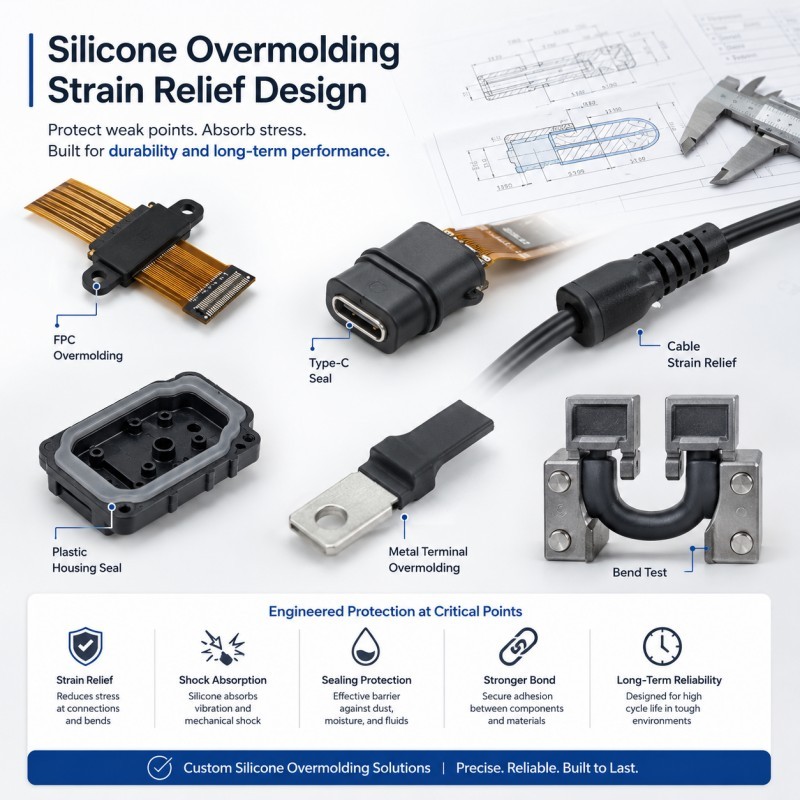
Electronic components often fail not because the circuit design is wrong, but because repeated bending, pulling, vibration, moisture, or assembly stress damages the connection area. FPC edges, cable exits, connector joints, solder points, and compact electronic modules are especially sensitive. This guide explains how silicone overmolding can be designed to provide strain relief, waterproof sealing, dust protection, and long-term stability for custom electronic components.
Answer Excerpt
Silicone strain relief for overmolded electronics is designed by molding silicone around sensitive connection areas such as FPC edges, cable exits, connector joints, metal terminals, and plastic housings. The goal is to reduce bending stress, protect solder joints, prevent cable fatigue, improve waterproof sealing, and keep the component stable during assembly and long-term use. A good design should consider silicone hardness, bend radius, bonding method, substrate positioning, sealing path, mold structure, and validation testing.
Transition Paragraph
Below are the key questions engineers, product developers, sourcing managers, and OEM/ODM buyers usually ask when developing silicone overmolded electronic components with strain relief requirements.
People Also Ask: What is strain relief in silicone overmolded electronics?
Strain relief is a structural design that reduces mechanical stress on sensitive areas of an electronic component. In silicone overmolded electronics, strain relief is usually created by molding silicone around the transition area between a flexible part and a rigid part, such as an FPC edge, cable exit, connector housing, solder joint, or metal terminal.
Without strain relief, repeated bending or pulling can concentrate force at one small point. This may cause FPC cracks, copper trace fatigue, solder joint failure, cable breakage, connector loosening, or waterproof sealing failure. Silicone can help distribute stress over a larger area because it is flexible, elastic, and suitable for molded protective structures.
Strain relief is not only a soft cover. It must be designed according to the real force direction, bending angle, assembly method, and product environment. If the silicone layer is too thin, it may not protect the connection area. If it is too thick or too hard, it may make the product difficult to assemble or may transfer stress to another weak point.
For electronic products, silicone strain relief is often used together with waterproof sealing, dustproof protection, insulation, soft-touch protection, and impact resistance.
For flexible electronic modules, FPC with silicone overmolding can help protect circuit edges, seal exposed areas, reduce bending stress, and improve durability in compact product structures.
People Also Ask: Why do electronic components need strain relief?
Electronic components need strain relief because many failures happen at transition points. A flexible cable connected to a rigid housing, an FPC connected to a sensor module, or a metal terminal embedded in a plastic connector can become a stress concentration area.
When a product is used repeatedly, the weak point may face bending, pulling, twisting, vibration, or thermal movement. Even if the component passes the first assembly test, it may fail after thousands of bending cycles or after long-term use in humid or vibrating environments.
Common failure areas include:
FPC bending edges
Cable exits
Type-C interface joints
Connector backshell areas
Solder joints
Metal terminal roots
Sensor module edges
Wearable device connection zones
Waterproof electronic module seams
Plastic-to-silicone transition areas
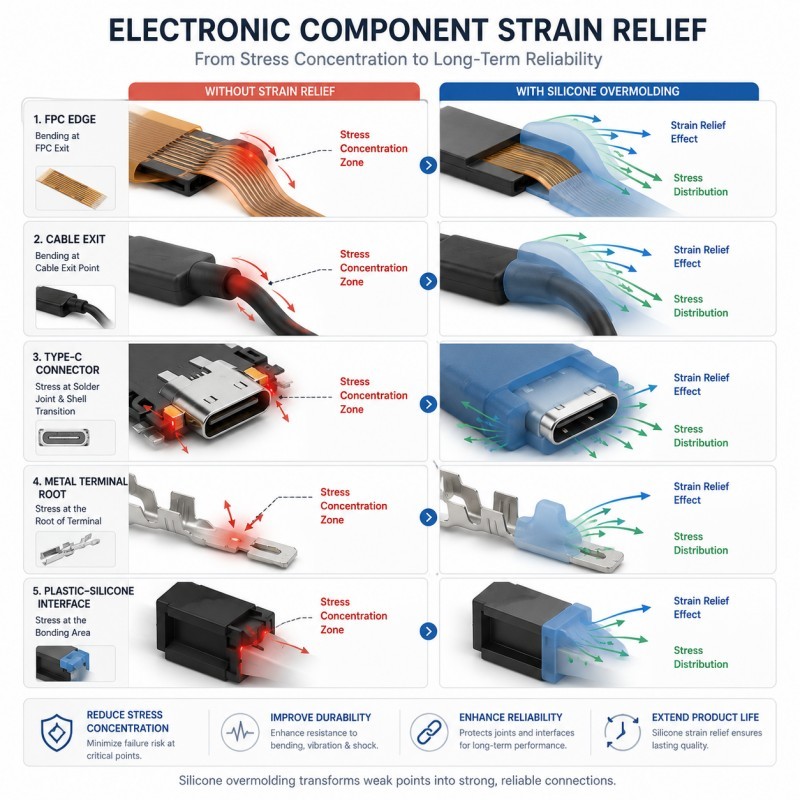
Silicone overmolding can reduce this risk by creating a soft transition layer. Instead of force being concentrated at one sharp edge, the silicone structure spreads the force across a larger area. This helps protect electrical function and mechanical stability.
For B2B buyers, strain relief should be considered early. If the product is already too compact, it may be difficult to add a reliable silicone structure after the mold design is finalized.
People Also Ask: How does silicone overmolding improve FPC protection?
Silicone overmolding improves FPC protection by covering selected areas of the flexible printed circuit with a soft, elastic, and protective silicone layer. This can help protect copper traces, reduce edge stress, seal moisture-sensitive areas, and provide a controlled bending transition.
FPC is thin and flexible, which makes it useful for wearable devices, medical electronics, smart modules, sensors, automotive electronics, and compact consumer electronics. However, this flexibility also makes FPC sensitive to bending fatigue and positioning error during molding.
For FPC silicone overmolding, the design should clearly define:
Silicone coverage area
Exposed pad area
Copper trace protection zone
Bending zone
Solder joint protection area
Stiffener location
Waterproof edge
Strain relief length
Final assembly position
Electrical test requirement
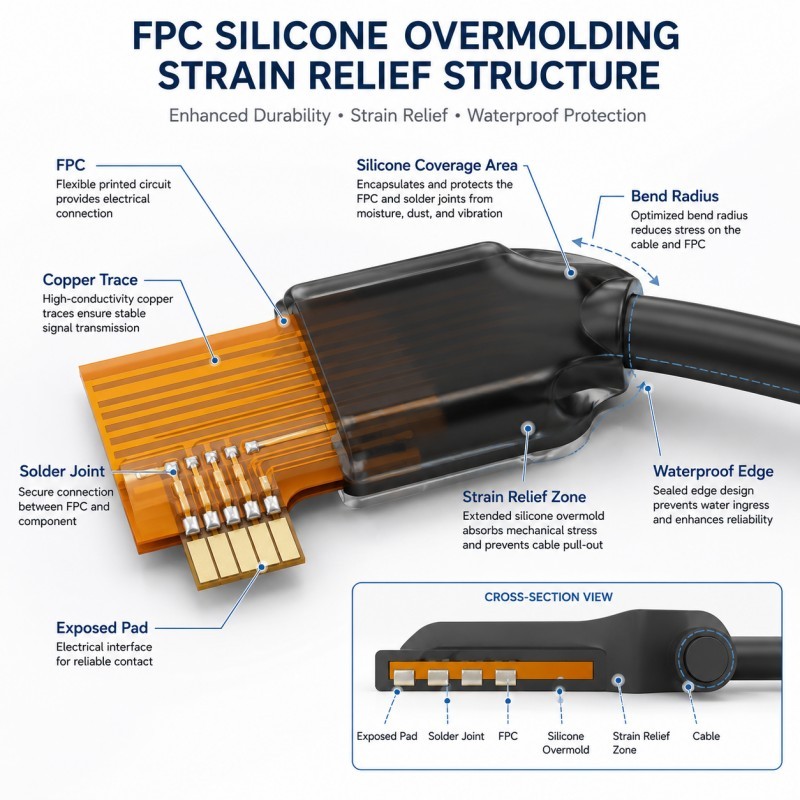
The silicone should not cover contact pads or test points unless the design requires full encapsulation. The mold should hold the FPC accurately so that the silicone coverage does not shift. If the FPC moves during molding, the final part may fail electrical testing or assembly.
A good FPC strain relief design should allow controlled flexibility. The goal is not to make the FPC completely rigid. The goal is to prevent sharp bending at the most fragile location.
People Also Ask: How do cable exits and connector joints use silicone strain relief?
Cable exits and connector joints use silicone strain relief to reduce bending force near the connection point. This is common in waterproof connectors, charging cables, sensor cables, wearable devices, handheld electronics, and industrial electronic modules.
When a cable exits a hard plastic housing or a connector body, the cable may bend repeatedly at the same location. Without strain relief, the cable jacket, internal wires, solder joint, or terminal connection may fail. Silicone can form a tapered, flexible boot around this area to reduce bending concentration.
A cable strain relief design may include:
Gradual transition shape
Tapered silicone boot
Flexible bending zone
Thicker root support
Controlled bend radius
Waterproof sealing edge
Mechanical locking feature
Bonding area to plastic or metal
Cable jacket compatibility
Pull and bending test requirement
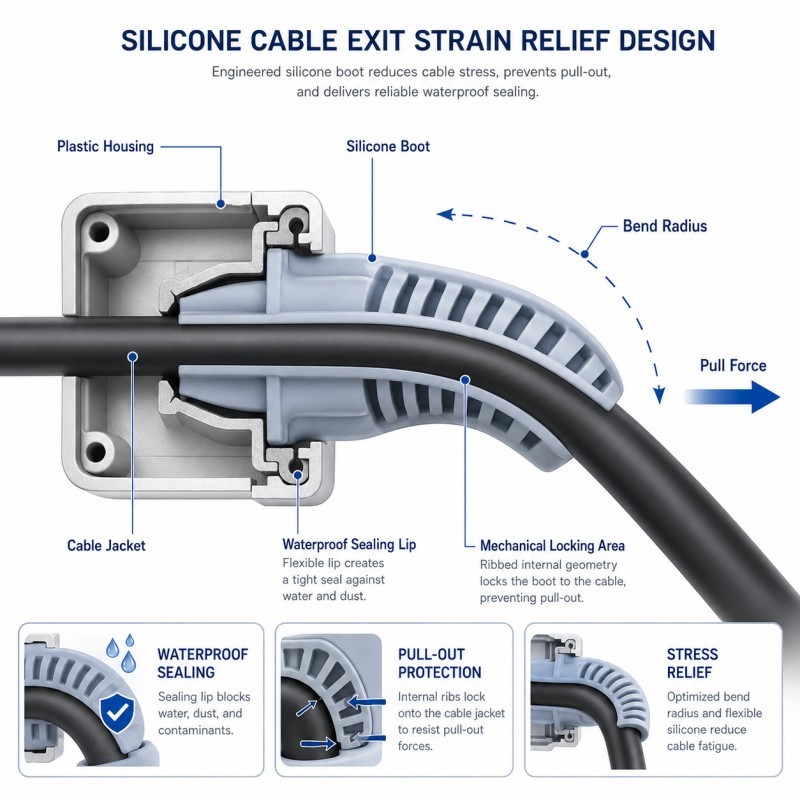
For waterproof electronic components, strain relief and sealing must work together. A silicone boot may reduce bending stress, but if the bonding edge or sealing lip is poorly designed, water may still enter along the cable or housing interface.
For connector housings, electronic enclosures, buttons, and cable exit structures, plastic with silicone overmolding can integrate waterproof sealing, strain relief, soft touch, and assembly protection into one component.
People Also Ask: How should silicone hardness be selected for strain relief?
Silicone hardness should be selected according to flexibility, support, sealing performance, assembly force, and durability requirements. A softer silicone can bend more easily, while a harder silicone can provide better support and shape stability.
For strain relief, softer silicone may help reduce stress concentration because it allows smoother bending. However, if the silicone is too soft, it may tear, deform, or fail to support the connection area. Harder silicone may protect the root area better, but it may also move the bending point to another location if the transition is too stiff.
The best design often uses geometry and hardness together. For example, a tapered silicone structure can provide stronger support near the root and smoother flexibility toward the end. This helps guide the bend instead of forcing it into one sharp point.
Material selection should consider:
Shore A hardness
Tear strength
Compression recovery
Elongation
Aging resistance
Temperature resistance
Bonding performance
Waterproof requirement
Touch feel
Product environment
For small strain relief structures and precision electronic silicone parts, liquid silicone injection molding can support fine details, stable dimensions, complex sealing lips, and repeatable production.
People Also Ask: What is the difference between covering, sealing, and strain relief?
Covering, sealing, and strain relief are related but different functions. A silicone layer may cover a component, but that does not always mean it seals water or reduces stress. Engineers should define the main function before mold design.
| Function | Main Purpose | Design Focus | Common Risk |
|---|---|---|---|
| Covering | Protects surface or hides selected area | Silicone thickness, coverage boundary, appearance | Silicone covers functional areas or creates assembly interference |
| Waterproof Sealing | Blocks water, dust, or moisture | Sealing lip, compression ratio, bonding edge, mating surface | Leakage through edge, parting line, or poor compression |
| Strain Relief | Reduces bending, pulling, or vibration stress | Bend radius, transition length, hardness, root support | Stress moves to another weak point |
| Electrical Protection | Protects traces, pads, or terminals | Exposed areas, insulation distance, FPC positioning | Pads are covered or electrical function is affected |
This table helps buyers avoid unclear requirements. If the project needs both waterproof sealing and strain relief, the silicone structure must support both functions. A part designed only for sealing may not protect against bending fatigue. A part designed only for flexibility may not provide waterproof sealing.
People Also Ask: How does mold design affect silicone strain relief performance?
Mold design affects strain relief performance because it controls silicone shape, thickness, boundary, insert positioning, parting line, venting, and flash-sensitive areas. A good strain relief structure cannot be produced consistently without proper tooling.
For FPC overmolding, the mold must hold the FPC accurately and protect exposed pads. For cable strain relief, the mold must control the silicone boot geometry and cable position. For connector strain relief, the mold must control the sealing edge, insert position, and functional interface.
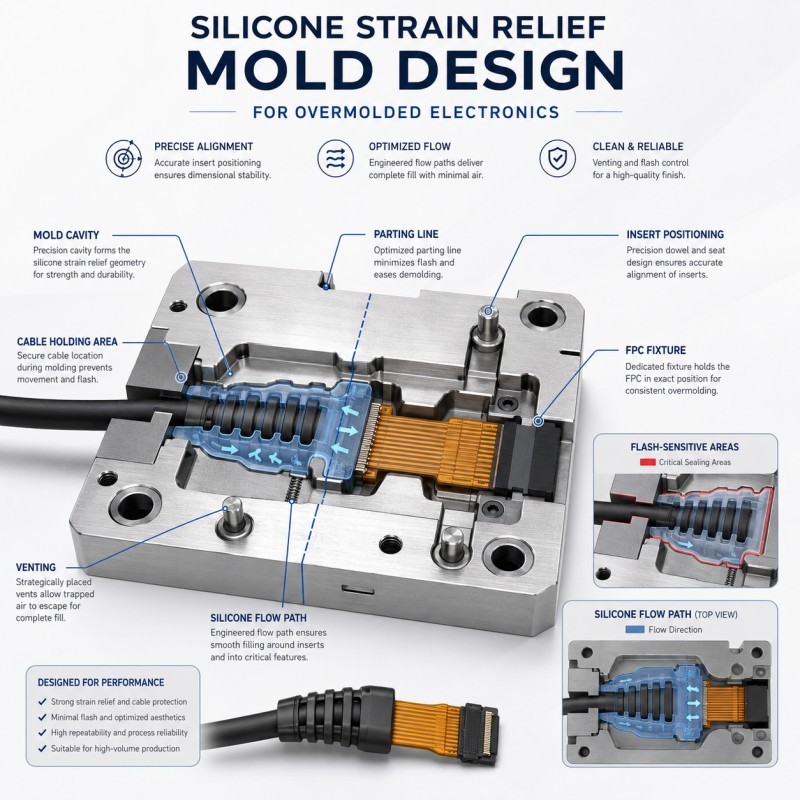
Parting line design is important because flash may affect sealing, appearance, or bending performance. If flash appears on a bending surface, it may become a weak point. If flash appears near a connector interface, it may block assembly.
The mold should also support stable production. A sample mold may prove the concept, but mass production requires consistent insert loading, controlled silicone flow, repeatable dimensions, and practical inspection standards.
For strain relief and waterproof electronic parts, design and tooling services help review DFM risks, insert positioning, parting lines, mold feasibility, sealing surfaces, and mass production stability before mold opening.
People Also Ask: How should strain relief be tested before mass production?
Strain relief should be tested according to the real product application. Testing may include bending test, pull test, torsion test, vibration test, waterproof test, aging test, assembly test, and electrical function test.
A part may look strong after molding but fail after repeated bending. Another part may pass bending but fail waterproof testing. For FPC components, electrical testing before and after bending may be necessary. For cable exit components, pull force and bending angle should be defined. For connector parts, assembly fit and waterproof sealing should be validated together.
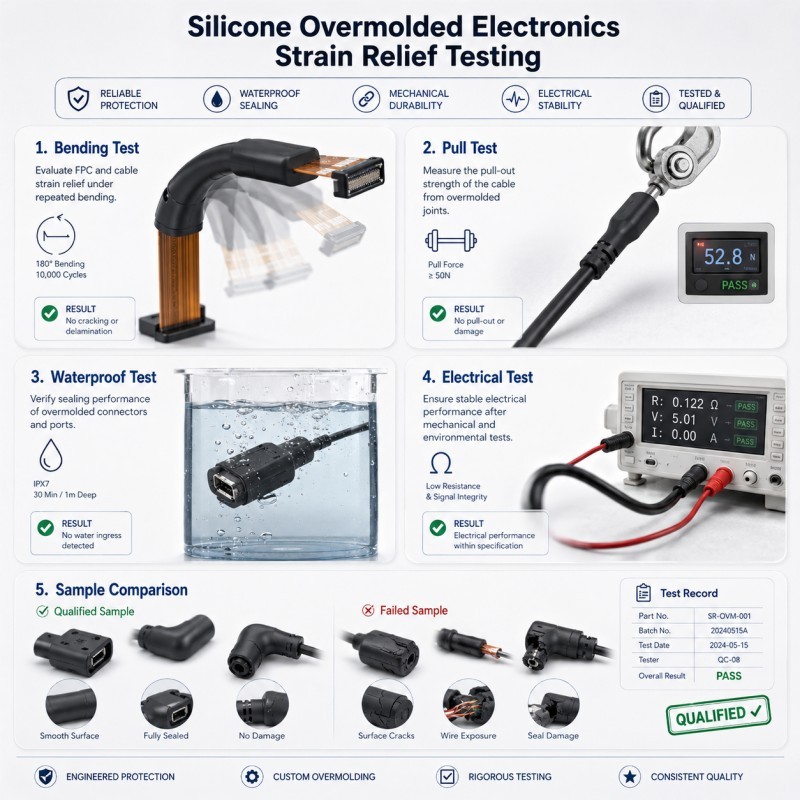
Useful validation questions include:
Does the silicone remain bonded after bending?
Does the FPC still pass electrical testing?
Does the cable exit resist pulling force?
Does the part still seal after repeated movement?
Does the silicone tear at the transition area?
Does the insert shift during production?
Does flash affect bending or assembly?
Can the process remain stable in mass production?
Testing should not only check the silicone part alone. It should evaluate the final assembly or a representative test fixture whenever possible.
People Also Ask: What should buyers confirm before opening a strain relief mold?
Before opening a strain relief mold, buyers should confirm the application, substrate material, bending direction, pull force, silicone coverage area, exposed functional areas, hardness, waterproof target, assembly method, testing standard, and expected production quantity.
If the project involves FPC, the drawing should clearly mark exposed pads, bending zones, copper trace areas, solder joints, and silicone coverage. If the project involves cable or connector overmolding, the drawing should define cable diameter, jacket material, connector position, sealing edge, and strain relief length.
A useful project checklist includes:
Product application
2D drawing and 3D file
FPC, cable, plastic, or metal substrate material
Silicone coverage area
Exposed functional area
Bending direction
Bending radius requirement
Pull force requirement
Silicone hardness
Waterproof target
Assembly method
Testing standard
Estimated quantity
Sample timeline
Mass production plan
Clear information helps the manufacturer choose the right material, mold design, insert fixture, process parameters, and inspection method.
People Also Ask: How does SiliconePlus support silicone strain relief projects?
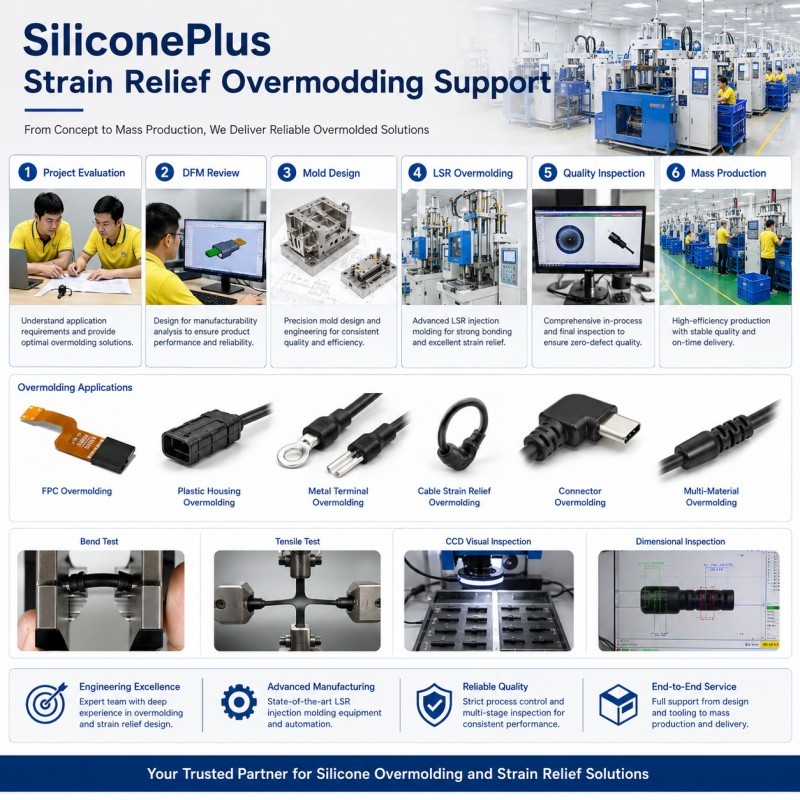
SiliconePlus supports silicone strain relief projects by reviewing product structure, substrate type, FPC or cable layout, silicone coverage area, waterproof requirement, material hardness, tooling feasibility, and production stability before mold development.
Shenzhen Liyongan Silicone Rubber Products Co., Ltd. focuses on custom silicone overmolding manufacturing solutions, including liquid silicone injection molding, silicone over plastic, silicone over metal, FPC silicone overmolding, silicone over silicone, compression molding, mold development, sample production, inspection, and OEM/ODM mass production support.
For metal terminals, sensor inserts, connector contacts, and structural electronic parts, metal with silicone overmolding can help provide sealing, insulation, soft protection, and mechanical support when bonding and insert positioning are properly controlled.
The company can support projects for 3C electronics, mobile phone waterproofing, wearable electronics, medical electronics, automotive connectors, beauty and health care devices, and industrial electronic modules. For early-stage designs, the engineering team can help buyers decide whether the part should use FPC silicone overmolding, plastic with silicone overmolding, metal with silicone overmolding, silicone over silicone, or a separate molded silicone protection part.
A reliable supplier should not only quote the part size. It should ask how the part bends, where the force comes from, which area must remain exposed, how the seal will be tested, and what failure risk the customer wants to avoid.
FAQ About Silicone Strain Relief for Overmolded Electronics
1. What is silicone strain relief?
Silicone strain relief is a molded silicone structure that reduces bending, pulling, vibration, or twisting stress on sensitive connection areas such as FPC edges, cable exits, connector joints, solder points, and metal terminals.
2. Why is silicone useful for strain relief?
Silicone is flexible, elastic, durable, and suitable for molded protective structures. It can help distribute stress, protect weak transition areas, support waterproof sealing, and improve comfort or soft-touch performance.
3. Can silicone overmolding protect FPC?
Yes. Silicone overmolding can protect selected FPC areas, seal edges, reduce bending stress, protect solder joints, and provide strain relief. The design must protect exposed pads and electrical contact areas.
4. Can strain relief and waterproof sealing be combined?
Yes. Many electronic components need both strain relief and waterproof sealing. The silicone structure should be designed to reduce bending stress while also maintaining a controlled sealing path and bonding edge.
5. What tests are used for silicone strain relief parts?
Common tests include bending test, pull test, torsion test, vibration test, waterproof test, aging test, assembly test, and electrical function test. The test method should match the real product application.
6. What information should I provide for a silicone strain relief project?
Buyers should provide drawings, 3D files, samples, substrate material, silicone coverage area, exposed functional areas, bending direction, pull force requirement, waterproof target, testing standard, and estimated quantity.
Conclusion
Silicone strain relief is important for electronic components that face bending, pulling, vibration, moisture, or repeated assembly. A well-designed silicone overmolded structure can protect FPC edges, cable exits, connector joints, metal terminals, solder points, and waterproof interfaces while improving long-term reliability.
For B2B buyers, strain relief should be reviewed before mold development. The best design depends on bending direction, silicone hardness, coverage area, bonding method, waterproof path, insert positioning, mold structure, and validation testing.
Shenzhen Liyongan Silicone Rubber Products Co., Ltd. provides custom silicone overmolding, liquid silicone injection molding, FPC silicone overmolding, silicone over plastic, silicone over metal, silicone over silicone, waterproof silicone seals, medical silicone parts, automotive silicone components, 3C electronic silicone parts, wearable device seals, and industrial custom silicone components.
If you are developing an FPC silicone overmolded part, cable exit silicone strain relief, waterproof connector seal, Type-C overmolded component, metal terminal silicone protection part, or custom electronic silicone component, share your drawings, samples, substrate material, bending requirement, waterproof target, and testing standards with our engineering team. We can help review the structure and suggest a suitable manufacturing solution.
What type of electronic silicone overmolded component are you developing? Leave a comment, share this guide with your engineering or sourcing team, or contact SiliconePlus to discuss your custom silicone manufacturing requirements.