From Prototype to Mass Production: How to Keep LSR Overmolded Parts Consistent
- Share
- publisher
- siliconeplus
- Issue Time
- Jul 8,2026
Summary
Prototype success does not always guarantee stable mass production in custom LSR overmolding projects. This article explains how engineers can improve consistency from sampling to mass production by controlling DFM review, mold validation, material selection, process parameters, insert positioning, inspection standards, and production documentation.
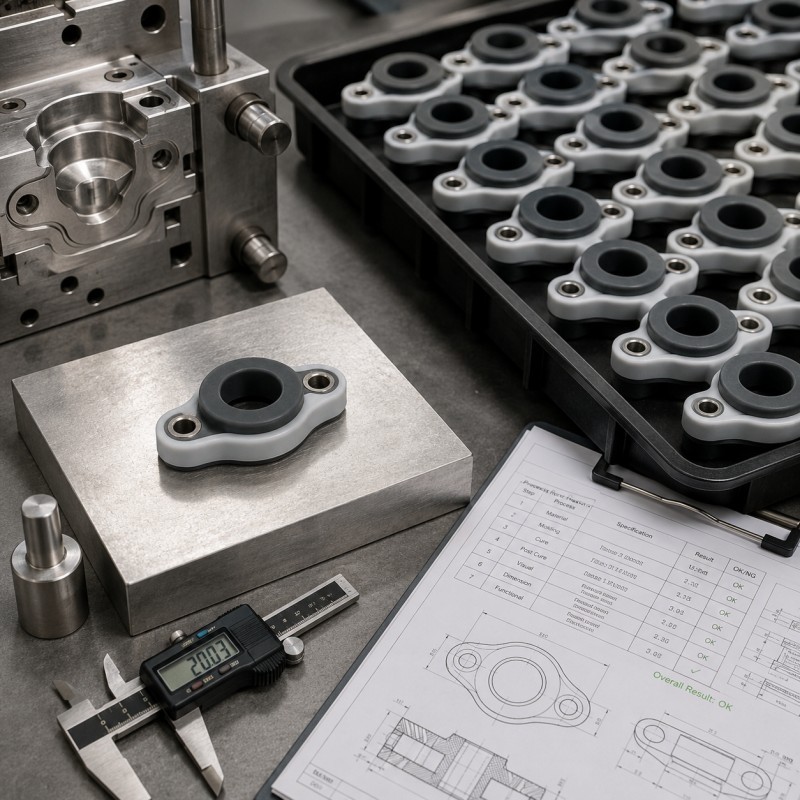
A successful prototype is only the first step in a custom LSR overmolding project. Many parts look good during sampling, but problems may appear when the project moves into mass production.
The sample may pass visual inspection, assembly testing, waterproof testing, or bonding evaluation. However, once the same part is produced in hundreds, thousands, or tens of thousands of pieces, new risks may appear. Silicone thickness may become unstable. Insert positioning may shift. Flash may increase. Bonding strength may vary. Color may change slightly. Sealing performance may become inconsistent between batches.
For custom LSR overmolded parts used in automotive electronics, medical devices, wearable products, sensors, 3C components, and industrial assemblies, prototype quality and mass production quality must be managed as one complete process.
A reliable manufacturer should not only make a good sample. The real challenge is to make the same quality repeatedly.
Answer Excerpt
To keep custom LSR overmolded parts consistent from prototype to mass production, engineers should control DFM review, tooling validation, silicone material selection, insert positioning, injection parameters, curing conditions, flash control, dimensional inspection, bonding tests, sealing tests, and production documentation. Stable mass production depends on repeatable tooling, repeatable process settings, and clear quality standards.
Why Prototype Success Does Not Always Mean Mass Production Success
Prototype production is often more flexible than mass production. During sampling, engineers may adjust mold temperature, injection pressure, insert loading, trimming, inspection, and handling manually. A small batch may receive more attention and more manual correction.
Mass production is different. The process must be repeatable. Operators, machines, molds, inserts, materials, inspection methods, and packaging must all follow stable standards.
A prototype may pass because it was carefully adjusted one piece at a time. But mass production requires every batch to meet the same dimensional, bonding, sealing, appearance, and assembly requirements.
This is why early engineering control is important before production approval.
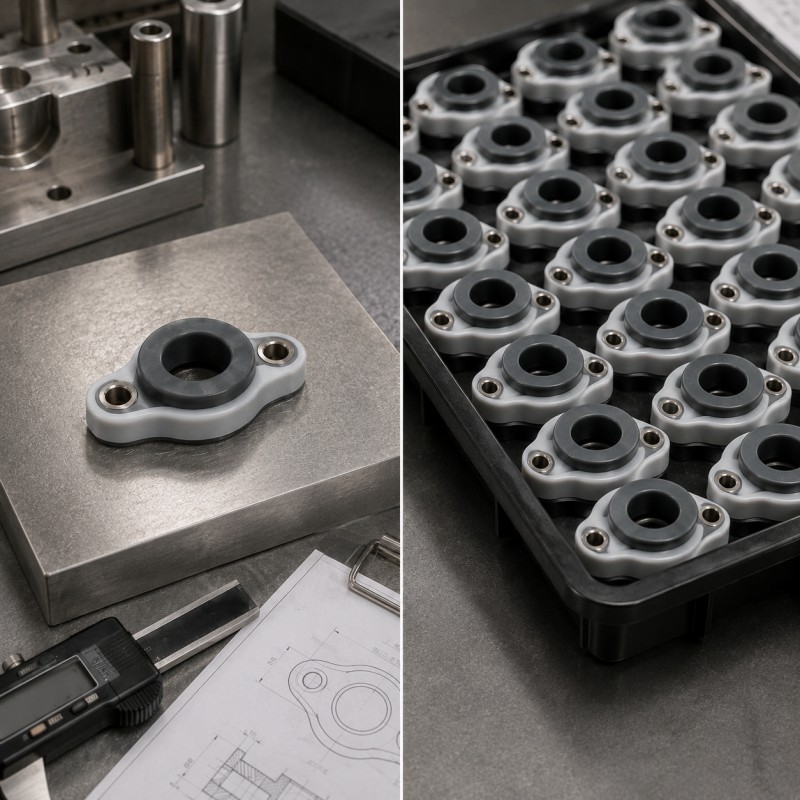
DFM Review Should Be Completed Before Tooling
Consistency begins before the mold is built. If the product design has hidden risks, mass production will become unstable even if the first sample looks acceptable.
DFM review should check the substrate material, silicone coverage, bonding area, sealing lip structure, wall thickness, insert positioning, demolding direction, parting line, venting, flash-sensitive areas, assembly tolerance, and testing requirements.
For silicone over plastic parts, engineers should review plastic heat resistance and deformation risk. For silicone over metal parts, surface treatment and mechanical retention should be checked. For FPC silicone overmolding, pressure control, bending zones, and circuit protection should be evaluated.
A good DFM review can reduce repeated mold modification and improve production stability from the beginning.
Tooling Validation Is More Than Making the First Sample
Tooling validation should confirm whether the mold can support stable production, not only whether it can produce one good part.
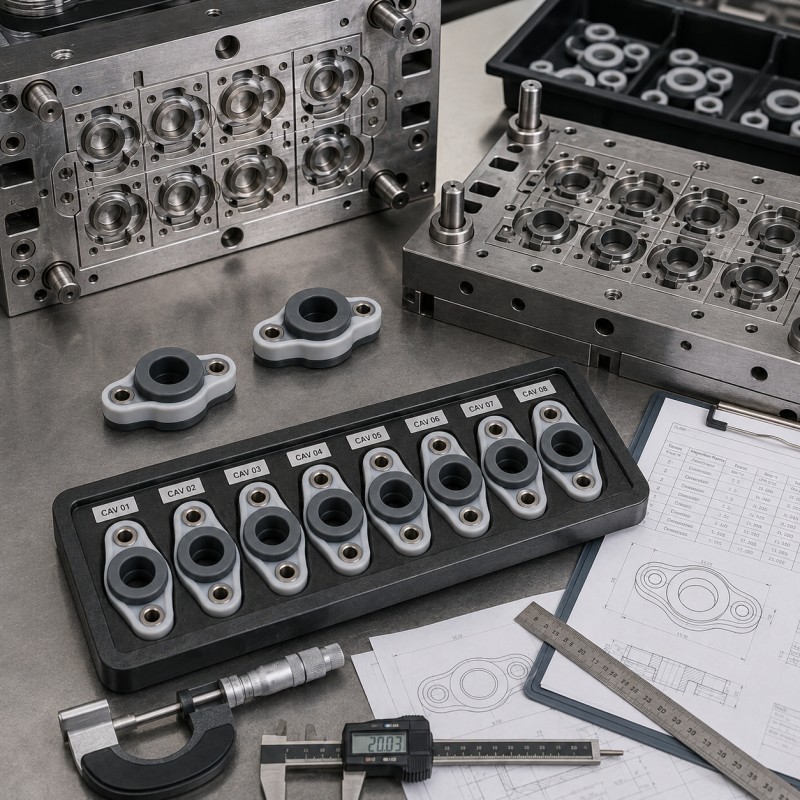
Engineers should check mold alignment, insert loading repeatability, cavity balance, gate position, venting, shut-off surfaces, parting line, demolding stability, and flash control.
For multi-cavity molds, each cavity should be compared carefully. If one cavity produces thicker silicone, more flash, weaker bonding, or a different dimension, mass production quality will become inconsistent.
A stable mold should produce repeatable parts across different cavities, different cycles, and different production batches.
Material Selection and Batch Control
Liquid silicone rubber material affects hardness, flowability, curing behavior, tear strength, compression recovery, bonding performance, color stability, and long-term durability.
During sampling, the selected LSR grade should match the real application requirement. It should not be chosen only because it is easy to mold or available quickly.
For mass production, material batch control is also important. Different batches should meet the same material standard. Color, hardness, mixing ratio, storage condition, and shelf life should be controlled.
If the project requires self-adhesive LSR, medical-grade silicone, high-transparency silicone, high-tear silicone, or special hardness, material traceability and incoming inspection become more important.
Process Parameters Must Be Locked After Approval
A stable LSR overmolding process depends on controlled process parameters.
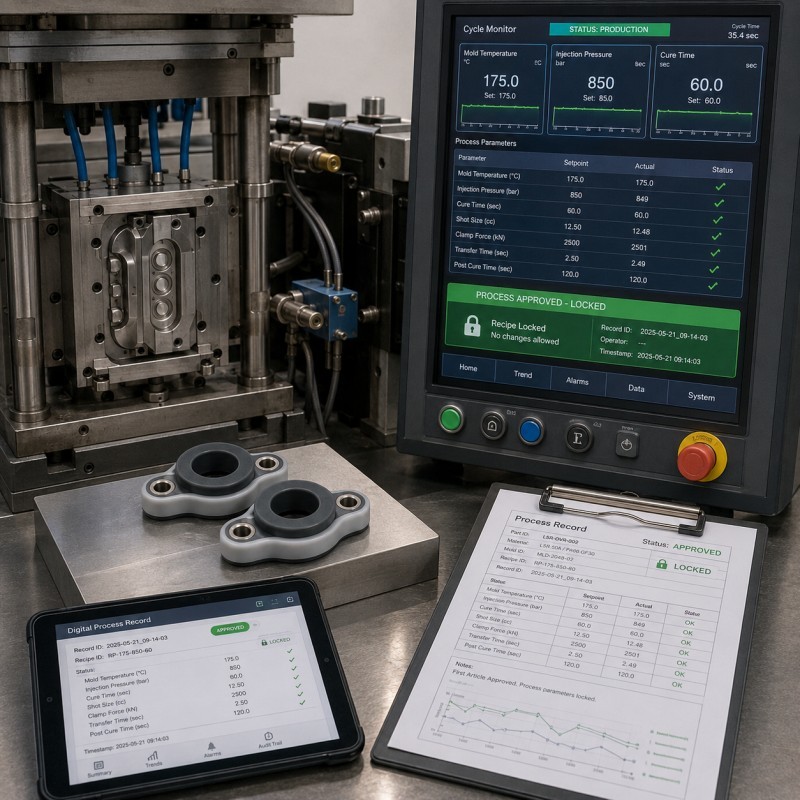
Important parameters include mold temperature, injection pressure, injection speed, curing time, clamping force, metering ratio, mixing quality, insert temperature, demolding timing, and post-curing requirement if needed.
During sampling, engineers may adjust these settings to find the right process window. After the part is approved, the confirmed parameters should be recorded and controlled.
If operators change temperature, pressure, curing time, or injection speed without review, the final part may show flash, bubbles, weak bonding, incomplete filling, deformation, or dimensional change.
Mass production requires process discipline, not only machine capability.
Insert Positioning Must Be Repeatable
Many custom LSR overmolded parts include plastic inserts, metal inserts, FPC, cables, connectors, or sensor components. If the insert position changes, the silicone shape will also change.
Poor insert positioning may cause uneven silicone thickness, exposed substrate, misaligned sealing lips, bonding edge variation, flash on functional areas, or assembly interference.
For mass production, insert loading must be easy to repeat. The mold should have stable locating features, and operators should follow clear loading instructions. For delicate inserts such as FPC or small terminals, fixtures may be needed to prevent shifting, bending, or incorrect orientation.
Repeatable insert positioning is one of the most important conditions for repeatable overmolded quality.
Inspection Standards Should Be Defined Before Production
If inspection standards are unclear, production quality becomes difficult to control.
Before mass production, the team should define what must be inspected, how it should be measured, and what acceptance standard should be used.
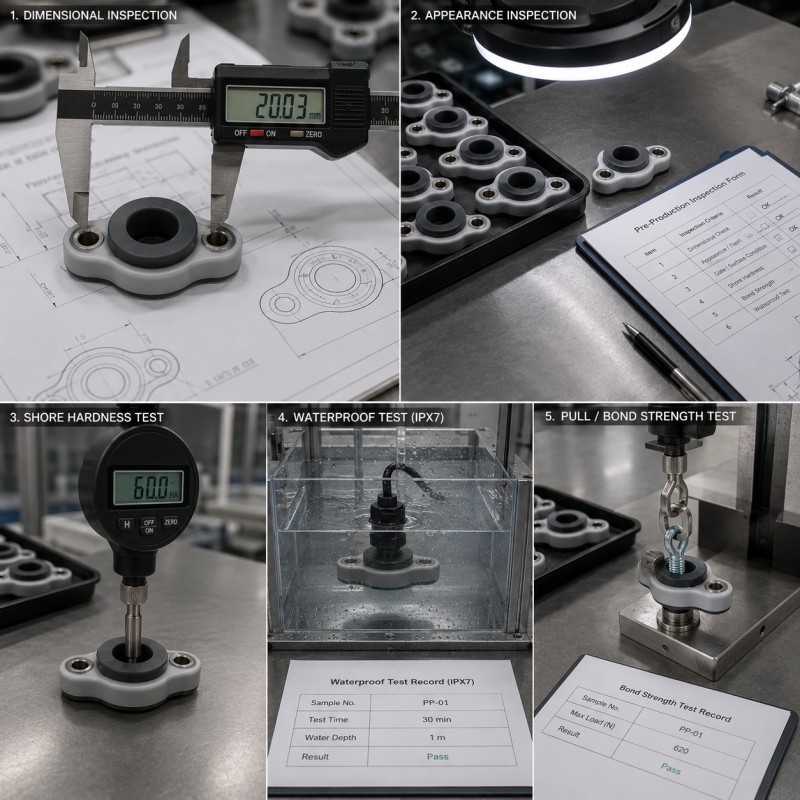
Common inspection items include silicone thickness, critical dimensions, flash limit, bonding area, sealing lip height, surface appearance, color, hardness, insert position, assembly fit, waterproof performance, pulling force, peeling strength, and functional testing.
For precision components, visual inspection alone is not enough. Dimensional measurement, functional tests, and application-level validation should be included where needed.
Clear inspection standards help prevent disagreement between sampling, production, quality control, and customer-side acceptance.
Common Risks When Scaling from Prototype to Mass Production
Several risks often appear when a custom LSR overmolding project scales from prototype to mass production.
The first risk is flash variation. A small amount of flash may be acceptable in a sample, but excessive flash during production can affect sealing, assembly, and appearance.
The second risk is bonding inconsistency. Bonding may change if surface treatment, insert cleaning, material grade, or process temperature is not stable.
The third risk is dimensional drift. Silicone thickness, insert position, and molding tolerance may change if the mold, process, or insert supply is unstable.
The fourth risk is testing mismatch. A sample may pass simple tests but fail real customer-side assembly or environmental testing.
The fifth risk is documentation gap. If the approved sample process is not recorded clearly, production may not reproduce the same result.
Production Documentation Helps Control Repeatability
Production documentation is not only internal paperwork. It is part of quality control.
For custom LSR overmolding projects, documentation may include approved drawings, material specifications, mold records, process parameters, insert loading instructions, inspection standards, defect samples, packaging requirements, and quality control plans.
When documentation is clear, operators know how to load inserts, technicians know the approved process window, inspectors know what to check, and production managers can identify abnormal changes quickly.
For OEM/ODM projects, documentation helps ensure that repeat orders can match the approved sample.
Validation Tests Before Mass Production
Before full production, the part should be validated according to its real application environment.
Common validation tests include dimensional inspection, visual inspection, hardness test, pulling force test, peeling test, waterproof test, air leakage test, assembly test, compression test, bending fatigue test, aging test, temperature cycling test, and functional test.
For automotive, medical, wearable, sensor, and industrial applications, test requirements should be discussed before tooling because they may affect material selection, mold design, sealing structure, bonding method, and inspection standards.
A production-ready part should not only look correct. It should pass the tests that match its real use conditions.
How SiliconePlus Supports Prototype-to-Production LSR Overmolding
SiliconePlus supports custom LSR overmolding projects involving plastic, metal, FPC, silicone, cable, connector, and electronic insert structures. Our team can review drawings, samples, material requirements, bonding areas, sealing structures, insert positioning, tolerance requirements, process risks, and testing standards before mold development.
We can support DFM review, silicone material selection, custom tooling, sample production, process optimization, inspection, and OEM/ODM mass production.
For automotive connector seals, wearable device components, medical silicone parts, FPC protection structures, waterproof buttons, cable strain relief parts, sensor modules, and industrial sealing components, early engineering review can help reduce the risk of prototype approval but mass production failure.
Conclusion
Prototype approval is important, but stable mass production is the real goal of a custom LSR overmolding project.
To keep silicone overmolded parts consistent, engineers should control DFM review, tooling validation, material batch stability, process parameters, insert positioning, inspection standards, production documentation, and validation testing.
If you are developing a custom LSR overmolded part and want to reduce the risk of sampling success but production failure, send us your drawings, samples, material information, application requirements, testing standards, and estimated quantity. SiliconePlus can help evaluate the right overmolding solution from prototype to mass production.