FPC Silicone Overmolding for Flexible Electronic Components
- Share
- publisher
- siliconeplus
- Issue Time
- Jun 29,2026
Summary
FPC silicone overmolding helps protect flexible circuits from moisture, dust, bending stress, vibration, and assembly damage. This article explains how liquid silicone rubber can be molded onto FPC components for wearable devices, medical electronics, sensors, 3C products, and custom flexible electronic assemblies.
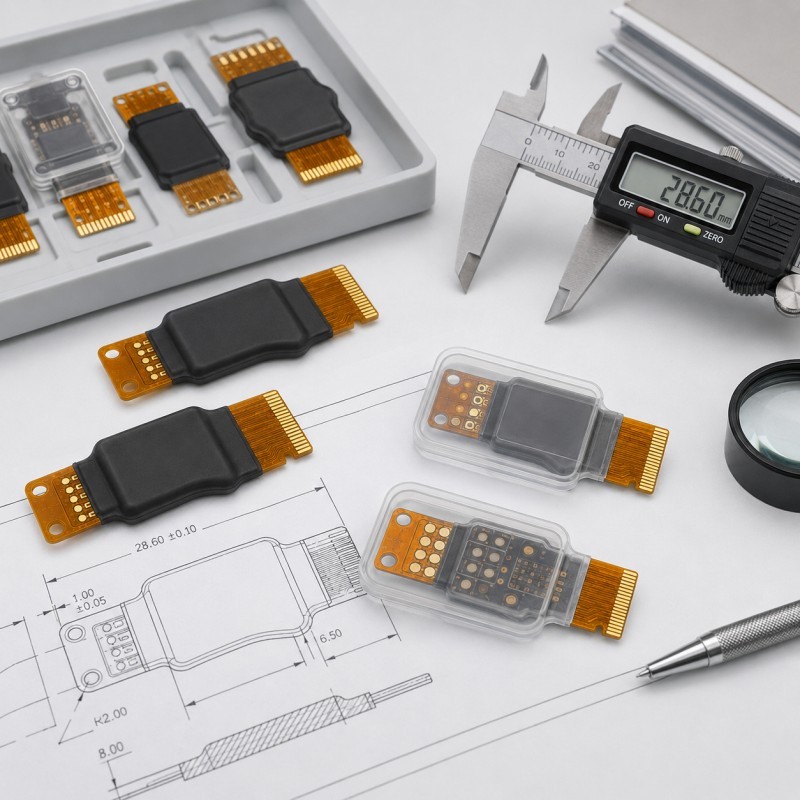
Flexible printed circuits are widely used in wearable devices, medical electronics, sensors, automotive electronics, 3C products, and compact electronic modules. Compared with rigid PCB structures, FPC components are thinner, lighter, and more flexible, making them suitable for small and curved product designs.
However, flexibility also brings new engineering challenges.
FPC components may be exposed to bending, pulling, vibration, moisture, dust, sweat, cleaning agents, temperature changes, and assembly pressure. If the circuit area, solder joint, connector interface, or cable outlet is not protected properly, the product may fail during testing, assembly, or long-term use.
This is why many engineers choose FPC silicone overmolding for flexible electronic components.
By molding liquid silicone rubber directly onto selected areas of the FPC, manufacturers can create a soft, sealed, insulated, and strain-relief structure without relying only on glue, tape, or separate rubber covers.
Answer Excerpt
FPC silicone overmolding is a custom manufacturing process that molds liquid silicone rubber onto flexible printed circuits. It helps protect FPC components from moisture, dust, bending stress, vibration, pulling force, and assembly damage. It is commonly used in wearable devices, medical electronics, sensors, automotive electronics, 3C products, and compact electronic assemblies.
What Is FPC Silicone Overmolding?
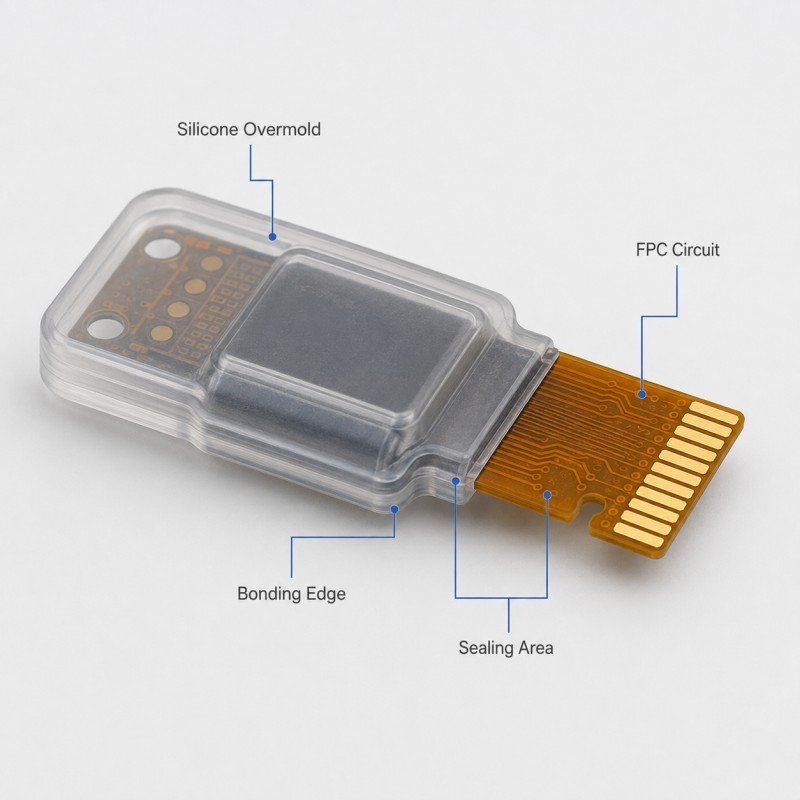
FPC silicone overmolding is a process where liquid silicone rubber is molded directly onto a flexible printed circuit or selected FPC assembly area.
The silicone can cover, seal, support, or protect specific areas, such as:
- Cable outlet areas
- Solder joints
- Connector transition areas
- Sensor connection areas
- Flexible circuit bending zones
- Waterproof sealing areas
- Strain relief sections
- Soft-touch user contact areas
- Insulation protection zones
After molding and curing, the silicone and FPC become an integrated component. The silicone layer can improve protection, sealing, flexibility, and handling stability.
Unlike a separate silicone sleeve or manually applied adhesive, overmolded silicone is formed in a precision mold. This allows better control of silicone thickness, shape, position, surface finish, and production consistency.
Why FPC Components Need Silicone Protection
FPC components are designed to be flexible, but they are not immune to mechanical and environmental stress.
In real applications, FPC parts may be bent repeatedly, pulled during assembly, compressed inside a housing, exposed to moisture, or connected to sensors and modules in tight spaces.
Common risks include:
- Broken solder joints
- Cracked copper traces
- Moisture entering the circuit area
- Dust contamination
- Connector movement
- Cable outlet tearing
- Poor strain relief
- Short circuit risk
- Glue overflow or unstable coverage
- Assembly damage
- Bending fatigue failure
Silicone overmolding helps reduce these risks by adding a controlled protective structure around the FPC.
Key Benefits of FPC Silicone Overmolding
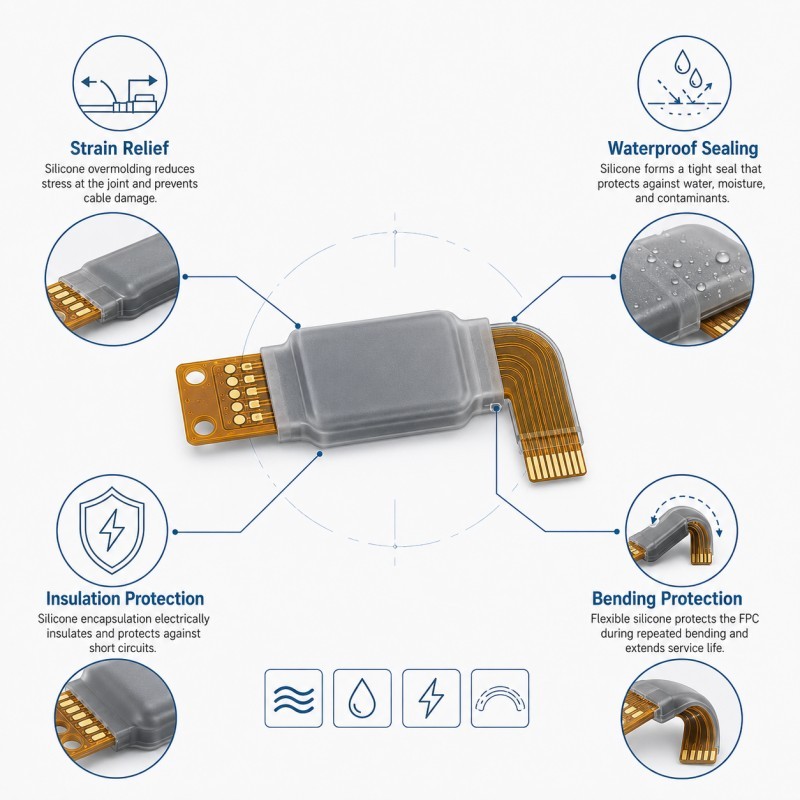
1. Better Strain Relief
One of the most important functions of FPC silicone overmolding is strain relief.
When an FPC is connected to a sensor, connector, cable, or module, stress often concentrates at the transition area. If the FPC bends sharply or is pulled during assembly, the copper traces or solder joints may be damaged.
Overmolded silicone can create a soft transition zone. This helps distribute stress more evenly and reduce the risk of cracking, tearing, or connection failure.
For wearable devices, medical sensors, and compact electronics, this is especially important because the FPC may be moved, bent, or compressed repeatedly.
2. Moisture and Dust Protection
FPC assemblies are often used in products that require moisture resistance, dust protection, or skin-contact durability.
Silicone can help seal selected areas of the FPC and protect sensitive circuit zones from moisture, sweat, dust, and contamination.
This is useful for:
- Wearable sensors
- Health monitoring devices
- Smart rings and smart watches
- Medical electronic modules
- Beauty device components
- Automotive sensor parts
- Outdoor electronic modules
The sealing design should be reviewed according to the real product housing, compression structure, waterproof test requirement, and application environment.
3. Electrical Insulation
FPC circuits may need insulation around exposed conductive areas, solder joints, terminals, or connection points.
Liquid silicone rubber can provide an insulating layer around selected areas of the FPC. This helps reduce short-circuit risk, improve user safety, and protect the circuit during assembly.
The silicone thickness, coverage area, and material properties should be defined according to voltage, contact risk, product structure, and testing requirements.
4. Soft Protection Without Rigid Encapsulation
Some protective materials are too rigid for flexible electronic components. If the protection layer is too hard, it may create stress concentration or reduce flexibility.
Silicone is soft and elastic, making it suitable for flexible circuit protection. It can protect the FPC while still allowing controlled bending and movement.
This is useful when the product needs both protection and flexibility.
5. Cleaner Appearance and Better Production Consistency
Manual glue dispensing or tape wrapping can create inconsistent appearance, uneven thickness, overflow, bubbles, or unstable coverage.
FPC silicone overmolding uses a mold to define the silicone shape. This improves repeatability and helps create a cleaner, more stable finished part.
For B2B OEM/ODM projects, this is important because samples must not only look good but also remain stable during mass production.
Common Applications of FPC Silicone Overmolding
Wearable Electronics
Wearable devices often use FPC structures to connect sensors, charging areas, buttons, antennas, and internal modules. These parts may face bending, sweat, skin contact, moisture, and repeated movement.
FPC silicone overmolding can help protect sensor connection areas, improve waterproof sealing, reduce bending stress, and create a soft contact surface.
Medical Electronic Components
Medical electronics may use FPC components in sensors, monitoring devices, handheld diagnostic products, wearable medical modules, and compact electronic assemblies.
Silicone overmolding can provide soft protection, insulation, sealing, and strain relief. For medical-related applications, material safety, cleanliness, surface quality, and inspection requirements should be carefully reviewed.
Automotive Sensors and Electronic Modules
Automotive electronic parts may face vibration, temperature cycling, dust, and moisture. FPC silicone overmolding can help protect flexible circuits inside sensors, connectors, lighting modules, and control components.
The design should consider vibration resistance, sealing requirements, assembly force, and long-term durability.
3C Electronic Components
Consumer electronic products often require compact design, clean appearance, and reliable assembly. FPC silicone overmolding can be used for interface components, small sensor modules, flexible connectors, buttons, and internal electronic structures.
Low flash, accurate positioning, and stable appearance are important for these applications.
Beauty and Personal Care Devices
Beauty devices may combine FPC circuits, sensors, metal contact parts, and soft silicone structures. FPC silicone overmolding can help improve sealing, soft touch, insulation, and assembly protection.
For these products, appearance consistency and user contact comfort are also important.
Important Design Factors Before Tooling
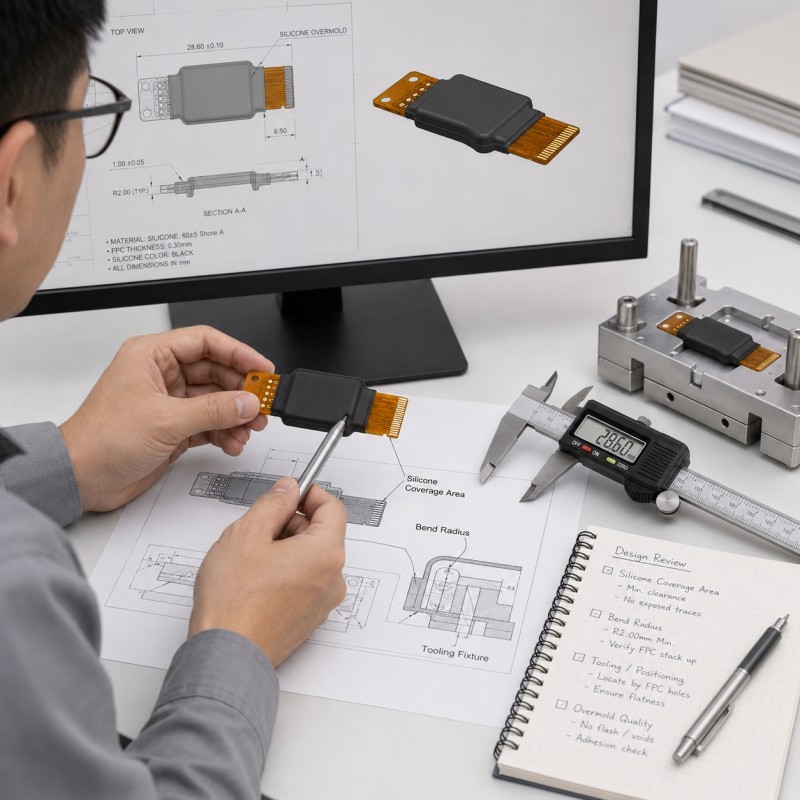
FPC silicone overmolding requires careful engineering review before mold development. FPC is thinner and more flexible than plastic or metal inserts, so the molding process must be controlled carefully.
FPC Thickness and Flexibility
The FPC thickness affects mold positioning, silicone flow, bonding area, and bending performance.
If the FPC is too thin or unsupported, it may shift, deform, or wrinkle during molding. If the FPC has stiffener areas, solder joints, or components, the mold must be designed to avoid damage.
Engineers should confirm:
- FPC thickness
- Bend radius
- Copper trace layout
- Solder joint location
- Stiffener position
- Component height
- Tolerance requirements
- Handling method during molding
Silicone Coverage Area
The silicone should cover the areas that need protection, but it should not interfere with functional zones.
Before tooling, the design should define:
- Which area needs sealing
- Which area needs strain relief
- Which area must remain exposed
- Silicone edge position
- Silicone thickness
- Contact surface requirements
- Assembly clearance
- Inspection points
If the silicone coverage is too small, protection may be insufficient. If it is too large, it may interfere with bending, assembly, or electrical function.
Bonding and Mechanical Retention
FPC surface bonding can be challenging. Depending on the FPC material, surface treatment, and silicone grade, chemical bonding may need additional support.
In some cases, mechanical retention may be designed through holes, slots, wrap-around structures, or local encapsulation.
The goal is to prevent the silicone from peeling away during bending, pulling, waterproof testing, or long-term use.
Mold Positioning
FPC placement inside the mold must be stable and repeatable.
Poor positioning may cause:
- Silicone misalignment
- Uneven coverage
- Exposed circuit areas
- Silicone overflow
- Flash on functional areas
- FPC deformation
- Poor appearance
- Inconsistent sealing
For small FPC components, precision positioning is one of the most important parts of mold design.
Injection Pressure and Flow Control
FPC parts can be sensitive to molding pressure. If pressure is too high or flow direction is not controlled, the FPC may shift or deform.
Mold flow should be designed to avoid damaging sensitive areas. Venting should also be controlled to reduce air traps, bubbles, and incomplete filling.
Bending Radius and Stress Distribution
Since FPC parts are designed to bend, the overmolded silicone structure must support bending instead of blocking it.
If the silicone edge is too sharp or too thick in the wrong area, it may create a new stress concentration point. A smooth transition and proper bending radius can improve long-term durability.
FPC Silicone Overmolding vs Glue Dispensing
Glue dispensing is often used for simple protection, but it has limitations in precision and repeatability.
Compared with glue dispensing, silicone overmolding can offer:
- More stable shape control
- Better thickness consistency
- Cleaner appearance
- More repeatable production
- Better strain relief structure
- Better sealing structure design
- Lower risk of glue overflow
- Better suitability for OEM/ODM mass production
However, silicone overmolding requires mold development and early DFM review. It is more suitable for projects that need stable production, better appearance, repeatable sealing, or integrated structural protection.
Prototype Testing Before Mass Production
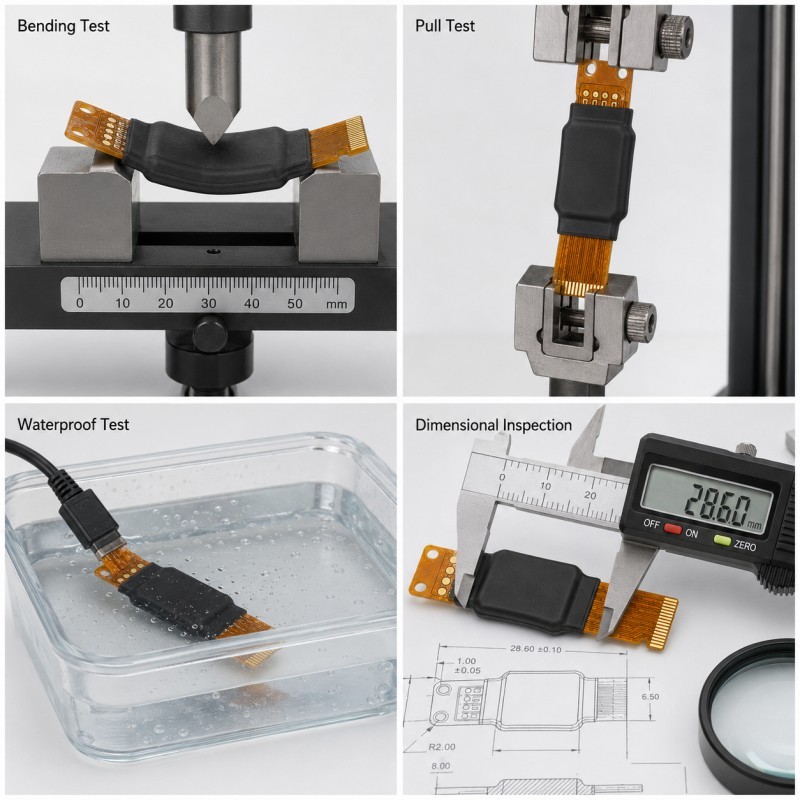
Before approving mass production, FPC silicone overmolded parts should be tested based on the actual application.
Common tests may include:
- Visual inspection
- Dimensional inspection
- Bending test
- Pulling force test
- Peeling test
- Waterproof test
- Air leakage test
- Assembly test
- Aging test
- Temperature cycling test
- Electrical function test
For wearable, medical, automotive, and sensor applications, testing should confirm both electrical function and silicone protection performance.
How SiliconePlus Supports FPC Silicone Overmolding Projects
SiliconePlus supports custom LSR overmolding projects involving FPC, plastic, metal, and silicone substrates. For FPC silicone overmolding projects, our team can review your drawings, samples, FPC structure, silicone coverage area, bonding requirements, sealing function, bending conditions, and testing standards before mold development.
We can support DFM review, silicone material selection, custom tooling, sample production, process optimization, inspection, and OEM/ODM mass production.
If your project requires FPC silicone overmolding for wearable electronics, medical sensors, automotive modules, 3C components, or compact flexible electronic assemblies, early engineering review can help reduce bonding, sealing, and bending failure risks.
Conclusion
FPC silicone overmolding is an effective solution for flexible electronic components that require protection, sealing, insulation, strain relief, and production consistency.
Compared with glue dispensing, tape wrapping, or separate silicone covers, LSR overmolding can create a more controlled and integrated protective structure around selected FPC areas.
However, successful FPC silicone overmolding depends on proper FPC design, silicone coverage, mold positioning, bonding strategy, injection flow, bending radius, and validation testing.
If you are developing a custom FPC silicone overmolded component, send us your drawings, samples, FPC structure, application requirements, testing standards, and estimated quantity. SiliconePlus can help evaluate the right overmolding solution from prototype to mass production.