Can LSR Bond to PBT, PC, PA or PPS? A Plastic Compatibility Guide for Silicone Overmolding
- Share
- publisher
- siliconeplus
- Issue Time
- Jul 27,2026
Summary
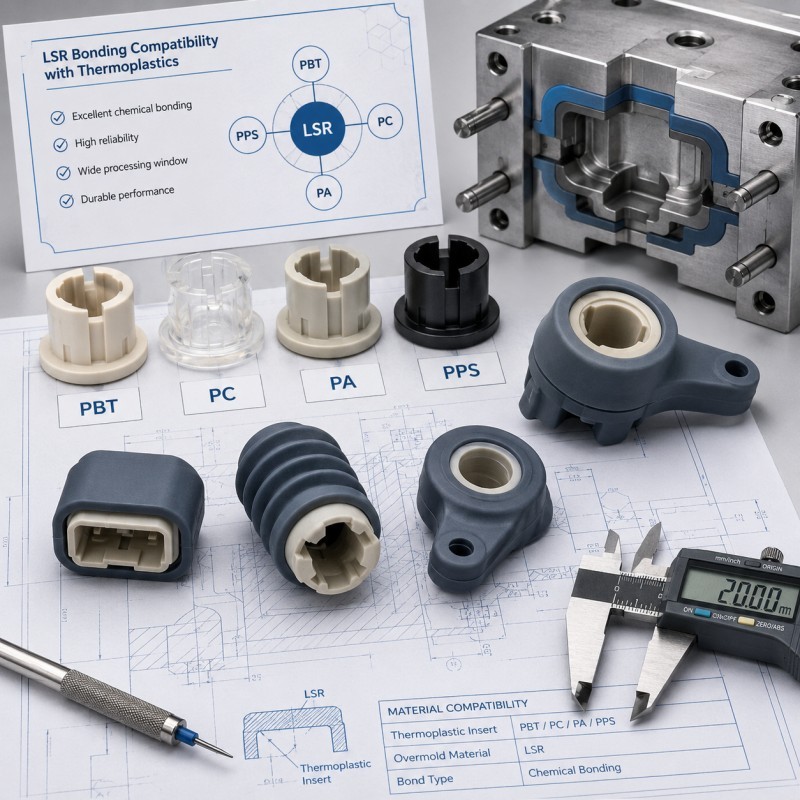
LSR can bond to PBT, PC, PA and some PPS grades, but the result depends on the exact thermoplastic grade, additives, surface condition, mold temperature and silicone chemistry. Standard LSR usually needs a primer, plasma treatment or mechanical locking, while selected self-bonding LSR grades can achieve primerless adhesion to certain plastics. Every material pair should be validated through molding trials, peel or pull testing, thermal cycling and application-specific sealing tests.
Answer Excerpt
LSR can bond to PBT, PC, PA and certain PPS compounds, but the plastic family name alone is not enough to confirm compatibility. Bonding depends on the exact resin grade, fillers, additives, surface contamination, silicone formulation and molding conditions. Self-bonding LSR can provide primerless adhesion to selected thermoplastics, while difficult combinations may require plasma treatment, primer or mechanical retention. Every material pair should be tested before tooling approval and mass production.
Selecting a plastic substrate for liquid silicone rubber overmolding is not simply a matter of choosing a heat-resistant resin.
Two components may both be described as “PBT” or “PC” but behave very differently during molding because of glass-fiber content, flame retardants, lubricants, pigments, release agents and recycled material content. A material combination that bonds successfully during the first sample trial may also fail after thermal cycling, humidity exposure or continuous mass production.
For this reason, engineers should treat silicone-to-plastic adhesion as a complete material, process and structural system rather than as a single material property.
For projects requiring integrated sealing, soft-touch areas or protective silicone features, plastic with silicone overmolding can reduce secondary assembly and create a more repeatable multi-material component.
Can LSR Bond Directly to Plastic?
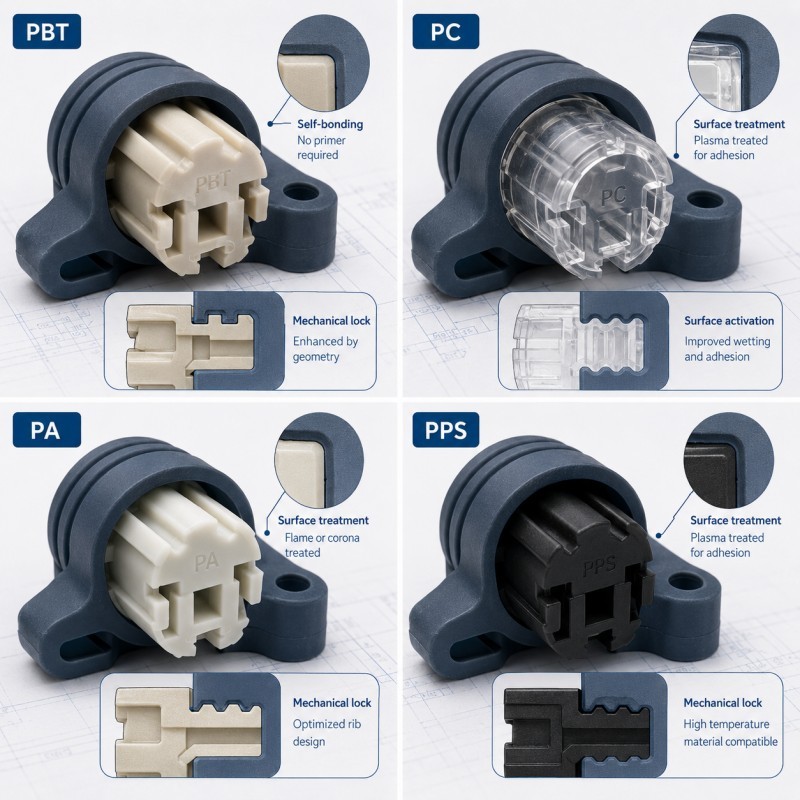
Yes, LSR can bond directly to selected plastics, but standard LSR does not automatically produce a reliable chemical bond to every thermoplastic.
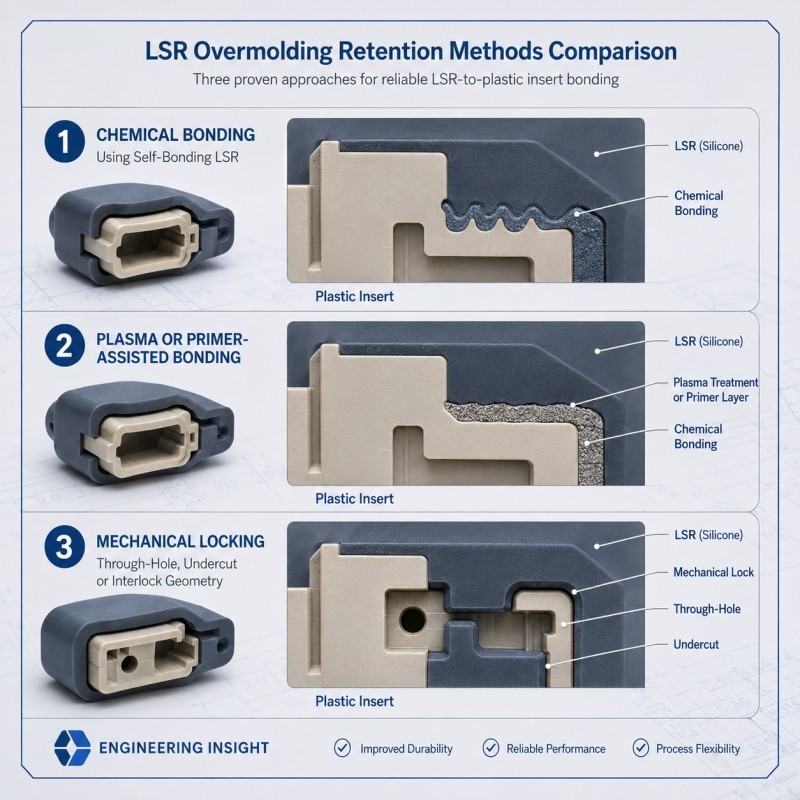
There are three common approaches:
- Self-bonding LSR, which contains adhesion-promoting chemistry designed for selected thermoplastic or metal substrates.
- Surface-assisted bonding, using primer, plasma, corona or another validated surface-activation process.
- Mechanical retention, using holes, undercuts, grooves, windows or interlocking geometry to physically hold the silicone.
Some self-bonding LSR grades are specifically marketed for primerless adhesion to plastics such as PA and PBT. Other commercial self-bonding series support selected PC, PBT and copolyester substrates. Material suppliers still recommend testing each exact substrate because surface properties vary between individual resin grades.
A robust design may use more than one approach. For example, a project may use a self-bonding LSR for chemical adhesion while also adding small retention holes to protect the interface against long-term peel loading.
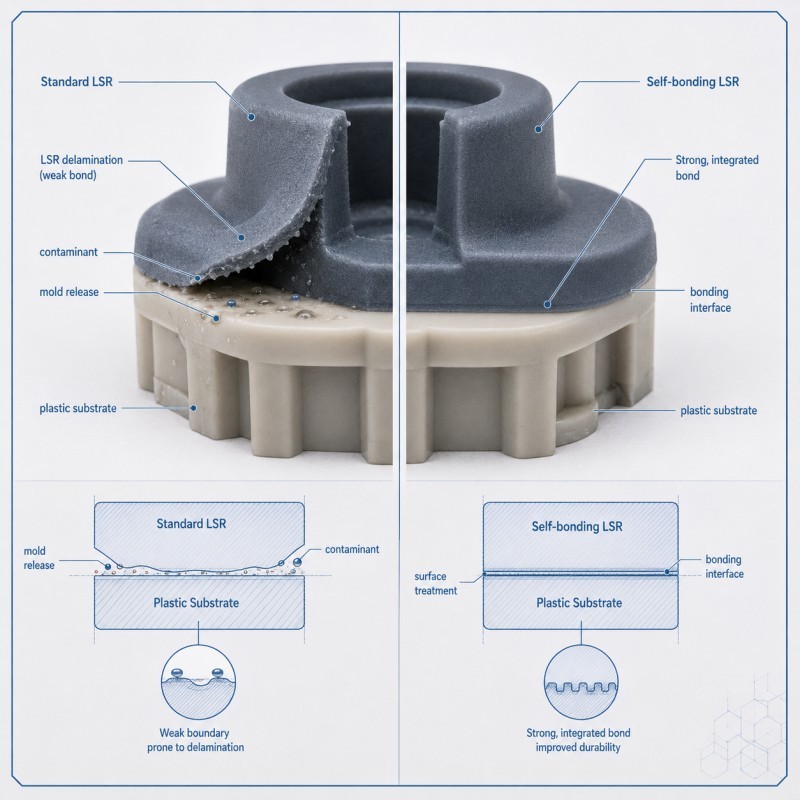
Why Does Standard LSR Not Automatically Bond to Every Thermoplastic?
Ordinary LSR is formulated primarily for molding performance and elastomer properties, not universal adhesion.
The silicone must cure against a plastic surface that may contain:
- Mold-release residue
- Lubricants
- Flame-retardant additives
- Glass fibers
- Pigments
- Moisture
- Dust or handling oils
- Migrating additives
- Recycled resin content
Any of these factors can change the actual surface that the LSR contacts.
Platinum-cured silicone systems can also be sensitive to certain contaminants. Wacker notes that sulfur-, amine-, phosphorus- and organometallic-containing substances may interfere with addition-curing silicone systems, which is why unknown substrate combinations should be evaluated through small-scale compatibility testing before production.
The most important rule is therefore:
Do not approve an overmolding combination based only on the general plastic name. Approve the exact plastic manufacturer, resin grade, filler percentage, color formulation and LSR grade
as one controlled material system.
LSR Compatibility with PBT, PC, PA and PPS
| Plastic | Initial feasibility for LSR bonding | Main engineering risks | Recommended starting strategy |
|---|---|---|---|
| PBT | Generally a strong candidate with selected self-bonding LSR | Moisture, glass fiber, flame retardants, mold release, insert deformation | Self-bonding LSR, dry material control, adhesion coupon test |
| PC | Feasible with compatible self-bonding LSR grades | Heat distortion, residual stress, surface additives, stress cracking | Lower-stress process window, validated cleaning, controlled insert temperature |
| PA | Feasible with selected self-bonding grades | Moisture absorption, PA6/PA66 differences, fillers, dimensional change | Drying and moisture control, exact resin-grade validation |
| PPS | Project-specific and more difficult to assume | Surface activation requirement, fillers, limited chemical adhesion | Plasma or primer evaluation plus mechanical retention |
The table is an engineering screening guide, not a universal approval list. Commercial self-bonding LSR products demonstrate that primerless bonding is possible with selected PBT, PC and nylon substrates, but the resin supplier and silicone supplier still require validation of each individual combination.
Can LSR Bond to PBT?
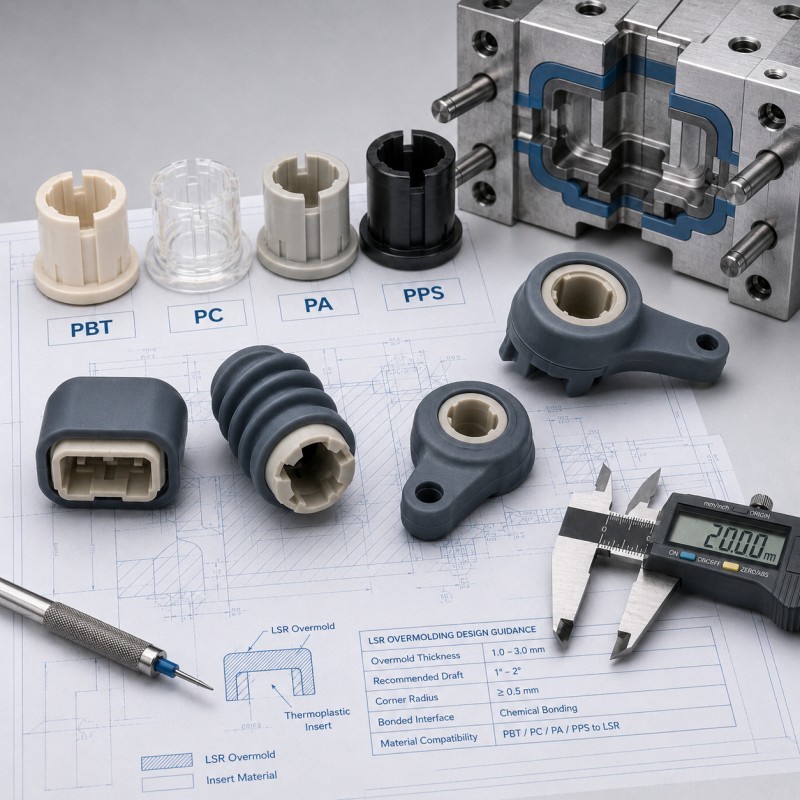
PBT is frequently considered one of the more practical engineering thermoplastics for LSR overmolding.
Selected self-bonding LSR grades are designed to adhere to PBT without a separate primer. This makes PBT suitable for applications such as:
- Connector housings
- Electronic frames
- Sensor bodies
- Waterproof structural inserts
- Automotive electrical components
- Medical and industrial device housings
Wacker’s ELASTOSIL LR 3070 series identifies PA and PBT as compatible examples for primerless self-bonding LSR, while Momentive also describes self-bonding grades intended for PBT overmolding.
However, “PBT” alone is not a complete specification.
A 30% glass-filled, flame-retardant PBT may produce a different surface condition from an unfilled general-purpose PBT. Mold-release agents, color masterbatch and recycled resin may also reduce adhesion consistency.
Key PBT controls
- Confirm the exact resin code and filler percentage.
- Follow the resin supplier’s drying requirements.
- Avoid uncontrolled external mold release.
- Inspect glass-fiber exposure in the bonding region.
- Keep the bonding surface clean after the plastic molding process.
- Validate adhesion after thermal cycling and humidity aging.
- Record plastic and LSR lot numbers during trials.
PBT should normally be tested first with a self-bonding LSR. If the bond margin remains low, add mechanical retention instead of depending only on a stronger primer.
Can LSR Bond to Polycarbonate?
LSR can bond to selected polycarbonate grades when the correct self-bonding silicone and molding window are used.
Momentive’s Silopren LSR 47X9 series identifies primerless adhesion to selected polycarbonate and PBT substrates. This confirms that PC-to-LSR bonding is technically feasible, but it does not mean that every PC grade will behave the same way.
PC requires particular attention to thermal and mechanical stress.
The plastic insert is exposed to a heated mold during liquid silicone injection molding. If the insert contains excessive residual molding stress, thin unsupported walls or an unsuitable material grade, it may warp, crack or lose dimensional stability during overmolding.
Key PC controls
- Check the PC heat-resistance grade.
- Review the original plastic injection-molding stress.
- Avoid sharp corners and thin unsupported insert sections.
- Validate any cleaning solvent before use.
- Reduce unnecessary insert heating time.
- Control injection pressure around weak plastic walls.
- Check dimensional change after repeated molding cycles.
- Test the completed part after humidity and thermal exposure.
For transparent PC, appearance requirements should also be included in the trial plan because haze, whitening, surface marks and local stress may be unacceptable even when the bond strength passes.
Can LSR Bond to PA6 or PA66?
Selected self-bonding LSR grades can bond to nylon substrates, including suitable PA grades.
Momentive’s Silopren LSR 2740 describes primerless adhesion to nylon and selected copolyesters, while Wacker also lists PA as a compatible example for its LR 3070 self-bonding series.
The principal production challenge with PA is moisture.
Nylon absorbs moisture from its environment. This can change dimensions, surface condition and molding behavior. If insert drying, storage time and workshop exposure are not controlled, the same PA component may produce different adhesion results between sample production and mass production.
Key PA controls
- Identify whether the material is PA6, PA66 or another nylon.
- Confirm glass-fiber and flame-retardant content.
- Dry inserts according to the resin specification.
- Define the maximum storage time after drying.
- Use sealed containers if required.
- Prevent operators from touching the bonding region.
- Compare freshly dried and conditioned samples.
- Validate dimensional change after humidity exposure.
A good PA overmolding trial should include more than an immediate peel test. The test plan should also consider whether the final assembly will operate in dry, humid, hot or chemically exposed environments.
Can LSR Bond to PPS?
PPS can be used in high-temperature and electrically demanding assemblies, but direct silicone adhesion should not be assumed.
Compared with PBT or selected PA grades, PPS is usually treated as a more project-specific substrate. Wacker’s silicone adhesion guidance identifies PPS among the more demanding plastic compounds that may require surface pretreatment such as plasma, corona or another activation method to obtain reliable bonding.
For PPS projects, engineers should evaluate:
- Exact PPS resin grade
- Glass or mineral filler percentage
- Surface roughness
- Mold-release content
- Plasma activation
- Primer compatibility
- Mechanical through-holes
- Dovetail grooves
- Edge wraparound
- Long-term thermal exposure
Where failure would cause leakage, electrical damage or safety risk, PPS should normally include a mechanical retention feature even when the initial chemical adhesion result appears acceptable.
What Determines Final LSR-to-Plastic Bond Strength?
1. Exact LSR grade
A standard LSR and a self-bonding LSR with the same hardness may produce completely different interface performance.
The silicone supplier’s adhesion table should be reviewed before mold design begins. Material availability, regulatory requirements, hardness, color, post-cure requirements and expected production volume should all be included in the selection.
2. Exact plastic formulation
The following variations can change adhesion:
- Virgin versus recycled resin
- Unfilled versus glass-filled resin
- Flame-retardant grade
- UV-stabilized grade
- Internal lubricant package
- Pigment and color masterbatch
- Mold-release additive
- Supplier or production-lot changes
A customer drawing that only states “PC” or “PBT” does not provide enough information for a reliable adhesion decision.
3. Surface condition
The bonding area must remain clean, dry and free of oils, dust and release agents.
Surface treatment should be controlled as a production process, not performed informally by operators. Plasma power, treatment time, treatment-to-molding delay and surface handling must be defined and recorded.
4. Mold temperature and curing history
The interface needs sufficient heat and curing time to develop adhesion, but the plastic insert must remain dimensionally stable.
Some self-bonding systems continue developing bond strength after molding. Wacker states that bonding of its LR 3070 series can improve through heat treatment or longer room-temperature storage, and Momentive reports similar post-molding bond development for selected self-bonding systems. The exact condition must follow the material supplier’s technical data sheet rather than one universal value.
5. Insert positioning
An insert that moves during injection can create:
- Uneven silicone thickness
- Incomplete bonding areas
- Flash at the shut-off
- Exposed plastic
- Seal-lip displacement
- Local peeling stress
For more detail, review how insert positioning affects custom LSR overmolding quality.
6. Product geometry
A flat chemical bond is often weaker against peel loading than against compression or shear.
The interface should therefore be designed so that normal product loads do not continuously pull the silicone away from the plastic edge.
Chemical Bonding, Primer or Mechanical Lock: Which Is Better?
There is no single best method for every project.
Self-bonding LSR
Best suited when:
- The substrate has verified compatibility.
- Clean high-volume production is required.
- Primer application would increase labor or contamination risk.
- A controlled two-component molding process is available.
Primer or plasma treatment
Best suited when:
- The selected plastic is not compatible with available primerless grades.
- The product volume justifies a controlled pretreatment process.
- Surface activation can be monitored and validated.
- The bonding surface is easily accessible before molding.
Mechanical retention
Best suited when:
- The substrate is difficult to bond chemically.
- Long-term peel stress is expected.
- The material formulation may change.
- Leakage or separation would create a high failure risk.
- The assembly must survive thermal cycling, vibration or fluid exposure.
The most reliable design often combines chemical bonding and mechanical retention.
Examples of retention geometry include:
- Through-holes
- Slots
- Dovetail grooves
- Edge wraparound
- Perforated ribs
- Undercut windows
- Interlocking channels
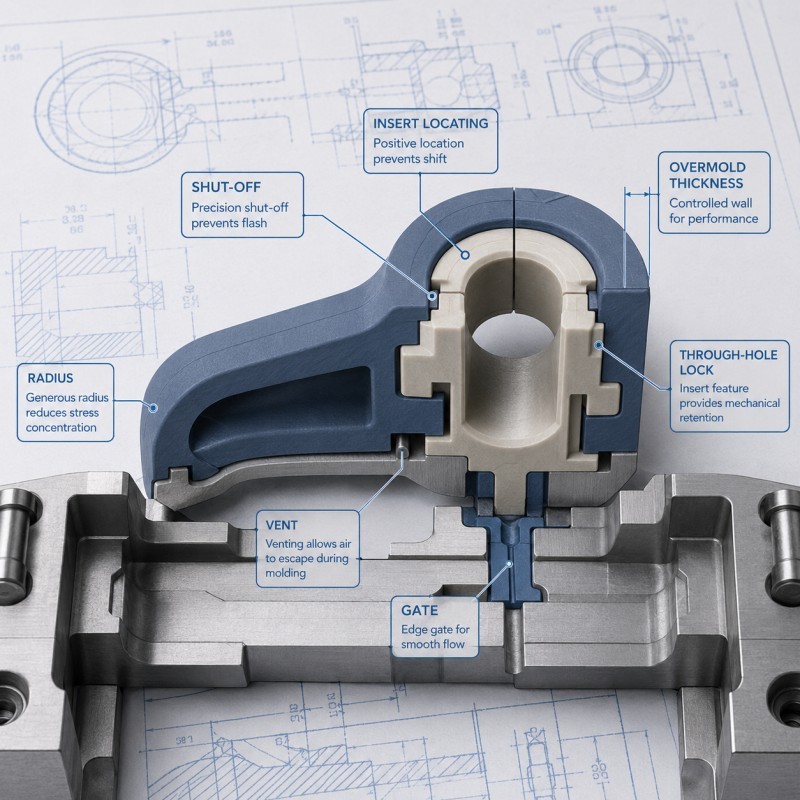
Mechanical locks should not block LSR flow or create trapped air. They must be reviewed together with gate position, venting and demolding direction.
Common LSR-to-Plastic Bonding Failures
Clean separation from the plastic
If the silicone separates and leaves a clean plastic surface, the failure is usually adhesive failure at the interface.
Possible causes include:
- Wrong LSR grade
- Plastic incompatibility
- Mold-release contamination
- Inadequate surface treatment
- Insufficient curing
- Moisture
- Additive migration
Silicone tears while material remains on the plastic
This is cohesive failure inside the silicone.
It often indicates that the interface is stronger than the silicone itself. Cohesive failure is generally a more favorable result, although the actual force must still meet the project requirement.
Edge peeling
The center may remain bonded while the silicone begins peeling from the termination edge.
Typical causes include:
- Sharp silicone termination
- Continuous peel loading
- Insufficient bonding land
- Thin silicone edge
- Local flash
- Poor radius transition
Bubbles or voids near the interface
Possible causes include:
- Moisture in the plastic
- Air trapped around grooves or through-holes
- Surface contamination
- Poor venting
- Gas released from the insert
- Excessively fast filling
Plastic insert deformation
Possible causes include:
- Plastic temperature resistance is too low
- Thin unsupported walls
- Excessive mold temperature
- Long heating time
- High injection pressure
- Poor insert support
Leakage after environmental testing
The part may pass an initial air-leak test but fail after thermal cycling or humidity aging.
This usually means that the interface, seal geometry or plastic insert cannot tolerate long-term dimensional change.
Recommended Development Process
Step 1: Collect complete material information
Before DFM, provide:
- Plastic manufacturer
- Exact resin grade
- Filler percentage
- Flame-retardant requirement
- Color masterbatch
- Recycled-content requirement
- Existing mold-release system
- LSR hardness
- Regulatory requirement
- Operating temperature
- Target production volume
Step 2: Screen the material combination
Mold simple bonding coupons using:
- Planned plastic grade
- Planned LSR grade
- Planned surface treatment
- Planned insert drying condition
Compare at least two process conditions rather than testing one sample only.
Step 3: Complete structural DFM
The silicone mold design and tooling review should cover the bonding land, retention geometry, insert support, gate, venting, shut-off and demolding direction before steel is cut.
Step 4: Establish a molding process window
Do not approve only one successful setting.
Verify acceptable ranges for:
- Mold temperature
- Injection speed
- Injection pressure
- Cure time
- Insert preheating
- Surface-treatment delay
- Post-molding storage
Step 5: Validate application conditions
Testing should represent actual use, including:
- Temperature
- Humidity
- Vibration
- Flexing
- Cleaning chemicals
- Oils or fluids
- Water pressure
- Assembly compression
- Expected service life
DFM Checklist for LSR Overmolding PBT, PC, PA or PPS
| DFM item | What engineers should confirm |
|---|---|
| Plastic identification | Manufacturer, exact grade, filler and additives are fixed |
| Bonding land | Sufficient continuous area without narrow interruptions |
| Edge termination | Rounded transition instead of a sharp peel-starting edge |
| Mechanical retention | Holes, grooves or wraparound added where bond risk is high |
| Insert support | Plastic is fully supported against injection pressure |
| Positioning | Datum, pins or cavity features prevent insert movement |
| Shut-off | Clear plastic-to-steel shut-off controls flash |
| Gate location | Flow reaches the bonding region without moving the insert |
| Venting | Air can escape from the final fill and retention features |
| Wall thickness | Silicone thickness is stable and does not create local stress |
| Plastic heat resistance | Insert remains stable during repeated molding cycles |
| Demolding | Ejection does not pull the silicone away from the interface |
| Surface handling | Bonding area is protected from oils, dust and release agents |
| Material traceability | Plastic and LSR lots are recorded during testing and production |
How Should LSR-to-Plastic Adhesion Be Tested?
There is no universal test force that applies to every component.
The test method should match the actual loading direction and failure risk.
Adhesion coupon test
Use flat or standardized material coupons to compare different LSR grades, plastic grades and pretreatments before final tooling.
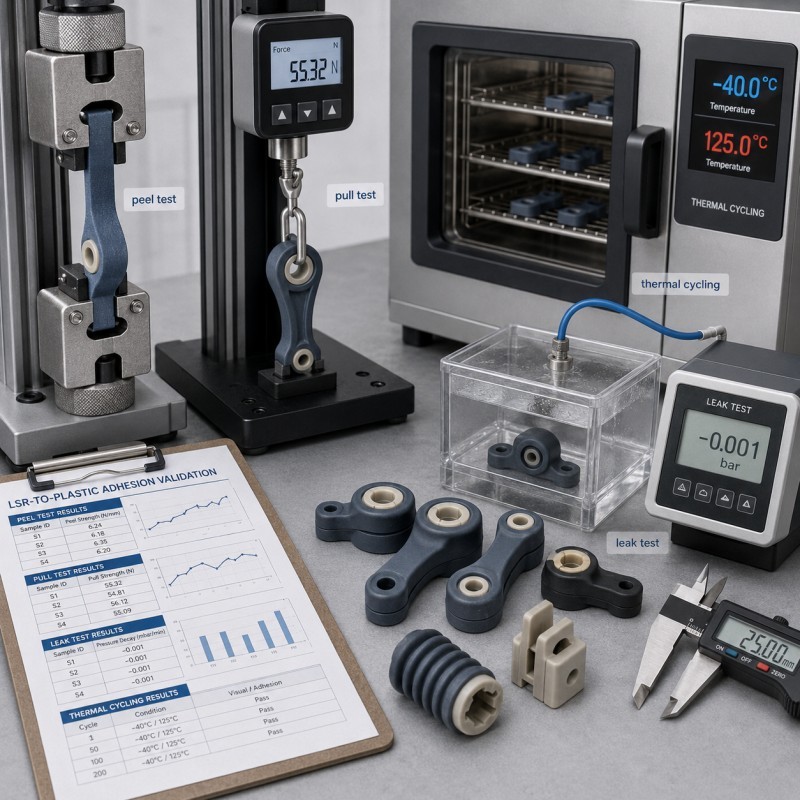
Peel test
A 90-degree or 180-degree peel test may be used where the geometry allows a controlled silicone tab.
Peel testing is useful for identifying interface consistency, but a coupon result does not replace final-part testing.
Pull-off test
Apply a controlled tensile load to the overmolded silicone feature.
Record:
- Maximum force
- Displacement
- Failure location
- Adhesive or cohesive failure
- Sample-to-sample variation
Cross-section inspection
Cut the overmolded part and inspect:
- Interface contact
- Voids
- Silicone thickness
- Retention-feature filling
- Insert position
- Flash and shut-off quality
Thermal cycling
Cycle the component between the project’s specified low and high temperatures.
Inspect for:
- Edge lifting
- Cracking
- Delamination
- Plastic warpage
- Leakage
- Change in pull strength
Humidity and fluid exposure
Evaluate water, humidity, oil, cleaner, coolant or other media that the final component may contact.
Leak testing
For sealing components, use a defined:
- Air pressure
- Water depth
- Test duration
- Temperature
- Acceptance leakage rate
Do not describe a part as IP67 or IP68 unless the complete assembled product has been tested under clearly defined conditions.
Typical Applications
Automotive components
- High-voltage connector housings
- Sensor seals
- Wire-harness interfaces
- Charging-port components
- Waterproof electronic covers
- Plastic frames with integrated sealing lips
Consumer electronics
- Waterproof buttons
- Speaker and microphone sealing frames
- Wearable-device housings
- Charging-port seals
- Camera-module sealing structures
- Soft-touch control components
Medical and healthcare devices
- Instrument grips
- Sensor housings
- Respiratory-device components
- Fluid-control components
- Plastic frames with integrated soft seals
Material compliance must always be assessed for the final material combination and application, not assumed from the general term “medical-grade silicone.”
Industrial equipment
- Sensor protection
- Electrical insulation
- Vibration-damping interfaces
- Waterproof control housings
- Plastic structural parts with integrated gaskets
How SiliconePlus Supports Plastic with LSR Overmolding Projects
SiliconePlus supports project review from material selection and DFM through tooling, sampling, testing and mass production.
Available project capabilities include:
- Plastic and LSR compatibility review
- Bonding-risk analysis
- Mechanical-retention design
- Insert-positioning review
- Mold-flow and venting consideration
- Precision mold development
- LSR injection molding
- Dimensional and appearance inspection
- Bonding, sealing and application-specific testing
- Prototype-to-volume manufacturing support
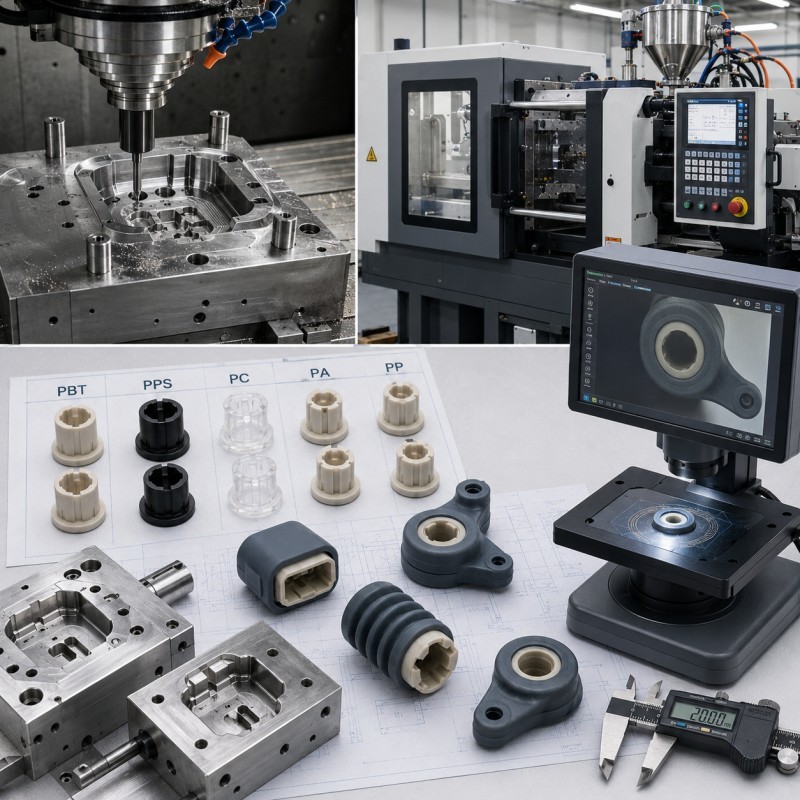
The company’s brand documentation lists 25 years of silicone manufacturing experience, more than 6,000 developed silicone projects, three CNC mold-processing centers, Makino EDM capability, liquid silicone injection equipment and 48 sets of precision measuring instruments.
Final capability claims such as tolerance, waterproof rating or compliance should always be connected to the specific product structure, test method and approved material system.
FAQ
Can standard LSR bond directly to PBT?
Sometimes, but it should not be assumed. A self-bonding LSR specifically evaluated for the exact PBT grade is the safer starting point. Glass fiber, flame retardants, mold release and pigments can change adhesion.
Does LSR bond better to PC or PBT?
Both can be feasible with selected self-bonding grades. PBT is commonly used in technical overmolding, while PC requires additional attention to heat distortion, residual stress and appearance.
Can LSR bond to glass-filled plastic?
It may be possible, but glass-fiber content changes the surface and dimensional behavior. The exact filled grade must be molded and tested.
Is primerless bonding always better?
Primerless bonding can simplify high-volume production, but only when the material pair has enough adhesion margin. Primer, plasma or mechanical retention may provide a more robust solution for difficult substrates.
Why does the bond pass during sampling but fail in mass production?
Common causes include material-lot changes, longer insert storage, moisture, operator handling, mold-release contamination, different curing conditions and uncontrolled plastic additives.
How can PPS bonding be improved?
Evaluate plasma or primer treatment and include mechanical retention such as holes, grooves or edge wraparound. PPS should be treated as a project-specific material combination.
What information is needed for a DFM review?
Provide the 2D or 3D drawing, exact plastic resin grade, filler percentage, LSR hardness, application, operating temperature, sealing requirement, annual volume and required tests.
Conclusion
LSR can bond to PBT, PC, PA and selected PPS compounds, but successful overmolding depends on much more than the plastic family name.
The final result is controlled by:
- Exact plastic formulation
- Self-bonding LSR compatibility
- Surface cleanliness
- Moisture control
- Mold temperature
- Insert positioning
- Interface geometry
- Mechanical retention
- Environmental testing
The safest development approach is to confirm the exact plastic and silicone combination early, complete the DFM before tooling, and validate both initial adhesion and long-term application performance.
For a project-specific evaluation, send your plastic drawing, resin data sheet and application requirements to the SiliconePlus engineering team.
Technical References
The material-compatibility guidance in this article is supported by official self-bonding silicone information from Wacker and Momentive. Their technical documentation confirms that selected LSR formulations can provide primerless adhesion to specified PA, PBT, PC, copolyester and other substrates, while also emphasizing that each exact resin grade must be tested before production.